• Enter your email address to subscribe to this blog and receive notifications of new posts by email.

    Join 241 other subscribers
  • Noshing on

    raw blueberry pie with microwaveable filling and graham cracker crust

    This mostly-raw blueberry pie is a snap to make and very versatile--the filling microwaves in a few minutes, and you don't even have to bake the zippy gingered graham cracker crust--perfect for a hot Fourth of July and all summer long.

  • Recent Posts

  • Contents

  • Archives

  • Now Reading

  • See also my Book Reviews

  • Copyright 2008-2024Slow Food Fast. All writing and images on this blog unless otherwise attributed or set in quotes are the sole property of Slow Food Fast. Please contact DebbieN via the comments form for permissions before reprinting or reproducing any of the material on this blog.

  • ADS AND AFFILIATE LINKS

  • I may post affiliate links to books and movies that I personally review and recommend. Currently I favor Alibris and Vroman's, our terrific and venerable (now past the century mark!) independent bookstore in Pasadena. Or go to your local library--and make sure to support them with actual donations, not just overdue fines (ahem!), because your state probably has cut their budget and hours. Again.

  • In keeping with the disclaimer below, I DO NOT endorse, profit from, or recommend any medications, health treatments, commercial diet plans, supplements or any other such products.

  • DISCLAIMER

  • SlowFoodFast sometimes addresses general public health topics related to nutrition, heart disease, blood pressure, and diabetes. Because this is a blog with a personal point of view, my health and food politics entries often include my opinions on the trends I see, and I try to be as blatant as possible about that. None of these articles should be construed as specific medical advice for an individual case. I do try to keep to findings from well-vetted research sources and large, well-controlled studies, and I try not to sensationalize the science (though if they actually come up with a real cure for Type I diabetes in the next couple of years, I'm gonna be dancing in the streets with a hat that would put Carmen Miranda to shame. Consider yourself warned).

Food that’s fit to print–but is it fit to eat?

It’s the next “brilliant” thing. In the wake of Grant Achatz, Ferran Adrià et al, the now common your-photo-in-icing cake decorations made using an inkjet printer and soy-based and other edible inks have given way to 3D printable food–or at least that’s what the researchers at Cornell are calling it.

Hydrocolloid Printing: A Novel Platform for Customized Food Production (PDF)

Hydrocolloids are suspensions of fine particulates in liquids–in common terms, gels. Also pastes, like cake frosting or masa. Basically uniform goos. The Solid Freeform Fabrication (SFF) unit squirts the stuff through a computer-programmable injector needle onto a platform based on the design you feed in, and it goes in layers so you get an engineered form. Cool, right? Food, any shape you want, and they contend it can be any flavor too.

But it has to be made of goo. And it can’t clog the needle. And it’s not all that new–the Italians have been extruding pasta shapes for over a century. French pastry chefs did all the heavy lifting with choux paste and fondant flowers even longer ago. And in modern times Wilton makes all those fancy-looking metal tips for pastry bags that they sell in the craft chain stores and that will likely be tried out once and then sit forever in the back of your kitchen drawer.

But pastas, pastries and frostings are all about goo as a starting material. These guys are talking about fish.

Most of all, it isn’t all that appetizing, particularly when you see that they’re trying to sell you on a machine that can make what they’d like you to think of as a tomato with a goo composed of 1% gelatin, 8% xanthan gum and some tomato flavoring. Haven’t we had enough of synthetic tomatoes? Isn’t that what the heirloom movement is all about?

Apparently not. Here are the last couple of paragraphs of the paper I linked to above. See what you think.

It should be noted, however, that even if subtle differences are perceptible, it is not necessary in all cases to perfectly reproduce the original food; there is still great value in simulating the original food.

Regardless of whether a hydrocolloid approach is taken to food-SFF, or some other molecular gastronomic platform is employed, the potential future applications of food-SFF remain the same. From culinary professionals to laypeople, individuals from all walks of life will be drastically affected by food-SFF. Artistic boundaries will be pushed in fine dining and industrial producers will explore mass-customization. Laypeople will have housework time reduced and benefit from direct culinary skill injections. Web 2.0 will tackle the next great frontier as people from all over the world experience food in new ways, while forming social bonds and mass-collaborating.

Now that major barriers have been broken, such as high printer cost and proprietary restrictions, the stage is finally set for tremendous growth of food-SFF. Few things are more central to humanity than food, and therefore [it] should come as no surprise when food-SFF gains prominence as one of the 21st century’s important domestic technologies.

excerpted from:

Hydrocolloid Printing: A Novel Platform for Customized Food Production
Daniel L. Cohen, Jeffrey I. Lipton, Meredith Cutler, Deborah Coulter, Anthony Vesco, Hod Lipson

http://creativemachines.cornell.edu/sites/default/files/SFF09_Cohen1_0.pdf, accessed 9/12/11

Now tell me, is this future palatable to you? Or do you somehow, almost inconceivably, not relish the thought of a xanthan gum conglomerate taking over the world’s food supply and driving us fresh-food conspiracists underground? Dan Brown, where are you?

Pyrex and Anchor Hocking now both unsafe for cooking

I’m not sure how I happened upon Consumer Reports’ disturbing feature from January on exploding glassware cooking accidents in both Pyrex and Anchor Hocking tempered glassware. Since a lot of my microwave directions call for Pyrex bowls, I thought I’d better post about it asap.

Here’s the link explicitly:

http://www.consumerreports.org/cro/magazine-archive/2011/january/home-garden/glass-cookware/glass-cookware/index.htm

Because I’ve used my current Pyrex bowls and bakeware for more than 10 years, I’ve been looking recently to replace and/or add to my collection. But every time I’ve looked for it in the past year or so, I’ve hesitated–the stuff on sale is a blueish color. Or it’s a little thinner than I remember. Or it doesn’t feel or even sound right when I pick it up. And the cardboard overwrap has a lot of new warnings about when and how you can or can’t use it that are different than the old classic Pyrex. It’s confusing–can I use it the way I’m used to or not?

So even though the casseroles and pie plates are bright and shiny and new and usually on sale at my local supermarket and the Target, I’ve passed them up, thinking, “I’ll do it next time.”

According to the Consumer Reports piece, it’s a damn good thing I did. Read the article. Now. Please. Before you put any of this generation of Pyrex in an oven or microwave. Before you give a set to some newlywed as a kitchen gift.

And don’t buy this stuff. If you did, don’t use it for any kind of heating up, conventional oven or microwave (I know, so what good is it if you can’t heat stuff up in it? Wasn’t that the whole point?)

Apparently both companies are claiming that the explosions–which have caused burns and lacerations when the victims took a hot casserole out of the oven or microwave and set it down–are the result of misuse, or perhaps the glassware had gotten dinged or scratched and therefore the flaws had weakened it, and that it was a rare phenomenon. The article authors estimated a fairly high number of incidents in the past few years based on hospitalization records and other outside evidence.

Consumer Reports debunked the companies’ blame-the-victims ploy by testing both brands of glass cookware at various temperatures and setting the pans down on a variety of typical kitchen surfaces.

The results were not pretty–Pyrex had a slight temperature range advantage over Anchor Hocking, but a fairly high percentage of both broke or exploded if they weren’t used exactly within the laundry list of restrictions on the cardboard overwrap that came with the new bakeware.

Altogether, conducting the tests and videorecording them took more guts than I would have without lexan armor and a full face shield.

But, as I’ve said, I’ve been using my mixing bowls and pie plates for years without problems. What’s going on?

The article authors did track down a probable explanation for all this breakage in what’s supposed to be very durable glassware. Both brands have recently switched to a cheaper formulation for their glass. Pyrex–note, no longer made by Corning–at least used to be borosilicate glass but now uses soda lime glass, as does Anchor Hocking’s tempered glass. Borosilicate is the standard for laboratory grade glassware; it’s stronger and somewhat more expensive to produce–probably the mineral shortages of the past few years have made it more so.

Technically, you can temper soda lime glass, but even when tempered it’s not as strong as the old classic tempered borosilicate. It also seems to be less uniform–and the little unevennesses in the material create local instabilities that can cause cracks and even explosions when subjected to rapid or uneven heating and cooling. It only takes a split second in some cases.

Borosilicate is almost certainly what my old Pyrex standbys are made of, and I’m standing by them. I just wish I could have bought more at the time, or that someone else made them now. I wish Pyrex’s current manufacturers in particular had not ruined their product by changing glass to reduce costs, and that their managers weren’t scrambling to deny it.

For now, I’d say please DON’T use the newer Pyrex or tempered glass bakeware items for microwaving. They’re just not the same anymore. Use microwave-safe ceramic instead.

Too big to fail? Too good to pay taxes?

Source: Library of Congress

Every so often I review books and movies on Slow Food Fast, but as of yesterday, I’ve dropped my affiliate links to Amazon.com. In the past few weeks they’ve decided to fight tooth and nail not to pay sales tax like everybody else and support the states where they sell. First they cut off any Californians who had joined their affiliate seller program, which is annoying and kind of insulting. Not that I’d been getting anything much out of it, but I’ve also been a customer for years.

They’re even lobbying right now to add a ballot measure reversing California sales tax law for internet businesses. Their excuse is that they’ve built their empire on a tiny profit margin and paying sales tax will ruin the penny-seller pyramid. At the same time, they seem to believe they’ve got favored trading status and that any minor threat to their current model can be countered by threatening to withdraw their hiring. Forget that.

I live in a state that’s bent over backwards to court big business and internet retailers, given them all kinds of tax incentives and concessions for years so they wouldn’t move to Nevada or Delaware, and as a result has been absolutely gutted budgetwise. California takes in about a quarter of the nation’s new immigrants each year, has higher unemployment figures than most of the country, LA County alone has more than 300,000 women and toddlers enrolled in the not-very-generous WIC program,  and basic services are being cut right and left to meet the state’s budget deficit. The poor–and that’s starting to include more of the middle class here too–are paying for Amazon.com’s free ride.

And yet Californians represent one of Amazon.com’s biggest markets.

Even the (now former) California affiliates are thinking Amazon should be ponying up like the rest of us. If you sell here, you should be paying sales tax here.

And our sales taxes have finally gone down recently. For years they were up to 9.75 percent. Two days ago I bought a pair of jeans and was shocked–8.75 percent. Apparently that’s dropping further into the 7 percent range for online purchases.

But Amazon’s looking to sue, as they did (and lost at trial) in New York.

Where can you get the books I recommend on this site? Alibris pays sales tax in California, and I’d recommend them.

Or, if you’re in Southern California, head to Vroman’s in Pasadena. Not only is Vroman’s a century-old independent bookstore, both branches are well stocked for hip, academic and traditional booklovers. And the staff are personable, they do lots of readings events, have a huge cooking section, and do online orders if you need something special. The bigger branch on Oak Knoll has a nice café as well.

Big Food mobilizes against child marketing guidelines

This Washington Post article isn’t the absolute clearest–looks like it was written as a last-minute rush piece, actually, but it’s worth getting to the end.

The basic idea is that in 2009 Congress demanded the CDC, FDA, USDA and FTC come up with a coherent set of voluntary nutrition guidelines for what the food industry can market directly to kids.

I’m not a big fan of voluntary nutrition or safety compliance guidelines for the food industry–mostly because industry players generally feel free to ignore or toy with them and then claim some kind of advertising advantage they haven’t earned. Voluntary guidelines also come with all kinds of soft landings and easy outs, and the proposed guidelines here are no great exception.

But in any case, now the four agencies have done it, and the food and restaurant industry is doing the predictable–throwing big lobbying bucks into a disinformation campaign-slash-tantrum.

How big? The campaign manager won’t say, but the preliminary guidelines report that US food industry marketing to kids 2-17 years old is currently something over $1 billion in three key categories (breakfast foods, restaurant chain food, and snacks).

So it probably won’t surprise you that companies like General Mills, Kellogg, and Pepsico have teamed up with ad-carrying media partners like Viacom (read: Nickelodeon) and Time Warner to try and quash the voluntary industry guidelines. Figure on the campaign to be spending in the mid-millions or more. They’d rather “salt and burn” instead of “cut the salt and learn.” And what a waste.

What will probably surprise you is just who this coalition–calling itself the “Sensible Food Policy Coalition”–?!!–hired to handle the campaign: Anita Dunn, a former Obama communications director whose husband, Robert Bauer, is  still White House counsel. Not a really lovely mashup, there.

Why she’s taking on the food industry campaign so they can keep protecting their ability to market garbage to the young and vulnerable is one question. Why the FDA and FTC, which have the power to decide what nutritional and medical claims, among other criteria, are valid and can be used in advertisements to adults, let alone kids and teens, are bothering with a voluntary measure instead of doing a proposed regulation to limit such marketing to youth is another.

In both cases, the answer is almost certainly money. The food and media industries have it, the federal agencies don’t.

[As it turns out, the FDA and FTC don’t have power to restrict Big Fo0d’s marketing to the under-17 crowd after all. They lost that specific ability in 1981–start of the Reagan administration… Reagan’s “ketchup is a vegetable” declaration was the beginning for drastically lowered nutritional standards and branded fast food concession contracts for public school lunches.]

So the right question under these circumstances is, where do you want to put YOUR money? How about this, if the federal agencies can’t get a decent result and the lobbies are buying off everyone else:

Boycott the Boxes. Hit ’em where it hurts.

Box 1–TV: If you have kids, limit their access to TV, and teach them to turn off the sound during the ads. Do it yourself. Treat the ads like the silly nuisance they are from the minute your kids are old enough to watch. Tell your kids the truth: most of the products advertised on kids’ shows are too shoddy–and overpriced–to market to grownups. The companies make them bright and loud and cheesy because they think kids can be fooled easier (your kids should be beautifully insulted at that if they’re about six or seven years old).  Go with PBS and videos you approve rather than commercial TV as much as you can.

Box 2–Packaged stuff parading as food: Skip almost everything that comes in a cardboard box or a plastic overwrap, or in a can. You can do this. You’ll save an awful lot of money by buying store brands only and cutting out the most pernicious items–sugared and high-salt packaged breakfast cereals, bags of starchy snack extras, and sodas, at least on an everyday basis. Save sodas and chips for parties, not for school lunch or part of dinner.

You’d do even better to go with fresh vegetables and whole fruits for most snacks and make a good habit for relatively cheap. They taste pretty good, don’t take long to fix, last at least a week in the fridge, and your kids won’t get sick overeating them.

There’s a reason the Pringle’s slogan is the very smug  “Betcha can’t eat just one.” No one says that about carrots or broccoli, or even about apples. Ever eaten too many of those in one sitting? Didn’t think so. Vegetables and whole fruits keep you satisfied longer, don’t hyperstimulate your appetite for snacks, and they don’t put on pounds that take a long time to work back off. They don’t promote cavities, either. Even nonsweet junk foods do–all that processed starchy stuff sticks to your molars like glue.

Acai, African mangoes, and the ‘tiny belly’ con

The Washington Post:  ‘tiny belly’ online ad part of scheme, government says

Acai berry distributors have been under scrutiny from the FTC since the spring, but the “tiny belly” and “1 weird old tip” ads that flood the margins of your online newspaper are part of an elaborate scheme to sell you fake diets based on acai, African mangoes, hCG (placenta extract), and other snake oil.

According to the FTC, though, the true objective may be something else–the “free samples” require you to register your credit card.

Google and the other main ad server claim they’re weeding out bad ads, but this one is so prominent on so many sites you just have to wonder what kind of cut they’re getting from it. Because the same damn wiggling abdomen cartoon is everywhere, used over and over, it should be a snap to eliminate.

File this under: unappetizing.

On the inevitable hot dog eating contests

I did something at my in-laws’ Fourth of July cookout that I haven’t done in years: I ate a hot dog. So did my husband. I think my daughter ate two and a half hot dogs (actually, I think she ate more and gave us a story, but her grandfather maintains that someone else may have gotten the extras in the pack). Given how crappy hot dogs generally are, you may be wondering why we did this: because my in-laws made the effort to buy kosher ones for us, and because Hebrew National hot dogs don’t have much in the way of carb, and my daughter is fairly crazy about them (because we don’t cook enough meat for her tastes at home).

What hot dogs, kosher or otherwise, do have–and this is why I have to put in a huge caveat–is sodium. And saturated fat. A regular H-N hot dog has about 490 mg sodium. A knockwurst (which we decided against; the flavor’s not really very different, it’s just bigger) has 810 mg. Plus more calories and saturated fat, though the regular’s no great bargain–as much fat as protein, easily.

I have to admit they taste a lot better grilled outdoors on an actual grill than they do indoors in a grease-laden cafeteria service pan, especially since you can dress them up significantly with sharp mustard, crusty French rolls instead of whitebread buns, and sauerkraut and browned onions instead of the usual insipid cafeteria ketchup. So I can go with the “once a year, enjoy, and just eat a little more carefully the rest of the week” argument.

However. Hot dog eating contests are just wrong. Sixty-two or however many hot dogs appear in the “ain’t it amazing?” recordbreaking stories section of your local newspaper the next morning? Enough hot dogs for 30 people or so? That’s not enjoyment, that’s not even tasting the food–tasting slows one down, and possibly triggers the dire appetite signal to retreat or suffer an immediate reversal of fortune after just a few hot dogs. Even for teenage contestants.

For the non-contestants among us (such as my daughter), I say, two hot dogs is probably the outer limit of sanity in one day–so just figure you’ll eat the other sixty another time. Two is about half your recommended daily max for sodium intake and about the max for saturated fat. And it’s not really delivering much in the way of protein. What’s true of bologna is just about as true for hot dogs–they’re made of meat, but they don’t add up nutritionally to actual meat (about 6 or 7 grams of protein per dog), and they sure have a lot of downsides without delivering the really distinctive flavors and variety of, say, gourmet specialty sausages.

There aren’t a lot of kosher specialty sausages made widely available in the US at this point. Actually, according to my father-in-law, there aren’t enough true (pork) and high-quality bratwurst distributors either anymore, and the owner of the one available to them, who happens to operate in my mother-in-law’s native state of Wisconsin, has openly supported political causes and candidates that are thoroughly repugnant to them.

I suspect that leaves a bad taste in everyone’s mouth on the Fourth of July.


Truth in restaurant menus, one way or another

The LA Times has this to say about restaurant nutrition today–seems like restaurant chains are starting to wake up to the embarrassment of their menu offerings now that California, New York City, Philadelphia and a few other governments have made nutrition info mandatory. The FDA is slated to make restaurant nutrition labeling and disclosure apply across the nation sometime in the coming months–the proposed regulation was released for public comment in April and the comment period has been extended to July 5th, and the finalized regulation is supposed to take effect 6 months after publication.

So chains like Panera, Applebee’s, California Pizza Kitchen and IHOP are hustling to look a little less awful before the big wave hits.

About time, too: the other night my husband rented “Super Size Me” (we’re always more than a little behind the times) and I could only stand to watch about five minutes of it. Somehow, between putting the dishes away and getting a few of my own chores done, I managed to catch the movie’s key scenes–I see a glimpse of director Morgan Spurlock doing pushups and then getting his abdominal fat measured at the doctor’s with a caliper before launching the month of MacDonald’s. A minute or so later I see him eating the first of many supersized burger-and-fries meals while narrating the experience from the driver’s seat of his parked car. He’s burping and starting to sweat about a third of the way through. I was horrified–Spurlock is obviously suffering but he keeps pushing himself anyway (chorus: because he’s a boy). Back to the kitchen and my husband is laughing uncontrollably (chorus: because he’s also a boy). Suddenly the inevitable (and highly appropriate) happens–Spurlock excuses himself, opens the door just in time, and starts vomiting onto the pavement. I just left my husband to it at that point. I think he was starting to weep.

The next day, though, he gave me the upshot of what I’d missed. Despite the hilarity of it all, the outcome was pretty sobering–in about 3 weeks of the Mac-only diet, Spurlock has gained 24 pounds that will take him months to work back off with 4 pounds extra that just don’t want to come off at all, and his cholesterol has shot up from enviable (<180 mg/dL, I think) to borderline high. Do the MacDiet for more than a month–for a whole year, say–and you might be looking at the crossover from fit to overweight to actually obese. So, as much as I make fun of them, sometimes boys can pay attention once they get over the thrill of a good grossout.

But back to the restaurant menu scramble.

Some of the chains’ solutions look reasonable–offering half-sandwiches with a salad or soup, paring down the calories and fat in the salads and soups, for that matter, and–gee, how ever did they come up with this miracle answer?–taking some of the cheese (or “cheez”, depending on the caliber of restaurant) back off everything, or at least going to part-skim.

The half-sandwich thing is a bit of a cop-out, but given how big standard sandwich portions have gotten over the past twenty years, it’s definitely a step back from linebacker troughing.

On the other hand, some of the chains really aren’t working hard enough to make a real change. Personally, I hate any form of plopped scoops of straight grease added purposely as a garnish and I always have, so the move to lower-cal mayo doesn’t impress me, nor does the new-improved strategy of not dolloping whipped cream onto every dessert. Ditto the menu recommendation at IHOP that you don’t have to add pats of butter to your stack of pancakes if you don’t want to. (Whew! Finally!)

I know that in fact these are going to be important steps back to sanity for some people, but tell me the truth, here: does a 120-calorie tablespoon serving of fat make the real difference in an 1100-calorie supersized sandwich with a deep-fried filling and cheese on top? Or a stack of pancakes the size of your plate and the height of your head and loaded with enough gooey canned topping to frost a cake?

For chain restaurants, the real problem here is the serving size–they’ve been working way too hard to keep up with the Joneses because serving bigger is impressive, you can charge more, and it’s almost as cheap wholesale as a proper-sized serving. P.F. Chang’s pasta dishes also currently run something like 1100 calories a plate, and no wonder–each of the bowls holds enough pasta to feed three or four normal adults if they were eating at home and had a salad to go with it.

These restaurants are at least doing something in the right direction (or stopping doing everything in the wrong direction, anyway). But upscale restaurants don’t have the government pressure to change and they’re less likely to look–at first glance–as though they’re overfeeding you for the money. Tiny chic portions, right? Check again, because here’s the other kicker in the LA Times this morning:

Pizzeria Ortica’s budino di cioccolato

This one is actually in the Food section, a “Culinary SOS” request for a layered chocolate and caramel pudding. I’m only linking to the 2nd page of the recipe–so scroll down to the bottom and check out the nutrition on it. If the poor lady who requested the recipe has already seen it, she’s probably cringeing.

Each—that’s EACH–small, elegantly served glass of pudding Continue reading

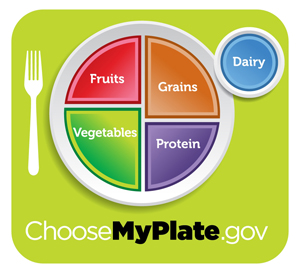
The new MyPlate icon–fantastic or plastic?

Everyone in the food press seems to be weighing in on the new replacement for the much-cursed USDA Food Pyramid in all (both?) its glorious confusion and obfuscation of real nutritional goals that might have (and should have) undermined the beef, corn, pork, corn, sugar, corn, and soy industries if they’d ever been presented honestly.

So where does that leave us? With ears of fresh corn that are more than 50 cents apiece in Los Angeles supermarkets, and the new…

USDA MyPlate logo

Already, the USDA’s MyPlate web site is in a certain amount of branding trouble (and of course, that’s what counts most in America): the Texas DMV had already bagged “MyPlates.com” for its vanity license plate division (highly unappetizing), and Livestrong.com already has its own well-established “MyPlate” food calculator and fan base. And those items come up first on Google searches. As in, the whole first page or more. The government site ranks way down the list and had to water down the impact of its original name choice with “choose” just to get a URL. Can it elbow out the competition just by bolding the “MyPlate” part?

What really counts are the food and nutrition opinion maker comments, though. And a lot of those are detracting in a nitpicking way that I think kind of misses the point.

The first thing they all have to say is that the plate looks dumbed down. Forgive me, but wasn’t the Food Pyramid’s unreadable and unusable design a large part of the problem? The MyPlate icon is simpler and more direct, and it names real food groups, not “Big Mac” or, on the haute side of things, any of Ferran Adrià’s foams. No wonder foodies and populists alike are wondering what it has to do with them.

A small sampling of the main arguments:

MyPlate: The Food Pyramid for dummies? (LA Times): Dr. Andrew Weil and others discuss what’s still wrong with the new icon. Weil says “fruits” could still include fruit juice, which is usually a useless sugar bomb in comparison with whole fruit, and he worries that the protein section, which comes with a guideline to eat 8 oz. of fish per week, might encourage unthinking people to increase their mercury intake since swordfish is on the guideline menu, as are some of the generally overfished popular species of fish. Weil’s not wrong about the fruit juice vs. actual fruit, but his hand-wringing about fish is really geared for well-off readers who can afford to eat much of it. All the fishes he names are Continue reading

They don’t learn, do they?


The Washington Post reports this fabulous new piece of House Republican budget thinking:

Food safety advocates decry FDA cuts 

Didn’t we have a half-billion-egg recall just last summer? And peanut butter contamination? And the spinach, and the tomatoes? And, from the Chinese pharmaceutical and foodstuffs contingent, melamine in quite a number of items, including pet food and infant formula, to fake a high protein level?

Didn’t everybody in the House get up on their hind legs and demand more FDA field inspections, more accountability, more food safety? And now the House majority are cutting the FDA proposed budget from a modest raise proposed by the White House to less than the FDA received for this year’s operations?


Political Pancakes, or, Why is Borders flogging so much lard?

Why Borders is not getting my business this week

Why Borders is not getting my business this week

I know–highly unappetizing. I don’t think even a full teaspoon of salt would help here. And I’m getting back to actual food as of today, I promise.

But I just had to “share” my inbox this morning before I get started. Borders has now closed its Pasadena store but keeps sending me these fabulous discounts in the pretty hope that I’ll schlep to Arcadia to check them out. What does it say when a huge business that’s trying to stay afloat after two decades of leading the field misses so blatantly in its one-to-one personalized marketing?

For that matter, what does it say (reading the tea leaves here) when Newt Gingrich looks like the most coherent and readable (and properly-dressed) selection? I mean, I was there–in 1995 I started working at NIH and promptly got caught in the federal furloughs when he lost his budget armtwisting attempt on Bill Clinton.

What does it say when the Gritch is allegedly trying to run for president and his soon-to-be-available tome is grouped with those of three other deeply discounted “authors” who have no actual public service background, just a penchant for loud titles and  army drag (of various centuries)? Where the hell did Laura Ingraham get that hat? No wonder she’s not keeping up with Patt Morrison. And I thought French food was a no-no for today’s discerning ultraconservative trougher?

I do also wonder at the significance of Ann Coulter’s latest effort being discounted just that six percent more than everyone else’s…maybe it’s the fact that she’s jumped (appropriately) on the vampire-empire bandwagon? Too bad there are no handsome devils on the cover (almost guaranteed there are none inside either). I’m sure they’d sell like hotcakes. Maybe she’s included an actual recipe for hotcakes (with blood sauce or fava beans or something)?–You never know.  Can she actually cook? Without fatback?

Given the deep and undoubtedly thorough marketing research Borders has done (by sending me of all people this fabulous selection of deals), I’m sure they’ve already figured out which way the wind is blowing. I can smell it from here.

In honor of this great selection, I’ve decided to pull out the stops and dig into the older of my cookbooks for an appropriate response.

Semi-Patriotic Pancakes–No Lard AND No Blood (well, at least no added salt)!

Makes about 16 3-4″ diameter pancakes, enough for 3-4 people

  • about 1 c. bread flour, whole wheat flour, matzah cake meal, buckwheat flour, or any mix of these as desired (to preserve our individual freedoms. Put that gun down, Jeb! We’re talking first amendment, not second!) Generally if you’re using buckwheat or whole wheat, it’s better to go half-and-half with regular flour so the pancakes aren’t too heavy or grainy
  • 2 large eggs, separated–I usually toss one of the yolks but keep both whites
  • dollop of plain milk-and-cultures-only yogurt (for that Mediterranean touch)
  • milk or buttermilk (depending how sour you are, and if you use buttermilk skip the yogurt)–about a cup, but might be more to make the batter consistency come out right
  • 1 T sugar (any color, even green if that’s all you’ve got and can stomach the results)
  • 1 capful vanilla extract AND/OR a shake or two of cinnamon (keep it small)
  • oil or butter –1 T for the batter, the rest for frying

Optional mix-ins: blueberries or raspberries (fresh are good, but if you have frozen ones leave them frozen to add when you fry the pancakes; otherwise make a sauce of defrosted ones to serve at the table instead), chopped peeled apples, pecans, chocolate chips, etc. etc. NO: liver, fava beans, or blood-anything!

1. In a large bowl mix the the flour, sugar, flavoring(s), egg yolks, the tablespoon of oil or butter, the dollop of yogurt if using,  and enough milk or buttermilk to make a thick but just-pourable batter. If you’ve got chopped apples, nuts or chocolate chips, you can mix them in now.

2. In a second bowl beat the egg whites to reasonably stiff peaks, then fold them gently into the batter to lighten it. Start frying as soon as you’ve got this done.

3. Fry 3-4″ dollops (about 2-3T each) of the batter in a large (preferably nonstick) frying pan over medium to medium-high heat. If you’re adding berries, add a few to each pancake as soon as you’ve spooned the batter into the pan, and let the pancake batter rise around and over the berries a bit before flipping to the other side.  You’ll know to start flipping the pancakes when you see the bottom edge start to look solid and a ring of small bubbles appears just above it–but I sometimes go a little longer to make sure because the leavening is egg whites-only, which makes a pretty delicate batter. You don’t want the pancakes to collapse completely.

4. “Stick a fork in ’em, they’re done.”–The late, great governor of Texas, Ann Richards, July 15, 1992, in an interview with David Letterman about the Republicans’ chances, and quoted on page 61 of my swiss-dot cookbook… Incidentally, she was wearing an outfit that puts any of Ann Coulter’s to shame–she had her very, very white hair up in a classic Texas beehive and she was wearing a hot pink miniskirt that she actually had the legs for. I miss her still.