

• Enter your email address to subscribe to this blog and receive notifications of new posts by email.

    Join 241 other subscribers
  • Noshing on

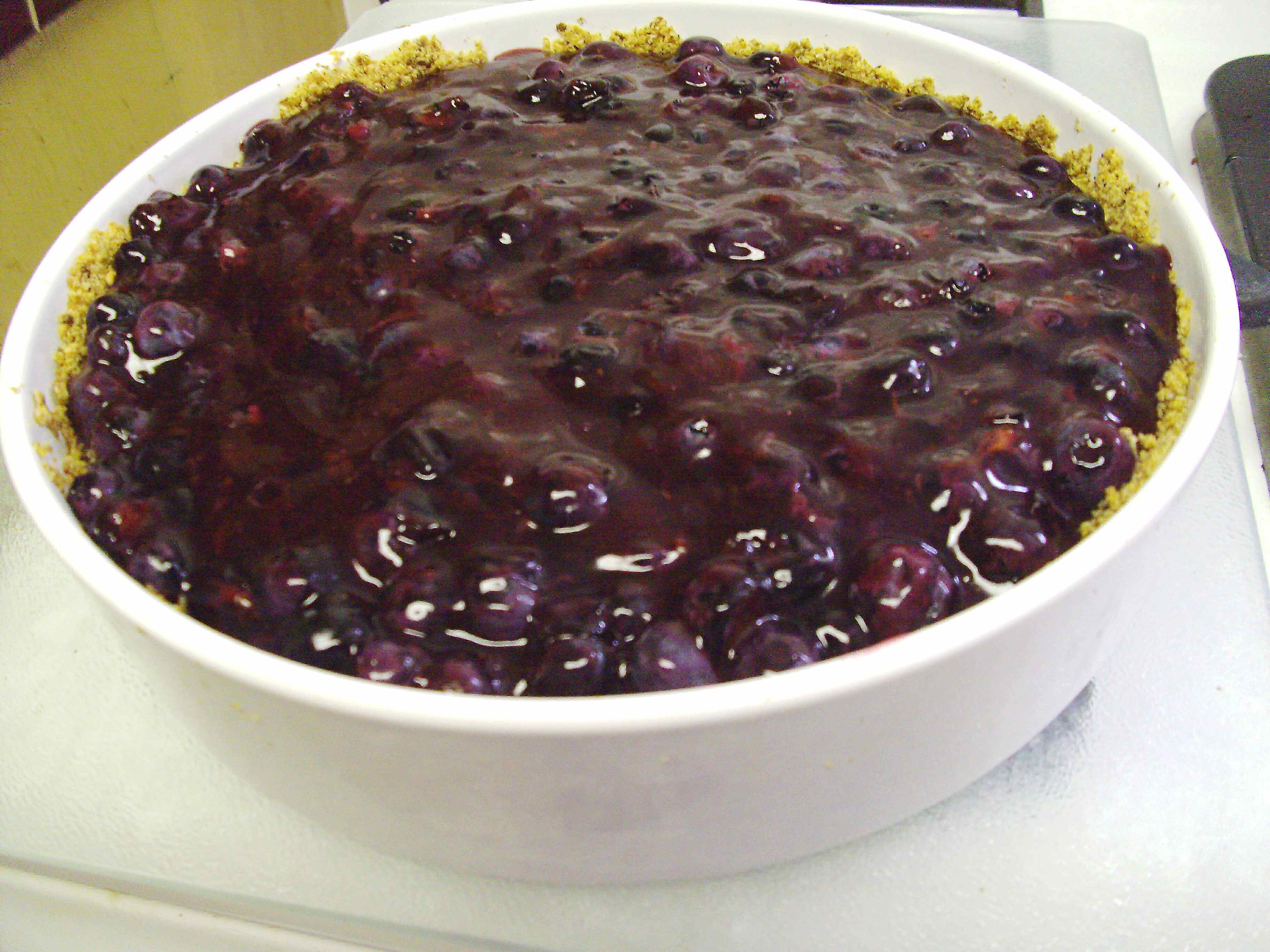
    raw blueberry pie with microwaveable filling and graham cracker crust

    This mostly-raw blueberry pie is a snap to make and very versatile--the filling microwaves in a few minutes, and you don't even have to bake the zippy gingered graham cracker crust--perfect for a hot Fourth of July and all summer long.

  • Recent Posts

  • Contents

  • Archives

  • Now Reading

  • See also my Book Reviews

  • Copyright 2008-2024Slow Food Fast. All writing and images on this blog unless otherwise attributed or set in quotes are the sole property of Slow Food Fast. Please contact DebbieN via the comments form for permissions before reprinting or reproducing any of the material on this blog.

  • ADS AND AFFILIATE LINKS

  • I may post affiliate links to books and movies that I personally review and recommend. Currently I favor Alibris and Vroman's, our terrific and venerable (now past the century mark!) independent bookstore in Pasadena. Or go to your local library--and make sure to support them with actual donations, not just overdue fines (ahem!), because your state probably has cut their budget and hours. Again.

  • In keeping with the disclaimer below, I DO NOT endorse, profit from, or recommend any medications, health treatments, commercial diet plans, supplements or any other such products.

  • DISCLAIMER

  • SlowFoodFast sometimes addresses general public health topics related to nutrition, heart disease, blood pressure, and diabetes. Because this is a blog with a personal point of view, my health and food politics entries often include my opinions on the trends I see, and I try to be as blatant as possible about that. None of these articles should be construed as specific medical advice for an individual case. I do try to keep to findings from well-vetted research sources and large, well-controlled studies, and I try not to sensationalize the science (though if they actually come up with a real cure for Type I diabetes in the next couple of years, I'm gonna be dancing in the streets with a hat that would put Carmen Miranda to shame. Consider yourself warned).

AbFab Mousse au Chocolat: lighter, faster, and still incredibly rich

The Daring Duo–back and brasher than ever in an Alexis Bittar jewelry ad from a couple of years ago. I don’t remember which mag I tore it out of, but who cares? It’s Valentine’s Day, Sweetie, so bling it on!

Preface: Usually I’m at least a couple of days late discussing anything related to New Year’s, Valentine’s Day, or pretty much any celebration involving dessert. Partly because the January and February months–and into maybe April–are always the ones where people struggle to recover from the big food holidays. And obviously it’s been harder on most of us to feel buoyant, celebratory or romantic these past two years. But I worked really hard all last fall writing interviews and moderating high-profile author events for a book festival, then doing and redoing flights for my daughter, who graduated early but her travel program fell through at the last minute. This much later I’m still feeling pretty chewed up and in need of a reward… And my husband has a badly mis-scheduled board meeting tonight and thinks he shouldn’t be the first to bail.

So I don’t know about you, but I’ve decided I could use a kick right about now, something uplifting and energizing and frankly decadent, but without having to work hard now or pay the piper afterward. Something like all the Valentine’s Day-themed chocolate mousse recipes everyone’s starting to trot out in food media, only a lot faster, less bloated and more chocolate-powered, and–of course!–made mostly in the microwave. If I get heart palpitations I want it to be from exhilaration, not indigestion or overwork.

Even though it’s already 3:37 pm here and probably too late to help you much if you’re stuck on a Valentine’s Deadline on the east coast. Go with plain 5-minute ganache instead–and some champagne for tonight, and save this one for the weekend instead–if it’s the real deal, your romance or at least the shopping hijinks you want to get up to will still be there.

I actually came up with this recipe way back in August, as a distraction from my book festival duties, but really–who wants to be thinking about chocolate mousse in August? So I decided to save it for now, when it will do the most good. Or bad, because I’ve been good way too long. And then I came across not only Season 1 but also a book of the published original AbFab scripts. It was practically kismet, I’m telling you! So–pardon my excess while I find some bling to get into character...
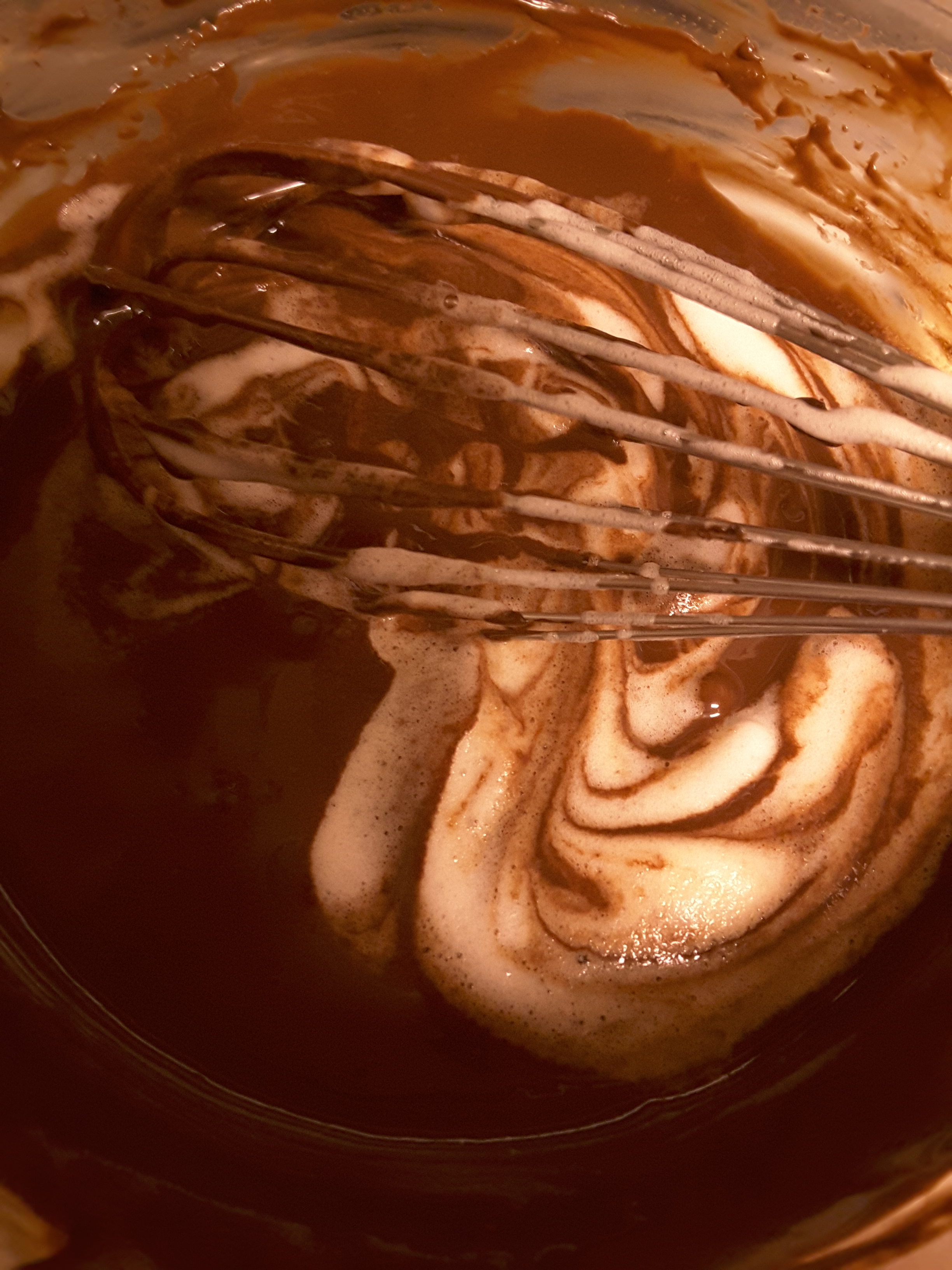
Folding beaten egg whites into the microwaved chocolate base for a lightened-up chocolate mousse.
Mousse au chocolat, Sweetie! It’s what microwaves are for!

THIS IS NOT your typical Meilleurs Oeuvriers de France high-concept mousse au chocolat. It’s not Hervé This, it’s not Pierre Hermé, it’s not Thomas Keller or Dominique Ancel. It’s not even the utter classic back-of-the-French-chocolate-bar-wrapper version that Dorie Greenspan quotes–and so, for that matter, does Alice Medrich. No name-dropping at all here (who, Moi?). Or at least no hyperlinks.

Just a tribute to a pair of troublemaking women who don’t cook at all, as far as I can tell, and a good thing too. But they aspire to everything this mousse is about–taste, time, fortune and fame, fashion superiority, basic naughtiness, and above all, a good time on a plate with no regrets the next morning.

So this is my take in honor of Absolutely Fabulous. It is very, VERY chocolate. And chic, despite my iffy photography and food styling abilities. And yet reasonably svelte. It will leave you quivering and swooning where you stand. This is what it’s all about, Sweetie.

Despite the fact that there’s no butter. No cream. And no crap. It’s not a heart attack in a tiny coupe (it only tastes like it, and maybe feels like it due to the high chocolate content). It’s not 450 calories and a day’s worth of saturated fat that goes right from your gallbladder to your hips, bypassing the heart as a lost cause.

You will not need to struggle into a larger pair of jeans [Season 1, Episode 2] after eating this, even if you manage to eat an entire quarter of it in one sitting without tottering to the couch and wishing you hadn’t and that you’d listened to me about Less being the New More.

This mousse au chocolat is so intense that even a spoonful or two is Almost a Religious Experience. At least if you’ve been fully vaccinated, you’ve been masking up (fashionably, as in, “LaCroix, Sweetie. La. Croix.“) instead of threatening your local chocolate purveyors and flight attendants, and thus your tastebuds still have their mojo. Because as everyone knows, breathing privileges and, just as important, flying privileges, are key to powershopping [Absolutely Special, aka AbFab in New York].

Once you recover from the chocolate rush, you will fan yourself, sip your bitter demitasse and your bottle of overpriced springwater, and leave the premises refreshed, overhyped and ready to shop for something sparkly as illustrated above–either completely garish, overpriced and pulled right from the runways with the tags still on…or, and we hope this is you, effortlessly elegant and sleek and elusively cool and yet still somehow totally rock ‘n’ roll, depending on whether you’re identifying with your inner Eddie or your inner Pats at the moment.

You will feel entitled, because the heady combination of making something like this mousse au chocolat mostly in the microwave, eating a petite portion in tiny refined bites and still being overwhelmed by the utter chocolatude of it all, without fearing the scale or the mirror the next morning, is the holy grail for those of us who worry secretly that we can’t really have it all.

Pardon me, I think Bvlgari is calling my name…

PS–EULA/legal disclaimer: the Management takes no responsibility for the shocking next-day surprise jewelry / footwear / custom marble courtyard sculpture bills you may have racked up in the heat of the moment. Or the return shipping and restock fees thereof.

PPS~~ ~~ THE ACTUAL FINE PRINT, ahem! ~~ ~~

Now…I did claim in the headline that this recipe is “faster” as well as lighter. And that’s…almost true. The key question is, compared to what? Because however you make chocolate mousse, you will have to give it several hours and preferably overnight in the fridge to set up properly. The only ones that set up in much less time contain either enough hard fats to solidify in an hour or so, which they will also do to your arteries, or else enough questionable fillers and thickeners to turn what should be an ethereal chocolate experience into dull, heavy American commercial chocolate pudding.

Part of the intrigue of chocolate mousse is the depth of flavor, but the other part is the texture. Getting it right is a little, though only a little, tricky to achieve with a significantly lighter reduced-fat, reduced-waistline version like this one.

My first attempt was almost right, and definitely fast, and really, really, really–I thought it would rock the first time out of the gate. It almost did. And of course I wish it had, because it would have been completely revolutionary.

I started with microwave ganache, amped up with cocoa powder to sub in for some of the bar chocolate–easy enough. Then I pivoted to microwave custard, easy and superfast, by dropping the egg yolks into the hot ganache and whisking and renuking immediately. So far, so good–thick, rich, smelling beautiful, and with the heat you’re reasonably well covered on the matter of egg safety. Do the same by folding in the beaten egg whites into the hot custard, I thought, waiting a minute and then rapid-cooling in an ice bath, and maybe you don’t have to use prepasteurized egg whites, which are more expensive, or else make a Swiss meringue. About five minutes from start to finish, no chaser, no waste, would be–Absolutely Fabulous. Wouldn’t it? and only two bowls plus the ice bath and a whisk.

I even went so far as to grate a bit of organic orange peel into the egg whites at the last. The dream and the taste–both divine.

The setup in the fridge wasn’t quite there, though, even the next day. It came out a little looser than I wanted, and the ethereal quality of chocolate mousse went slightly missing. Folding stiff egg whites into freshly hot custard had probably killed any risk of salmonella, but it also deflated the structure considerably after a while. It wasn’t completely stable in the fridge–so I froze it for a gelato, which was pretty good, actually, but it wasn’t mousse.

My second try was fussier–I did the near-Swiss meringue method Alice Medrich has used for pasteurizing egg whites, beating them with a spoonful of water and an extra tablespoon of sugar in a bowl over a skillet of simmering water to sterilize and stabilize them, and I also added a spoonful of cornstarch to the chocolate mixture–I know! not traditional!–but I had to test and find out. Would it work or would it end up tasting and textured like chocolate pudding?

This time the mousse stayed puffed beyond a doubt, and the next morning it had firmed up just enough to scoop and stay scooped. It was definitely chocolate mousse, though, not chocolate pudding–the bit of cornstarch hadn’t overdone it. A small test sample–the size of an egg, or maybe something you’d serve in shotglasses at a buffet–was really enough, too. Every millimeter of it was so intensely chocolate that it actually took me a few minutes to finish it in tiny, gelato spoon-style tastes, and I wasn’t automatically reaching for more. A little, or at least a little at a time, goes a very long way here–good news on the svelte front–and makes a big impression in a small cup, especially at the end of a meal.

Continue reading

Irish Soda Bread, Lighter on the Soda

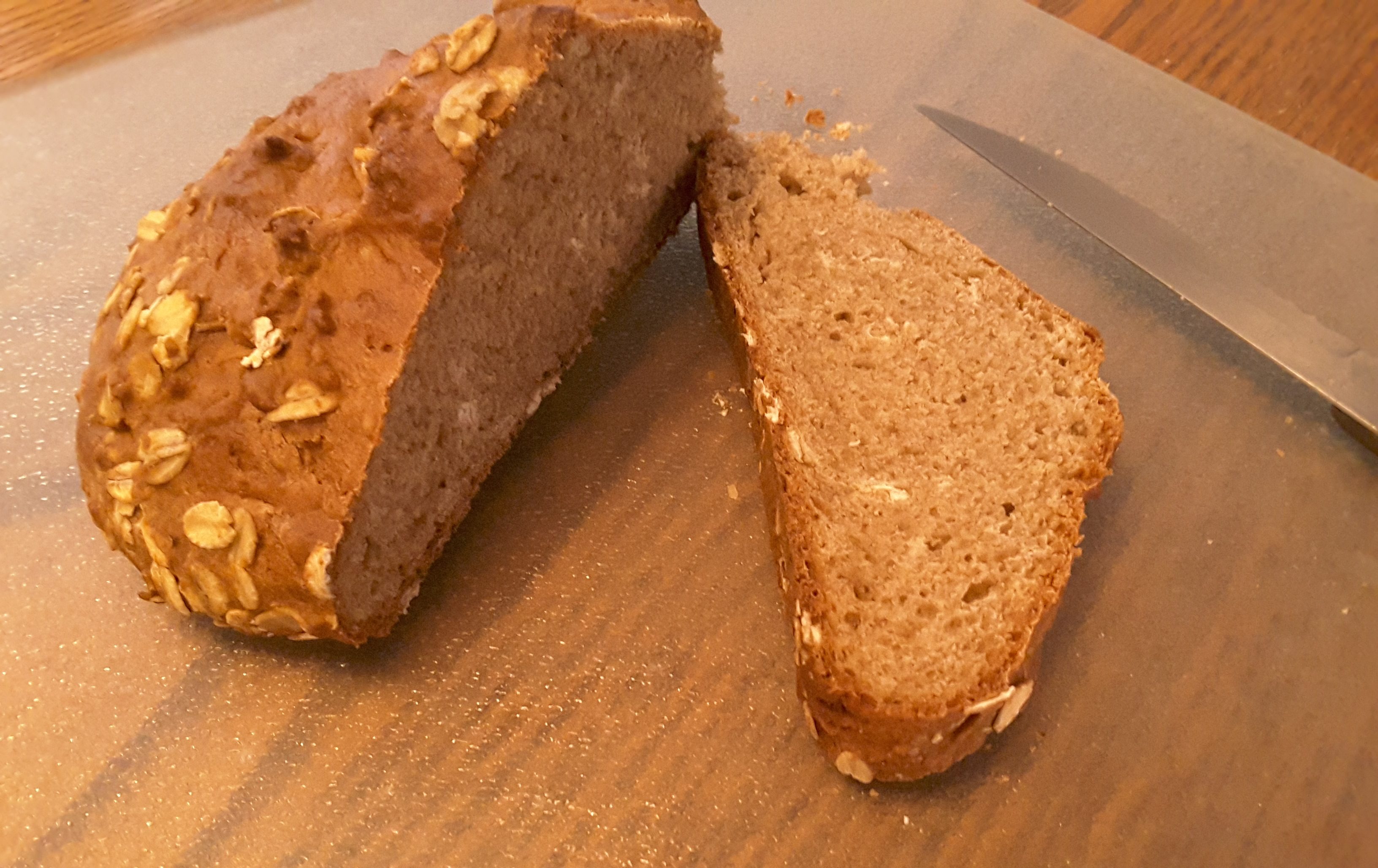
Irish soda bread with slice

Irish soda bread has a reputation—it’s quick and easy and yet rustic, but can be a bit rough on your stomach and supposedly goes heavy and rocklike within a day. Most people blame the whole wheat or the lack of yeast. I blame the soda.

This kind of quick bread was probably intended to be baked alongside the supper roast or casserole and eaten up at that meal—the loaves aren’t huge and there would probably be no leftovers to speak of. Time is of the essence when you’re making dinner for a hungry working family, and typical recipes I find call for a large tablespoon or more of baking soda for only two or three cups of flour. Then they cover the metallic/salt/soap flavor of the bicarbonate with extra spoonfuls of salt. The result is a high-sodium loaf that’s bound to irritate your stomach lining somewhat, even while fresh, and then will almost certainly end up pretty dry and hard, like the stereotypical box-mix Passover cakes, if you let it sit out at all.

I’m actually not sure whether the baking soda levels in today’s recipes are the same as or more exaggerated than classic ones. But considering some of the vintage recipes for similar quick breads, muffins, scones etc., from the 1930s or so, I suspect that the cheapness and novelty of baking soda and baking powder, which could replace eggs as well as yeast, made some of the recipe developers of the day more enthusiastic than they needed to be. Except, of course, if they were developing recipes for Arm&Hammer, Calumet or other brands…

Does it really need all that chemical leavening just to rise? As with tea breads, scones, and quick-mix oil- or applesauce-based cake layers, I find you can get away with a lot less than most recipes call for.  Half a teaspoon of baking soda is enough for two cups (8 oz. or 240 g by weight) of flour and the rise is just fine as long as you don’t wait around before sticking the mixed dough in the oven, and you have included an acidic ingredient like yogurt, buttermilk or vinegar to activate it. Then you don’t have to compensate the taste with excess salt either. The acidic ingredients and any dairy will tenderize the crumb as well.

In any case, these problems are easy to solve without doing your head in or spending a lot of cash on specific ingredients, because the beauty of Irish soda bread is its great adaptability to what you have on hand.

This is the adaptation I made a few times in March and April of 2020, when yeast was suddenly, inexplicably, sold out in the grocery stores, eggs were scarce and flour was being snatched off the shelves too.

Continue reading

Wanted: cooler heads, warmer hearts

…and less inflammatory bloat.

Warning: This is kind of a long make-up post with 3-4 related recipes out of my experiments since April. They’ve been helpful and fairly fast for coping with hot weather and hot tempers, mostly my own.

It’s been a long spring and summer not posting and just trying to get through, and wondering what kind of food post could possibly make up for the mess we’ve seen unfolding in this country.

So my thinking has kept roiling around in the manner of the following rant (much cleaned up):

We have to do better. As a nation, as a people, as individuals and members of our communities, as responsible and worthwhile human beings.

The proof is in the pudding, they say. This is true of both government and cooking. Right now we’re learning the hard way that you get out of it what you put into it. So watch what you put into it, and don’t treat yourself or your country like a garbage can. Prepare to vote like it matters, and in the meantime contribute as best you can to your local public schools’ support organizations to get students in low-income families the food and tech they need during distance learning.

— — —

I can’t help but cook, and usually I like to experiment, but with my husband and daughter suddenly home 24/7 for the past half year (my kid just went back to university across the country), and with temperatures getting up to 100+ some days here, staying creative about food without a lot of excess shopping trips or extensive cooking has meant staying fairly simple and more about fresh produce than about artiness in the kitchen, and maybe just using more herbs–one of the few things I seem to be growing successfully in the backyard. We all could use some shoring up healthwise and flavorwise, with some trimming back after a stressful winter and spring. So I’ve been trying hard to make the veg and fresh fruit more prominent and easier to grab-and-go for self-made lunches, without any of us having to work too hard.

But I have been cooking, and some of it has been good, and a lot of it has been anti-bloat AND good, surprisingly enough.

And it has in fact worked, most impressively for our daughter before she went back east.

So this is worth passing on, especially now: forget the “stress-baking.” Go for basic vegetables and fruit. Seriously. It makes a difference, and it might help lower your health risk, and possibly your food expenses, as well. Maybe even help de-stress.

My daughter came home from university in March seriously stressed out from the shift to online and upended plans. She’d been suffering acid reflux badly enough to be on daily medication, and had to ask me for mild zucchini-type vegetables only for the first couple of weeks home, because tomatoes were too much, and so were the hot peppers she loves.

Being home with us during the shutdowns meant a lot less “student” food, aka greasy takeout with its oversized portions. More beans and lentils and fresh veg and fruit every day. More sleep, more water, more hanging out with friends online or by phone, more socially distanced walks to get a break from us parental units (yay!). By June, she was already in visibly better shape, needing less insulin per day to stay in range, had lost the “freshman 10” from last year without major effort, and possibly (probably?) as a result, she was able to stop taking the acid reflux meds. Just in time for Anaheim peppers and Fresno tomatoes. And Indian food.

(okay, back to food):

For my husband’s birthday this summer, I took requests and ordered celebratory takeout from our favorite restaurant, which has been in Pasadena for over 20 years and just keeps getting better. We’ve only done takeout anywhere a total of three times since the shutdowns, partly because it’s a splurge and partly because the logistics are more nerve-wracking now (were they wearing gloves? were you? do you wipe down the containers? should you nuke them?) You don’t want to know how it went on our first try back in April when the bad news was first ratcheting up. Not at all fun. I vowed to my still-beloveds afterward that we’d do it again and this time I’d be calmer, and just decide ahead how to handle the containers safely.

In any case, by my husband’s birthday, we’d finally got the hang of it enough for us, and there’s no denying that it was delicious. It also inspired a couple of microwave-friendly dishes I plan to pass on to my kid now that she’s back and cooking for herself. Two (well, three) of these dishes are hot, the other frozen, and all are cheap, fast, surprisingly easy and pretty good–they’re even fairly close to the dishes I was trying to imitate, but a bit lighter fat- and calorie-wise.

Which is good because today we’re in a massive heatwave in Southern California, and it’s so hot I decided to try hanging wet sheets out on an old clothesline I’ve never used. I think they were dry by the time I finished pinning them up 5 minutes later. I know I was.

Lightening up Makhni Paneer

Makhni paneer-style tofu with pumpkin sauce, plus added green beans and cooked chickpeas for a microwaveable next-day lunch. Or in this weather, just eat it cold.

One of the dishes we ordered from the All India was makhni paneer, which is cubes of fresh-pressed cheese submerged in a very rich tomato cream sauce. I’ve looked in a number of cookbooks and online–could be ghee and cream or full-fat yogurt in the sauce, could be coconut milk. Tasty but way, way, way too rich for my blood (cholesterol, that is). Way.

Still–the ideas started churning. The makhni paneer had a slight tang and a suggestion of sweet under all the obvious richness, and showcased the spices in a completely different way from the other dishes at the table.

How do you do that, but lighter, and possibly a little faster?

I love paneer but my daughter prefers tofu, at least for my home renditions of saag paneer. That actually fits a recent wave in US Indian communities of making heart-healthier substitutions–unsaturated vegetable oil for ghee, tofu instead of paneer, lower-fat yogurt where possible, and hopefully backing down a little on salt. Even the All India offers tofu as an alternative. So we obviously start there.

But the cream sauce is really the main challenge. The bhuna (browned-onion/spice flavor base) works fine with unsaturated vegetable oil instead of ghee. You can precook the chopped onion in the microwave for a minute or so to get it going a little faster when it hits the frying pan without the need for salt. But for the bulk of the sauce?

A large can of pumpkin sitting on the shelf for one of those just-in-case moments (why do we always seem to have them?) caught my eye, and it suddenly seemed right.

Pumpkin? right color, right substantial thickness, smooth, decent taste, likely to go well with everything else, easy to thin out just enough with milk or soymilk to get it a little more like the sauce I was going for, only without fat and with lots of vitamin A and fiber. Use enough of it to make a difference and it counts as a vegetable. Check.

Plus, I’d once used it successfully as the base for a fat- and egg-free eggnog back in my 20s, the early days of cooking for myself. Squashnog? That’s what I’d put in my little blank-book cookbook. Maybe it would work here too. Continue reading

Halloween Candy Carb Guide

Halloween is coming…if you have a diabetic kid, as I do, it’s more difficult than Valentine’s Day to deal with the ups and downs. This year my daughter is in college and making her own decisions, but we’ve been strategizing since her first Halloween with T1D (Type 1 diabetes, the kind that requires insulin round the clock) about how to handle the (several pounds of) candy haul safely without spoiling all the fun.

She will tell you I spoiled it by throwing out one or more pounds (out of 3, more than we even handed out) behind her back a couple of years later, and she still feels ripped off. I will tell you that she eked out at least 2 of her 3 pounds of junk for over a month of getting to eat a piece or two every day with a meal, so what’s she complaining about?

Now of course she prefers actual chocolate, high-percentage, with some actual chocolate flavor instead of light-brown oversweetened waxy mush. But the appeal of trick-or-treating lasted a long time and is probably still going strong.

The point being, people with Type 1 diabetes still like candy and can in fact eat some of it with insulin to cover it, just “in moderation” as the Juvenile Diabetes Research Foundation puts it. In moderation meaning a little at any one time, preferably not on its own but with an actual meal that contains protein and vegetables and fiber to help de-spike it (for Halloween, I suppose I should say, “defang it”). And always with known and limited carb counts and the right amount of insulin to cover it.

Regular candy bars come with nutrition labels and carb counts, and you usually only buy one at a time, but Halloween throws everything off. The little minis and fun-sized and so on? And artificial sweeteners aren’t really the answer, especially not for kids, because there are some emerging health issues. If your kid (or you) have a candy haul with no labels, how do you carb count?

There are three ways to deal and you’ll want them all.

Start with the eyeball method

This is good for when you’re still on the street or at a party, or whenever you don’t have better measurement methods or official info handy…

If it’s a chocolate, the square minis (less than an inch on a side) are about 5 grams of carb apiece, and so are the small wrapped hard candies (“boiled sweets” in the UK) like Brach’s or Kraft peppermints and butterscotch, regular-sized thin 1″ plain lollipops and so on.

The slightly bigger 1 1/2″ long by 1/2″-5/8″ rectangles of standard chocolates are about 8-11 grams apiece.

The JDRF’s annual official guide to Halloween candy carbs

Once you get your haul home, or if you have a smartphone on you, use the official carb counts for any common candies with brand names. The  JDRF Halloween Candy Carb Guide is a PDF list you can print out and stick on the fridge or keep handy on your smartphone. They update it every year to keep it current.

When in doubt, weigh it out

Your best bet for any candy without a label–gummy worms, home-made or unwrapped chocolates, candy-bowl candy, etc.–is to weigh it on a scale that shows grams. Almost anything but sesame halvah (which you’re unlikely to pick up trick-or-treating) will be more than 85% carb by weight. (Halvah is about 50% by weight because it’s half sesame paste, half sugar syrup, but really. It’s kind of the exception.) Regular fudge is similar in texture but in terms of carb, it’s right up there around 90% like most commercial candies.

Most mass-market chocolate candy (i.e., Mars and Hershey, not the high-percentage bars) is 85-95% carb by weight, so if you weigh it in grams, multiply by 0.9 and you’ve got a pretty good estimate at least in reasonable single portions (1-2 pieces of candy, half an ounce or so). Hard candies like peppermints or butterscotch, Jolly Rancher, Lifesavers, etc. are basically 100% carb, so whatever they weigh in grams is the number of grams of carb. Jelly beans and gummy worms are in-between but figure 90-100% carb by weight.

Those percentages are a bit finicky and not everyone needs to know the carb to within a gram or so. If you don’t have a head for math or a calculator handy, just weigh it and figure it’s all carb, keep the portions limited to half an ounce (15-20 grams of candy) and and you won’t be off by more than 1-2 grams of carb.

For more tips on helping a young kid deal with diabetes and candy at Halloween, and more on general carb counting by weight for regular foods, check out the Carb Counts page (or just click the tab at the top of the blog).

Three nonsense words

That I don’t really want to hear about food or nutrition, pretty much ever, and certainly not as a way to welcome in 2018. Courtesy of the New York Times’ T Magazine this week:

To usher in the new year, we asked creative people to share the homemade recipes they count on to detox, cleanse — and refresh.

Please. When you start describing breakfast in terms better suited to a moist towelette, and when the breakfast product itself comes out looking…well, let’s not even go there. I mean, check out the before and after food photos and tell me I’m wrong.

The fashion-slash-yoga world tends to be convinced that cleanses and detox schemes are legitimate. Physiologists, internists and RDs with board certifications tend to disagree.

Juicing, while obviously ultra-fashionable (still? boggles the mind), actually removes all the fiber, concentrates the sugars, and makes you wonder, given the thinness and the (frankly hideous) color of the stuff in the goblet in the right-hand “after” photo, whether it wouldn’t have been more genuinely nutritious, tastier, satisfying and visually appealing at the same time just to make some chunky vegetable soup–with garlic and herbs, not this sweet swill–and just wash and eat the apple with the peel. Because of course it would.

Another article in the series shows the breakfast for a conceptual artist who includes “human bacteria” and Teva sandals in her exhibitions (why? and I mean, are you really tempted to follow her food conceits after reading that?)–a bowl with about 10 hazelnuts and a dusting of chia seeds, not exactly a meal, and on the side a shotglass of something that is admittedly a much better green than the first interviewee’s due to dark leafy greens rather than celery and carrots, but would still be better left unjuiced, lightly cooked in stirfry or soup form, and without any sweet stuff in it. And preferably with a hit of garlic.

No major calories in this kind of breakfast, and perhaps we should be grateful that they don’t throw in any bacon or its variants with the veg, but really. Those breakfasts look pretty bleak and cold and less balanced than they ought to be, whether green or not-such-a-good-green.

Why the “detox” label? Why the crash-style diet drinkies? Why an article series–not even just one ill-judged gush piece–on food that doesn’t really look or taste all that good or deliver that much actual nutrition as given in the recipes, and frankly isn’t necessary if you actually eat things like vegetable soup or broccoli and other greens as part of your regular meals? Is the NYT readership really that into these things? Are they in it for the post-holiday self-castigation value?

None of the women interviewed (and of course they are all women, at least so far) are  particularly unfit or overweight or heavily broken out or anything, and none of them look ill or hung over. Raises the question: just how badly did these people really eat during the holidays?

You’d think from the tone of the articles that these artists had all been rolling around in crappy green and red sugar cookies of increasing staleness and chugging quarts of full-on eggnog all December just for something to do.  It’s the only way the articles even begin to justify themselves.

Diabetes meets ethnic foodways in new ADA series

Just in at my library are two new cookbooks from the American Diabetes Association. Indian Cuisine Diabetes Cookbook by May Abraham Fridel (©2017, ADA, Inc.)  and The Italian Diabetes Cookbook by Amy Riolo (©2016, ADA, Inc.)  are written by two food authorities in their respective home cuisines. The books are bright, they’re attractive, the food looks decent and authentic.

But what makes them “diabetes cookbooks”? What have they changed–or not–about the recipes and what was the ADA’s role other than simply publishing them? Above all, how helpful are they to an average diabetes or prediabetes patient?

Both books start out with an explanation of their food traditions and what’s generally healthy about them. Both include a variety of food categories for different meals, from appetizers or chaats to mostly-protein “main” dishes to mixed casserole-type dishes to salads, breads, soups, cooked vegetables, fruits, baked sweets and drinks. The Indian cookbook also includes some useful spice mixes and tips on how to handle them, and the Italian one includes some traditional menu choices and tips on choosing wine.

The recipes are generally very DASH Diet-able with an emphasis on a variety of vegetables, beans, whole grains, low-fat dairy, whole fruits and nuts, along with smaller portions of meat and cheese and less added sugar for desserts.

On a closer read, the adaptations to recipes mainly look like sane portion sizing for starches and sweets, reducing or substituting poly- and monounsaturated fats for some of the saturated fats, cutting down excess sugars in sweets and desserts, adding fruit and vegetables, and substituting almond flour and dried fruits for standard flour and sweeteners. The recipes are adjusted just enough to be low in sodium and saturated fat, reasonable on calories, total carbohydrates and added sugars. The portion sizes listed are smaller than what you’d get at an American restaurant or see on a magazine cover these days but they’re close to the amounts people traditionally serve.

So the nutrition stats are a general improvement compared with most current cookbook-style recipes for equivalent dishes, and it looks like the nutrition guides at the bottom of each recipe are relatively accurate given the ingredients. So far so good. If this was the ADA’s doing, I’m all for it.  But it seems obvious to me that it would be better to trust the ADA reviewers’ understanding of diabetes nutrition than either cookbook author’s.

I was surprised to find that the ADA let each of the authors go her own way on the introductions, and that the health explanations tend to be vague and cultural rather than practical. In the Indian cookbook, Fridel describes ayurvedic dietary principles rather than talking about nutrients. Riolo also veers off into a discussion of which appetizer traditionally goes with which first course and how to choose Italian wines in a way that doesn’t really have anything to do with target carb counts or  exchanges for a meal either.

You can discount or admire these things as you please, but you can’t really learn a lot from them diabetes-wise. They’re not really directed toward helping patients put together balanced, carb-controlled meals from the nutrition stats given with the recipes.

Moreover, the ADA’s particular nutrition stats system lists “carbohydrate exchanges” separately from “starch,” “fruit” “vegetable” and “dairy” exchanges, even though most of the ingredients that fall into those categories contain significant carbohydrates. All of them have to be counted for diabetes management.

It’s not clear why their system differs so much in this regard from the Academy of Nutrition and Dietetics’ standard “Choose Your Foods” exchanges system for carb count approximations. It works okay for figuring out standard servings definitions for the major food groups if you’re following the DASH Diet or USDA/HHS MyPlate plans, but it’s not really in keeping with the way endocrinologists and certified diabetes educators train Type I diabetes patients. It makes carb counting and carb planning for meals more complicated than it has to be. That can’t be a good thing.

Also, simply giving the nutrition and exchanges stats for each recipe as it shows up in the book is not the same as teaching a new patient how to carb count or set up a balanced plate. Most of the dishes are mixtures of carb-containing and noncarb-containing ingredients–casseroles, soups with beans, meat and vegetables, biryanis, meatballs containing breadcrumbs, and so on. Those are some of the most difficult foods to estimate carbs for by eye, and it’s not visually obvious–or discussed in any detail–what the authors and their nutrition consultants at the ADA did to adjust these specific recipes.  In this regard the ADA books are no worse than most “diabetes diet” cookbooks and magazine recipe collections, but they’re also not much clearer.

Beginners really would do better to start with the carb and noncarb foods separated on the plate, at least until they get a feel for what to count and how much food to serve.

What both of these books–and any others in the ADA series–could use is a short, clear explanation for how to work through the nutrition stats they give in each recipe and how to plan a nutritionally balanced meal around that dish to reach a target total amount of carbohydrate. A two-page standard ADA primer with a basic diabetes meal plan diagram, some suggested per-meal carb counts or carb exchanges, a balanced-nutrition plate à la ChooseMyPlate.gov,  examples of where to look in the recipes for serving sizes and how to create a full meal from them, how to add things up for a meal’s total carb, etc., would help a lot. It might also be helpful to point out how to rework the meal plan if someone wants more than the standard serving amount or takes second helpings.

All in all, these two cookbooks aren’t terrible as cookbooks, but they’re not nearly as helpful as they could be as diabetes guides.

“Healthy” breakfast muffins? Miscalculated.

Julia Moskin’s latest “Recipe Lab” in the New York Times food section revisits one of my (cranky, irascible) pet peeves: the “healthy” muffin. She claims her version, filled with an expensive and lengthy list of the latest buzzword ingredients and yet supposedly lighter-textured than most bakery offerings, is healthy, always a warning sign, especially when paired with the instruction to make sure it’s well-leavened and to use “unprocessed” oils. These are code words for a heavy dose of baking soda and baking powder on the one hand and coconut oil, the newest darling of the hipster food world, on the other.

But–benefit of the doubt–I looked at the recipe and scrolled down to mouse over the nutrition stats. They’re provided in a popup link you can’t copy, with a very faint “i-in-a-circle” watermarked icon below the ingredient list. Not a good sign, generally: hiding the nutrition stats signals that they’re kinda suspish, or at least unflattering. But okay, at least they’re posted here.

Edamam provides the analysis–and per average muffin, 20 to the batch, claims the following stats:

318 cal, 16 g total fat, 1 g saturated fat, 0 trans, 9 g monounsaturated, 4 g polyunsaturated, 39 g carbohydrate, 2 g fiber, 19 g sugars, 4 g protein, 38 mg cholesterol,260 mg sodium

Something didn’t sit quite right with that. I looked up at the ingredient list.

Sure enough, the fat was provided by 1 1/3 cup of coconut oil. Yick. But never mind. The point here is that Edamam lists the saturated fat at a very improbable 1 gram per muffin.

There is–being kind about it–no way this is correct. The only thing I can think of is that Edamam used the soybean or canola oil option for the calculation, but why would that be? Coconut oil is listed as the much-preferred fat. And it’s got more saturated fat per gram than lard. About 82% saturated fat by weight, if you check the most reliable lab analysis at the USDA National Agricultural Library’s nutrient database. And actually, the mono and poly stats suggest something closer to olive oil than soybean or canola.

The correct calculation for 315 ml of coconut oil is 260 grams of saturated fat for the recipe. For 20 muffins, that’s almost 14 grams of saturated fat per muffin, not 1. And 14 grams is pushing the recommended daily max of 20 grams of sat fat for a 2000 calorie-per-day diet. Just for a muffin.

Given the nice way the New York Times provided the grams as well as cups and spoons measures in the recipe, here’s what I came up with, direct from the USDA NAL database and averaging a bit for the different options between apples and carrots and between walnuts and pecans.

  • Total calories for the recipe: 7213, per 1/20th (1 muffin): 361
  • Total saturated fat: 273 g,  per muffin: 13.7 g
  • Total monounsaturated fat: ~50 g, per muffin: 2.5 g
  • Total polyunsaturated fat: ~50 g, per muffin: 2.5 g
  • Total cholesterol: 744 mg, per muffin: 37 mg
  • Total carb for the recipe: 699 g, per muffin: 35 g
  • Total sugars: 390 g, per muffin: 19.5 g
  • Total fiber: 49 g, per muffin, 2.5 g
  • Total sodium: ~4670 mg, per muffin, 234 mg.

And yes, it’s kind of a pain to navigate all the USDA data chart by chart, ingredient by ingredient, put in the actual amounts in grams, have it recalculate the whole chart, add the totals up nutrient by nutrient, and then divide by 20. It would be so nice to find an accurate and complete free recipe-style app to pull all the relevant data and stick it in a single spreadsheet. The myfitnesspal.com recipe calculator is about the best I’ve found so far, but it’s not as complete, and neither unfortunately is the USDA’s Supertracker calculator, as far as I can tell.

How did Edamam and the New York Times Food Section do? The sodium, though a bit much for a single bready item (4 t. baking powder, 1 t baking soda and half a teaspoon of salt on top of that, plus whatever’s in the buttermilk), came out about right at 260 mg (I got 234 per muffin). The carbs are about right too, if kind of a lot. Sugar at 19 grams is about half the total carb and makes it no great bargain (not to mention, brown sugar plus maple syrup? cha-ching, and the maple flavor probably disappears with all the other stuff. Kind of a waste.). This is still a pretty cakey item, despite Moskin’s protestations to the contrary and all the grated carrot and blueberries and multigrain ethos. Edamam’s calorie estimate is a bit low by 40 cal per muffin. You could probably live with that.

But you shouldn’t. Because with the trendy, expensive coconut oil option, the published saturated fat estimate is way, way, way off. Way off. Bizarrely off.

I visited Edamam’s web site to see if I could figure out how they calculated this–whether their own calculator would give me the right result if I input “315 ml. coconut oil,” or whether their API, which features natural language processing, somehow makes  errors this big when it parses a recipe and does the lookup in the USDA database. Did it pull the wrong ingredient, or did the NY Times staff type the wrong thing into their recipe submission? Or what? Continue reading

BMI criticized again…by psychologists?

The International Journal of Obesity has just released a short article by Janet Tomiyama (UCLA) and Jeffrey Hunger (UC-Santa Barbara) et al–a team of psychologists. They analyzed NHANES data from 2005-2012 for about 75,000 individuals, and concluded that BMI status doesn’t correlate well with six concrete markers of cardiovascular and metabolic health–blood pressure, blood triglycerides and cholesterol, blood glucose, insulin resistance, and C-reactive protein. Extrapolating a bit from the NHANES study participant numbers, they conclude that millions of Americans–54 million–have been misclassified as unhealthy due solely to their BMI numbers.

According to their analysis, 47% of the overweight people in the study had healthy status (0-1 of 6 markers) other than their weight. About 30% of obese and even 16% of morbidly obese people had healthy status according to their protocol, whereas about 30% of those in the healthy BMI range had more than one actual cardiovascular or metabolic disease marker that would be ignored if only BMI is considered.

Is this really the death-knell for public concern over weight? Should it be?

Here’s how the UCLA press release puts it (with my emphases in italics):

But a new study led by UCLA psychologists has found that using BMI to gauge health incorrectly labels more than 54 million Americans as “unhealthy,” even though they are not.  […]

“Many people see obesity as a death sentence,” said A. Janet Tomiyama, an assistant professor of psychology in the UCLA College and the study’s lead author. “But the data show there are tens of millions of people who are overweight and obese and are perfectly healthy.”

Incorrectly labels? Perfectly healthy?

The definition for “healthy” used in this study is 0 to 1 known risk factor for CVD and diabetes. But clinically, one risk factor is often enough to be of acute concern, especially if it’s untreated high blood pressure or blood glucose. Those generally need treatment sooner rather than later.

Furthermore, the study as posted on Hunger’s web page excludes obesity and overweight a priori from that count of risk factors for CVD and diabetes. I don’t know the absolute latest research consensus, other than what was in the Dietary Guidelines for Americans Advisory Committee’s report last February, but my general understanding is that weight does show some statistically independent influence on CVD at least. That picture may be changing as we learn more about its interactions with other risk factors, but if it’s still valid, weight should have been counted as one of the existing “known risk factors” along with the other markers and that would have skewed Tomiyama and Hunger’s analysis considerably.

Even without those considerations, the different weight groups classified by BMI cutpoints do in fact show a significant increase in health risk from one category to the next. Turn Hunger and Tomiyama’s percentages around and you see that 70% of people in the 18.5-24.9 healthy BMI range have 0-1 risk marker other than weight; 53% in the 24.9-29.9 overweight range have more than 1 marker, 70% in the 30-35 range have more than 1 marker, and 84% in the 35 and over BMI range have more than one marker other than weight.

Plot those crude percentages and you’ll see a very sharp rise in risk incidence between the healthy and overweight categories, a reversal of fortune from “most people healthy” to “more than half at risk,” with further solidification of “most people at risk” as you venture further into obese and morbidly obese. There’s really no debating that trend, even given the narrow way this team has defined “healthy.” To say nothing of “perfectly healthy.”

Researchers in biomedicine (i.e., physical as opposed to psychological medicine) have recently reexamined whether the current BMI cutpoints defining healthy, overweight, obese and morbidly obese are in the right places to describe most people’s 10-year risk of overt CVD events (heart attacks and stroke), diabetes, or all-causes mortality, or whether BMI is just a continuous gradient of increased risk without definable cutpoints. At last count, the conclusion was that the current statistical best-fit cutpoints are pretty much correct, even though the data for individuals have a pretty big spread (and that each BMI step or number still has incrementally higher risk than the one below).

The upshot: BMI categories are still a pretty good marker of the overall health status of Americans when you’re talking about trends. Crude, yes. Exceptions for athletes with much more muscle than fat, yes. But the numbers are still strongly in favor of using BMI as a general warning flag to check for more specific cardiovascular and metabolic disease markers in individuals.

It’s very odd to see a paper like this coming from a team of behavioral psychologists, which Tomiyama and Hunger are. They’re at least nominally outside their field here, doing a statistical analysis on physical health data, and the paper’s methodology and definitions (along with some of their position statements in the American Journal of Public Health and elsewhere) show a specific agenda toward deconsecrating BMI and downplaying overweight and Continue reading

“The Dorito Effect”: Fervor over Flavor

So, the party’s over, the halftime show’s over, Denver won, a variety of pop stars are brushing off media criticism over what they wore, and a nation is figuring out how to deal with the caloric aftermath of buffalo wings and a variety of dips and chips. (My biggest excitement: locating the owner of a red Corvette with a leaking gas tank in time to deal with it and avoid a more dramatic spectacle. Luckily it was mid-afternoon and the owner was alert, sober, and not smoking. She  also wasn’t whining about having to go out to look at the car. As some of the male guests might have been, Corvette or no.)

Mark Schatzker’s recent book, The Dorito Effect, is an energizing read for those of us who aren’t really into the classics of Superbowl Sunday.

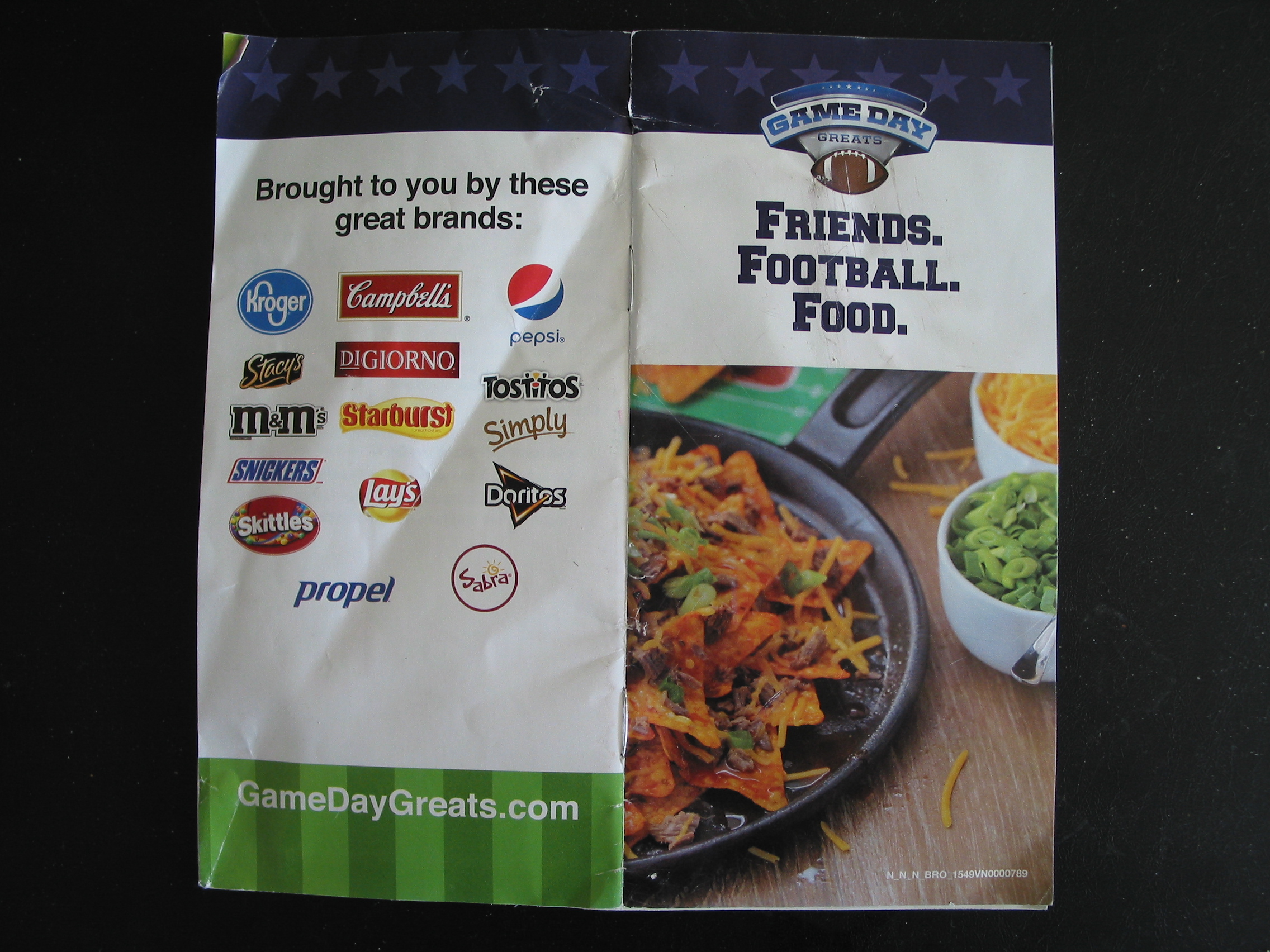
Kroger Superbowl recipe booklet

I’ll spare you the inside pages, but the closest to nutritious was Kroger’s own recipe for double-coated baked cauliflower “hot wings”–ingredients: a head of cauliflower, a little flour and water, garlic powder, Kroger’s store-brand hot sauce, and some melted butter to doll up the cauliflower florets before dipping in…ranch dressing. 

Not that it’s really so much about Doritos, but rather that it takes the 1960s invention of Doritos–a “taco-flavored” taco chip without any actual meat, cheese or salsa, just what has become known to all as orange cheez dust–as the first serious divorce between food and intrinsic flavor.

It isn’t really the first, of course, and Schatzker traces the history of post-WWII mass agriculture as the story of more food, grown quicker, with less and less flavor. Everything from tomatoes to chickens to broccoli to wheat comes under the microscope lens here. Yes, it’s another Michael Pollan-style examination of some familiar complaints about how and why nothing tastes the same anymore.

He collects reactions from champion kvetchers as diverse as Julia Child (she did it first, he claims, calling modern–1960s–American chicken tasteless and with the texture of “teddy bear stuffing”) to the Slow Food Movement (no relation, ahem!) to Michael Pollan himself, to a variety of old bickering couples who remember the flavor of old long-legged breeds of chickens now relegated to the remote gourmet sidelines of the vast factory-farming chicken industry…

Schatzker tells a fairly entertaining version of this tale–how Big Food and Big Agro convened with flavor chemists to alter the course of human gastronomy in the wake of WWII. As we breed livestock and produce to grow more, bigger, faster, he discovers, we lose not only flavor but nutrients and replace them with water and carbohydrate filler even in things like broccoli and tomatoes. And then we try to make up for that by dousing them in ranch dressing and orange cheez dust and artificial flavorings; hence the title of his book.

Coatings, dressings, artificial flavorings, salt, sugar and oils–these, he says, have become the substitute for intrinsic flavor in real foods, and a mainstay of the unsubstantial snack foods–starting with Doritos–that have pushed out bulk produce and unprocessed ingredients in the American diet.

Schatzker takes it a couple of steps further, though, presenting his theory that the loss of flavor in real foods is the key factor to blame for American overconsumption of calories, and that flavor is one criterion we should work to restore at a national level.

Yes, we’ve read much of this before elsewhere, but his interviews are still eye-opening. He interviews flavor chemists at McCormick, which does a lot more of its work behind the scenes of the restaurant and processed food world than you might think. Those little bottles of herbs and spices on supermarket shelves are just the tip of the iceberg.

Schatzker also profiles one of the original breeders of today’s heavy-breasted, fast-grown, efficient-feeding mass market chickens–though the man is still proud of that early work given the economic pressures on postwar America. He gets the inside story on the decline of flavor and nutrition in broccoli, kale, tomatoes, strawberries and other common produce, and learns why some top agriculture researchers eventually quit the corporate world to try and restore some of the diversity and quality that had been lost during the peak years of their careers. Continue reading

Thanks

I want to give a quick thanks to Dr. Marion Nestle, who took the time to let her readers and colleagues know about Sunday’s Dietary Guidelines post in her Twitter feed and on her blog, foodpolitics.com, which I’ve read with interest ever since starting this blog. The response has been overwhelmingly positive and I appreciate it very much.