
• Enter your email address to subscribe to this blog and receive notifications of new posts by email.

    Join 241 other subscribers
  • Noshing on

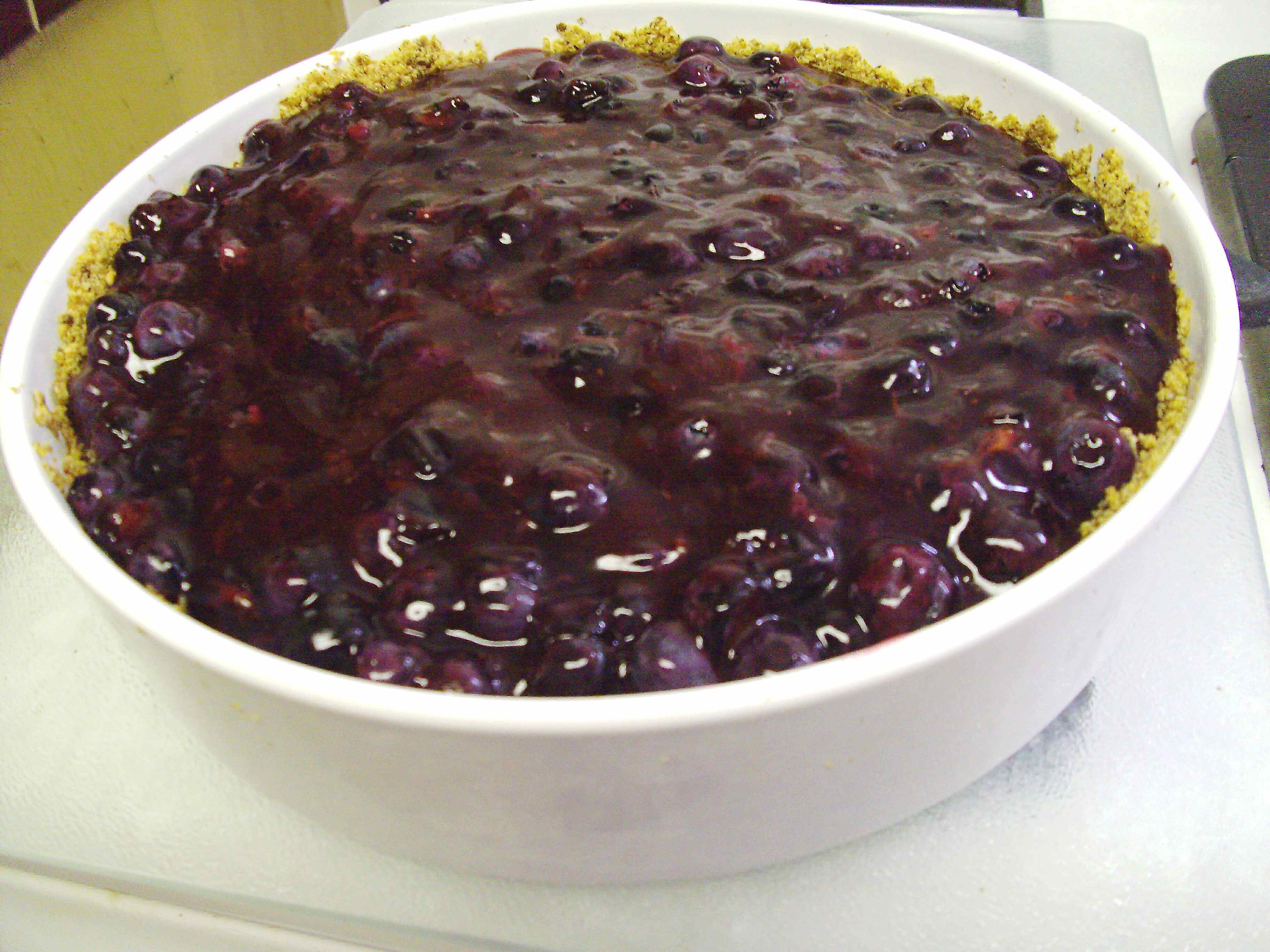
    raw blueberry pie with microwaveable filling and graham cracker crust

    This mostly-raw blueberry pie is a snap to make and very versatile--the filling microwaves in a few minutes, and you don't even have to bake the zippy gingered graham cracker crust--perfect for a hot Fourth of July and all summer long.

  • Recent Posts

  • Contents

  • Archives

  • Now Reading

  • See also my Book Reviews

  • Copyright 2008-2024Slow Food Fast. All writing and images on this blog unless otherwise attributed or set in quotes are the sole property of Slow Food Fast. Please contact DebbieN via the comments form for permissions before reprinting or reproducing any of the material on this blog.

  • ADS AND AFFILIATE LINKS

  • I may post affiliate links to books and movies that I personally review and recommend. Currently I favor Alibris and Vroman's, our terrific and venerable (now past the century mark!) independent bookstore in Pasadena. Or go to your local library--and make sure to support them with actual donations, not just overdue fines (ahem!), because your state probably has cut their budget and hours. Again.

  • In keeping with the disclaimer below, I DO NOT endorse, profit from, or recommend any medications, health treatments, commercial diet plans, supplements or any other such products.

  • DISCLAIMER

  • SlowFoodFast sometimes addresses general public health topics related to nutrition, heart disease, blood pressure, and diabetes. Because this is a blog with a personal point of view, my health and food politics entries often include my opinions on the trends I see, and I try to be as blatant as possible about that. None of these articles should be construed as specific medical advice for an individual case. I do try to keep to findings from well-vetted research sources and large, well-controlled studies, and I try not to sensationalize the science (though if they actually come up with a real cure for Type I diabetes in the next couple of years, I'm gonna be dancing in the streets with a hat that would put Carmen Miranda to shame. Consider yourself warned).

Three Films on Food and Memory

In the weeks before all the shutdowns and my daughter coming home from university for spring break–and now staying, to our relief–I decided to give myself a day’s mini-filmfest break as a reward for doing taxes. By the time I looked up from the 1040 checklist, though, nothing I really wanted to sit through was still playing at any of the theaters, and I’d missed both The Farewell and Uncut Gems. And now the theaters are closed.

Since I’m not on one of the streaming services, I took advantage of my local library DVD collections before the libraries, like everything else, decided to close. If you can stream these and you like thoughtful movies with food somewhere in the mix of topics and character sketches, they’re all worth watching.

First is Oscar-nominated foreign documentary Honeyland. I’d missed its limited run at my local independent theater only the week before (taxes, as mentioned), so when I spotted it at the library I snatched it up along with two others that were also surprising finds.

Honeyland follows Hatidze Muratova, possibly the last traditional wild beekeeper who, in her fifties, lives alone with her bedridden, elderly mother in a one-room stone hut, part of an abandoned village outside Skopje, Macedonia. She takes the regional bus into town on market days to sell the jars of honey she’s harvested from beehives in the rocks and gets a good price for them, but it’s still just enough to buy groceries with. Then a large, noisy family moves their cattle into the abandoned homestead next door and she makes friends with them, helping with the younger children. The father, ambitious to make a go of things, tries beekeeping himself, but ignores her advice for handling his box hives gently, gets a bad price at market and contracts bulk sales he can’t deliver to an aggressive and ruthless middleman. His hives start to fail, and the hungry bees attack her carefully fostered hives while his neglected cattle start dying. Eventually the family gives up and moves on, having squandered much of their own living as well as what she relied on–but not all.

Honeyland is fascinating just for its portrait of Hatidze, her resilience and her forthright, cheerful way of dealing with both bees and people. She and her mother live on the absolute brink, in a hut with a Franklin stove, a few cats, no other neighbors and very little food. Most of their daily diet is just cooked grain and yogurt or ayran and she still feeds the scraps to the cats. But she makes the most of everything she can.

When she goes to the city market she brings back some bananas and watermelon to tempt her mother to eat and enjoy a few bites of sweetness. She has just her one yellow dress and her kerchief, and no one to appreciate them, but while she’s in Skopje she spends two euros on a bottle of hair dye just for herself, and once home, she combs it through her hair with a sense of satisfaction, as though she were being pampered at a salon, while she chats with her mother about old times. Even at the end of the film, you get the feeling that Hatidze will find a way to prosper.

You do wonder a little how this documentary was achieved–they found room to fit a camera inside the tiny hut as she feeds her mother and helps her turn over on the bed, they filmed the bees stinging the neighbor’s children and his calves weakening and dying in the yard, they filmed the neighbor and the businessman raiding a nearby wild hive Hatidze relies on, just to supplement their jar count–how did the filmmakers get all that? What happened afterward?

Sometimes an extraordinary documentary like this weaves its way into your imagination more intriguingly than fiction, and sometimes the filmmaking unintentionally affects the subjects and becomes its own kind of quasi-fiction just by the nature of what it shows, what it doesn’t, and what’s behind the scenes. Did she stay or go? You have to ask, you have to wonder. The filmmakers do actually answer many of these questions on the Honeyland website, but you have to poke around and follow the press kit link to download the “press notes” PDF–a fascinating read.

The next film, Ramen Shop, is fiction and a bit slighter, but still with some pretty good moments. A young ramen chef working for his hard-as-nails father in Japan arrives at the shop one morning to learn that his father has died of a sudden heart attack. The son consults his uncle, who also works for the shop, about his childhood in Singapore with his Chinese mother, who died young, and the impossibility of recreating the soup she used to make him. Against his uncle’s advice, he decides to go back in search of the recipe and his mother’s family. Continue reading

Movie and a Pickle: “Deli Man”

About a week ago, my husband and I decided we were finally grown up enough to take ourselves out to a movie (and leave our slightly attitudinal teenager home to watch some sort of awful teen tv series without us). We’d heard from friends about a documentary called Deli Man that was showing at reasonable hours downtown, and it sounded not bad. We found parking at the bookstore next to the theater, ignored most of the threatening new signs about being towed if we didn’t shop the bookstore and get back out within 90 minutes (it was a Sunday evening, and the bookstore was closing early), and walked into a sparsely attended theater.

Which (the sparseness, I mean) was a shame for the theater and everybody who wasn’t there more than it was for us, because Deli Man is terrific.

You’ll laugh, you’ll cry, you’ll wonder what a Cordon Bleu-trained chef is doing in Houston kibbitzing with his customers in a strip mall deli while sweating the details behind the counter and agonizing over the memory of his grandfather’s idyllic but lost gravy recipe as he serves up gargantuan matzah balls, stuffed chops, and sandwiches you need to be a python to get your jaws around. Cue Jerry Stiller, Fyvush Finkel, Larry King and other New Yawk old-timers, the local Jewish community fans in Houston, and some of the best–and hopefully not last–deli men in the business.

See the trailer on YouTube.com


In between the semi-humorous profile of David “Ziggy” Gruber, third-generation deli man and one of the last under 50, plus (of course) all the kibbitzing from family and friends who wonder when and if he’s ever going to be marriage material, you get interviews with the old hands who themselves are sons and grandsons of the original great deli owners.

Sarge’s, 2nd Avenue Deli, Stage Deli, Carnegie Deli, Ben’s Best–most of the guys who are still in business and some who aren’t. They’re famous, they’re well-established, they dress nice…they’re still working backbreaking hours themselves and pushing their kids to get out and go to law school or into engineering because it’s such a hands-on business and training juniors with the right attitude is so difficult. And attitude is what counts.

David Sax (Save the Deli), Jane Ziegelman (97 Orchard) and Michael Wex (Born to Kvetch and Just Say Nu) trace the roots of the deli through the waves of Jewish immigration on the Lower East Side, the move to Jewish-style as opposed to kosher, and the decline in our times of a great old-neighborhood tradition as the old urban neighborhoods changed hands and Jews struck out for the suburbs.

You get a chillingly clear picture of why the number of Jewish delis has shrunk from thousands in New York alone after WWII to only about 150 nationwide today. At the same time you see why the deli guys hang in there–and so do their customers.

Jewish delis, kosher or not, are not the usual kind of American casual restaurant. They’re extremely personal and familial, as Jews still tend to be with each other. The old-style Jewish waiters would argue a lot; sometimes they’d tell you rather than ask what you were going to eat, and it became a classic shtick. But as Gruber pointed out on Alan Colmes’ Fox News Radio interview (and no, I can’t believe I’m providing a link to anything Fox either, but it was a good interview), the days of the cranky waiter are more or less gone.

And on the other hand, delis still deliver more for the money than the nouveau-hip places with $50 plates and $18 drinkies. The regular customers expect more–not necessarily more food (though that’s an impression you might get from the outsized portions), but for the deli owners and waiters to know them, talk with them, argue even–and remember exactly how they like their food.

We come from a culture that thrives on argument as a form of intimacy. If you’re not arguing (lightly, not nastily) with your wife, husband, kids, friends, shul members, and pretty much everyone else you care about…how can they be sure you’re really paying attention? It’s become a lost art, though–even Jews of my generation cringe when we hear our parents bellowing cheerfully up and down the stairs at each other. I had to train my genteelly brought up husband that there’s a huge difference between yelling out to him from the far end of the house and yelling at him, and I expected him to just yell back the answer and not get mad or insulted. He’s almost got it by now…

That kind of personal is what makes the give and take between kvetchy customers and ebullient owners work so well and it adds ta’am, flavor, to the whole experience of going to a deli. They know you, and they pay attention whether you’re a CEO or an average Joe.  You can’t get that in a chain restaurant; you don’t get it at a three-star haute palace.

Delis have also, at their best, been the kinds of places where seemingly hard-nosed owners were known to sustain their neighborhoods in hard times, sometimes secretly comping a free meal if a customer was out of work.

Deli Man is deliberately and intelligently personal even as it traces the history, the economics, the fans among the Broadway stars, and the paradoxical Americanness of the Jewish deli. There are plenty of old black-and-white vintage photos, a bittersweet tour of the Lower East Side and its remnants, and klezmer music from one of the modern greats. Far from becoming a Ken Burns wannabe, though, it’s funny, wry, well-paced, modern–and most of all, it gets to the heart of what makes a deli matter. From start to finish, this is a documentary that cuts the mustard. In fact, my only serious kvetch is this: too much pastrami, not enough corned beef.

Or pickles. So in honor of this movie I’m trying out a long-planned jar of pickled green tomatoes, something I remember with fondness and bemusement from my childhood. Whenever my grandparents would come down to Virginia to visit us, they’d schlep bags stuffed with good tough breads, real bagels, packets of corned beef and pastrami. Along with precariously packed containers–were they plastic tubs, or were they, as I remember, merely stapled glassine Continue reading

The Carmen Maura special

(The gazpacho edition)

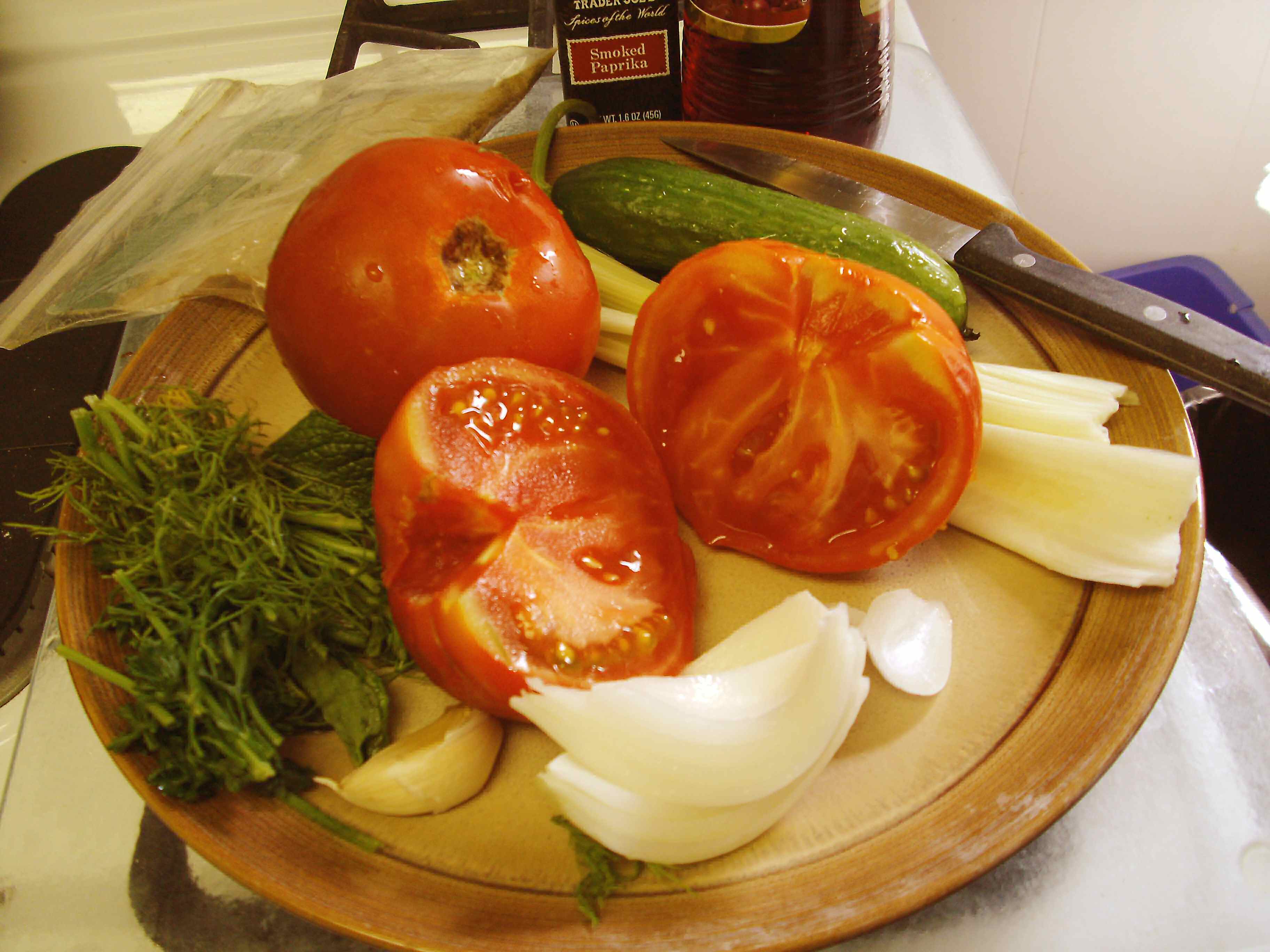
gazpachoingredients

My gazpacho has some extra ingredients like herbs and chile flakes–but nothing from the medicine cabinet!

So okay, five or six posts in a row–all summer long, in fact–with no recipes. Oy. I’m sure that says something about my summer between my daughter’s bat mitzvah in late June and the day she started back to school.

Contrary to the impression of no cooking, no cooking, especially in 100 degree heat (a sane approach to life if ever there were one) I have actually done some cooking, just not a lot of new dishes. So this post is just to catch up in summary form…

The bat mitzvah Saturday night dance party for instance–I made the cake for it, a huge monster of a Sacher torte. And yes, it was Duncan Hines devil’s food cake made with applesauce instead of oil for the layers, because it’s still better than from scratch, and a lot faster. None of my friends cook at all, I’m sorry to discover, and they were all bizarrely impressed that I didn’t get my cake from Costco, so despite how dismayed and embarrassed I was that they were fawning over a box mix cake, I took it as graciously as I could and didn’t tell them. It was actually a good cake, but huge. Four, count ’em four, boxes worth of DH for a very large 4-layer cake. Way too much. Apricot fruit spread between layers, killer chocolate ganache–from scratch, but easy–on top (another post will be dedicated to the shocking true story of ganache and its many creative uses, but it’ll have to wait until it cools down out here), plus a little creative decorating with strawberries and grapes by two friends when the upper layer split on the way to the forum, right before I could frost it, and I didn’t have the brains to just flip the whole thing over.

You know how that goes: you’ve rushed over to get there before the guests arrive, you’re wearing your grubbiest can-get-chocolate-frosting-on-and-no-one-notices black teeshirt and brown pants, you’ve forgotten your party clothes and your camera. Your friends see you looking harried and sweaty in the back kitchen, wielding a tub of ganache at a cracked cake and the chocolate fumes just get to them. They rush around sticking fruit on top like it’s kindergarten craft time again. They’re hard to stop once they get going, to tell you the truth. People really liked the cake anyway, and we had leftovers for the next 10 DAYS…still working it off.

TIP: don’t stick green grapes on top of chocolate ganache, they really don’t go all that well tastewise even if they looked fun at the time.

What else in the way of summer cooking? A bowl of dough in the fridge, turned into pitas and calzones (once the sun went down far enough that I could stand to turn the oven on for 20 minutes at a hop). Did that several times.

Frittatas–omelets for the three of us with mushrooms, onions, marinated artichoke hearts and feta, or spinach and feta, or just feta and feta…a lot of those, this summer, with about half the yolks removed and not missed at all. Makes a 10-minute supper, and you get your Julia Child mojo on when you go to flip it. You get to tell everybody to give you some room and keep the cat out of egg flippin’ range. Very impressive.

What else? Hummus–yet again, I know. Although I’ve made two batches this summer using chickpea flour instead of actual cooked chickpeas. Chickpea flour is raw, so you have to mix it up with water to a thick batter and then microwave it a couple of minutes, until it’s cooked through–it’ll be pretty thick, maybe even solid, but it’ll have lost the raw-bean taste when it’s done. Then I blended it in a food processor with water, garlic, lemon juice, cumin and tehina–which was fine, actually, and very smooth…until I packed it into the fridge and took it out the next day. It had set up like tofu, sliceable and slightly gelatinous! A little weird, no doubt about it. But still edible! and quick, dammit, very quick.

Other things–eggplant parmigiana, twice or three times, and really good. No apologies necessary.

Extra eggplant slices with a surprisingly good low-sodium chipotle salsa from Trader Joe’s and some low-fat mozzarella, microwaved and slid onto toasted ciabatta or fingerbread. Worth doing again, maybe even in casserole form–half salsa, half marinara, kind of a smoky parmigiana? Could be all right.

But it’s summer, you say. Where is all the fruit? You’re not wrong. Nectarines, plums of all shapes and colors, a few apricots, a few cherries, strawberries, and figs…all of them, eaten raw. But in the way of cooking (minimally, anyhow) I made a fantastic “raw blueberry pie” a week ago, cutting back a little on the sugar in the recipe I had from the San Jose Mercury News from years back, and using the microwave to cook the “jam” part (water, potato or cornstarch, sugar, 1 cup of blueberries, stirring madly every 30 seconds to avoid the starch turning into a rubber lump, and lime juice after the fact, once it thickened) before mixing in the other 3-4 cups of blueberries raw and sticking the whole thing in a graham cracker crust and chilling it.

But summer is mostly about tomatoes. Even in California, it is really, really HARD to get good tomatoes at the supermarkets, even in summertime (don’t even ask about corn, the prices are a disgrace to the nation). Unless you go to the Armenian corner grocery (where I’m headed yet again in about 5 minutes) to pick up bags and bags of huge, ripe Fresno tomatoes for salads. For about six or seven dollars, I can get ten or even more large beefsteak-style tomatoes…and these actually taste like something. They’re not the ones that go to the supermarket, because they just don’t last. They go to the small ethnic markets because they’re too ripe, and everyone knows that the regulars don’t shop small when it comes to tomatoes, peppers, eggplant and so on. They’ll get snatched up, no problem.

So what do you do when you get a couple of tomatoes that were pretty seriously ripe to begin with and are starting to split or get poked by the stems of the other tomatoes only a couple of days later?

I make gazpacho, because it’s a 5-second soup, it’s cold, it only takes what I have in the fridge, and I know I can eat half a cup at lunch every day this coming week and feel full for hours, especially in this heat. It’s the perfect diet food.

Well that, plus the fact that it makes me feel (momentarily, anyhow) like Carmen Maura in Women on the Verge of a Nervous Breakdown. It’s probably the most famous (mis-)use of gazpacho at the movies, and very funny. Continue reading

Movie Review: Family, fermented

The New York Times has a review today of a new French film in current release, You Will Be My Son, about an egotistical master vintner in Burgundy and the son whose winemaking instincts he scorns.

I’m thrilled this is going to be in theaters in the U.S., because I saw it last June on the plane home from Montreal, in French, and it was so well acted I thought the airline must have made a mistake–you know, putting in a good movie by accident instead of Alvin and the Chipmunks, various cheap CGI-driven “futuristic thrillers”, all the stuff that went straight to DVD and that you don’t really want to pay Netflix or Blockbuster an additional 5 bucks to see.

Much along those conventional lines, and starkly in contrast to You Will Be My Son, is a wine movie I highly recommend–skipping, that is, and which I also saw on a plane back from London several years ago. Believe me when I say that if Bottle Shock was the “hidden gem” of the selection as the in-flight magazine claimed, the rest of the movies available must have been just unwatchable.

Bottle Shock was supposed to be based on Judgment of Paris, George Taber’s nonfictional account of an upset between Californian and French premium wines in a 1976 blind tasting, but came out looking more like “Daisy Duke Does Napa”. With Alan Rickman thrown in (age 57ish then, and eating KFC onscreen, incompetently) in the role of the 29-year-old wine buff who set up the competition. And the late Dennis Farina, in a pink ascot, substituting for the wine buff’s 30-year-old female business partner. And Sam Rockwell’s ’70s longhair wig was like a bad toupee gone wild.

OK, do go find a clip or so of Bottle Shock (or is it Bottle Schlock?)  for those times when you’re punchy and want something that will give you that entertaining “clawing my eyes out” sense of superiority over an unbelievably putrid movie. With big-name movie stars ™.

No, really, don’t do it. Don’t do it. See You Will Be My Son instead. Part family drama, a little bit thrillerish, twisted and fascinating without any of the American movie must-have cliches, it will keep you on the hook long after you’ve left the theater. And the actors are subtle, intelligent, individual and believable. The whole thing is gripping and so different from the current insipid-explosive American style you’ll want to go raid the library for better-made oldies like All the President’s Men and The Manchurian Candidate.

Only one sour note: Skip the New York Times review itself. In his attempt at selling the appeal, which he didn’t really need to do, the reviewer stuck in a lot of the plot details, to the point where I feel the need for a spoiler alert. You Will Be My Son doesn’t need all that–it’s solidly made and it works well from the beginning. Go see it.

New York big-soda ban, long overdue

All the food behavioral experts on both coasts seem to be whining that New York City’s new ban on oversized sodas “won’t work”. Well, all the experts in New York and LA. Even Michelle Obama has backed off delicately from taking a position on it. Oy. People!

The Washington Post‘s columnists Ruth Marcus and Alexandra Petri have two different takes–one more serious but employing Yiddish to describe the psychology of the whole protest, the second, despite lack of Yiddish, funnier about people who insist on their right to drink a whole tubful of soda at a go. So I’m going to take the middle road–oh, screw it, I’m going to use Yiddish if I feel like it and still be hilarious despite my gravitas. Because it really is hilarious. If only it weren’t so sad.

Jon Stewart is quoted as kvetching that Mayor Bloomberg’s proposed ban is the only thing that can make him agree with conservatives. David Just, partner expert to Brian Wansink, says people “want” their big drinks and will surely just find a way to work around the restrictions.

Well, maybe a few will really want 20+ ounces of soda at a sitting badly enough to go back to the concession stands and wait in line three times to get 3 separate drinks of 8 ounces or so. Or juggle 3 small bottles back to wherever they’re drinking it all. But I’m betting most people won’t.

Why do people supposedly “want” such huge drinks in the first place? The oversized Big Gulp-style cups were a marketing ploy that started about 15-20 years ago at the burger franchises and the 7-Elevens. They were supposed to look like a huge bargain–for an extra however many cents, they’d double the amount of soda they gave you. What a deal! And the ploy worked–created a habit.

Most people don’t really need or even want that much soda, but as many of my coworkers–women especially–used to say, shrugging helplessly, “Well, I don’t really want this much, but this is the only size they sell.” And you really can’t split a 20-ounce with ice back at the office unless you have cups. Everyone will wonder whether you got tempted on the way back and started sipping from it. Eeeewww. You can’t save it in the fridge for later either because it goes flat pretty quickly.

The soda companies got the concessions for school cafeterias–why not brand the captive audience early–in exchange for money the schools have lost from their cities and states anytime those governments wanted to hand out tax relief to corporations–like soda bottling plants. A different version of “eat local”.

By now, people are so used to the soda bloat they’ve started to decide it’s their right to drink bigger than their stomachs–or bladders–can handle. And it is–you’re allowed to be stupid if you want to.  Only problem is, did the soda companies also offer to build more bathrooms to handle the outflow?

So I say Mayor Bloomberg, who’s in charge of the biggest city in America, is doing his city a huge favor by trying to get the soda industry’s claws back out of them. There’s no way the industry will scale back its sizes voluntarily, especially not if they can get experts like David Just to voice their incredible “the-consumer’s-the-one-who-wants-the-elephant-sized-drinks-we’re-just-providing-it-for-them” act.

When you get the big gulp-style Coke, how much of it are you really tasting? Maybe the first third of it? Maybe less. After that, are you drinking it while reading your computer screen? Driving? Watching tv or a movie? Would you really want someone to film–and then post on YouTube–footage of you slurping mindlessly throughout the day?

If you’re not paying attention to what you drink, is it worth drinking just because it’s there? Same for eating. And David Just and Brian Wansink–weren’t these the guys who did all that people-eat-30-percent-more-when-parked-in-front-of-a-tv-screen-than-at-the-table research? I do believe they were.

So getting back to a small Coke that you’ll actually pay enough attention to to taste? That might be worthwhile. Then you can think about what you’re tasting and decide if it’s good enough to keep drinking. Or whether, like me, you’d rather wait until next Passover, when Coke and other big soda manufacturers put out limited editions made with cane sugar instead of corn syrup.

I haven’t been a big soda drinker for years, and I usually don’t miss it at all. It was astoundingly easy to give up, and my teeth have thanked me ever since. On the rare occasion when I have a little at a party, my preferred soda is and always was definitely root beer or ginger ale, not cola, and usually I can only take about half a glass–it’s all way too sweet, even with ice. So I’m not the right person to sympathize with habitual soda drinkers–I just can’t get into it, and diet is gross.

But having tasted the sugar version of both Coke and Pepsi, I can say the difference it makes to both versions is amazing–much cleaner flavor, and a little is enough to be happy with it.

Meanwhile, a better idea would be to drink water instead of the big-3 flavors and save your shekels for small niche sodas with better, realer, more interesting flavors as an occasional treat.

Case in point: a summer soda tasting event in Los Angeles to raise money to reopen exhibitions from the shuttered Southwest Museum in Highland Park. The Southwest museum had wonderful Native American collections–kachinas, headdresses, Bakelite jewelry of the 1930s, photos, and much more. It was taken over by the Autry Museum a couple of years ago, but has remained dormant since then with a lot of its collections in storage and out of the public eye. I was fortunate enough to have taken my husband and daughter there about 10 years ago, before it closed.

Galco’s Soda Pop Stop, an independent soda market run by curator John Nese in Highland Park, is hosting the soda tasting–his second–with something like 500 different small brands, including plenty of nostalgia brands (though no NeHi Grape–don’t know if they’re still around) and imports.

According to a profile of Nese in The Quarterly Magazine, Galco’s motto is “Freedom of Choice”, with flavors like coffee, bananas, spruce, cucumber, mint julep, and many others–check out their huge soda list, which includes ingredients, prices and bottle sizes! Amazing. Maybe that’s the kind of freedom soda fans should be going for. Amazingly enough, most of these flavors don’t come in 20-ounce monstrosities, or even in plastic.

If you’re in Los Angeles on July 22, check it out–tickets are only $12 in advance, $15 the day of the event, and you can get them at Galco’s on York Blvd. or through the Friends of the Southwest Museum web site.

American Grown (Groan?)

I have mixed feelings about Michelle Obama’s forthcoming book, American Grown, which the Barnes & Noble web site describes as:

Now, in her first-ever book, American Grown, Mrs. Obama invites you inside the White House Kitchen Garden and shares its inspiring story, from the first planting to the latest harvest… Learn about her struggles and her joys as lettuce, corn, tomatoes, collards and kale, sweet potatoes and rhubarb flourished in the freshly tilled soil.  Get an unprecedented behind-the-scenes look at every season of the garden’s growth…  Try the unique recipes created by top White House chefs…  [read about a community] garden that devotes its entire harvest to those less fortunate, and other stories of communities that are transforming the lives and health of their citizens. With American Grown, Mrs. Obama tells the story of the White House Kitchen Garden, celebrates the bounty of our nation, and reminds us all of what we can grow together.

The book is due out –well, now, really, the end of May. But I’ll tell the truth here: I hate this description and I’m sorry she wrote the book just from the blurb. Really, this is the best they could do? It’s so colorless. It sounds like a bland, give-the-wife-a-project kind of capitulation written by the official White House handlers.

What I find most disheartening about the beige, friendly-sounding jacket blurb is the “About the Author” section, in which Obama is described as the First Lady of the United States and a mother of two daughters, and that in 2010 she started the Let’s Move program. These are all good things, and she’s done a lot with the program. But nowhere does it mention her career–now on hold for at least four years–as a lawyer, and a good one.

In terms of public relations, Obama has conducted her Let’s Move program more successfully than Hillary Clinton, who was also a skilled and high-power attorney, handled a much-embattled health care expansion plan in her eight years as First Lady. Clinton is thorny and opinionated and direct, and is only now learning to keep her moves as Secretary of State quiet rather than telegraphing all her punches–but she’s achieving a lot. Obama is a lot smoother and more immediately likeable–something the rightwingers got wrong from the start–and she’s full of common sense, people sense, and I keep hoping for big wins from her.

Obama’s charismatic and not easily ruffled, and she’s a fashion icon–you could see the newspapers focusing on that since it’s so much easier and picturable than a career full of sitdown negotiations with House Republicans and stacks of paper and emails. But both women have been in the awkward position of First Lady, competent people sidelined for significant numbers of years by their husbands’ presidencies, hemmed in by the public expectation that they’ll shrink themselves into June Cleaver-like roles.

The Lady Bountiful bit is homey, patriotic, old-fashioned and charming. But it’s also hideously condescending and weird as hell that in this day and age it’s seen as acceptable to shove a professional out of work and relegate her to homemaking, even if it’s on such a grand scale. Home gardening is what you do on your day off, when you’re out of work or retired. Even if you enjoy it and are great at it, which I’m not. The fact that I got no tomatoes until January this year says a few things. If we had to depend on what I can grow successfully, we’d starve.

So what I say is, if you’re gonna go First Lady, go big. For the press release, why not do it more like the blockbuster movie radio voiceovers?

[pulsing dark synth strains, standard gravelly yet unctuous baritone voiceover]

“IN A WORLD…where everything has stopped growing except the American waistline…comes a heroine for our times. Once a high-power attorney, now down on her luck and forced to smile at hostile crowds who want her husband to say something–anything–definite about the economy, Michelle Obama IS… The First Lady.

[patriotic/threatening military march starts to swell with a roll of the tympani]

With NOTHING MORE than a trowel, a packet of seeds, a groundskeeping staff of at least twenty, a fully-trained yet cooperative head chef and a large, green lawn, Michelle Obama is TAKING ON …. Corporate America. You’d better HOPE …

[tympani going crazy à la “2001: A Space Odyssey”]

…she WINS.”

See you at the movies!

Too big to fail? Too good to pay taxes?

Source: Library of Congress

Every so often I review books and movies on Slow Food Fast, but as of yesterday, I’ve dropped my affiliate links to Amazon.com. In the past few weeks they’ve decided to fight tooth and nail not to pay sales tax like everybody else and support the states where they sell. First they cut off any Californians who had joined their affiliate seller program, which is annoying and kind of insulting. Not that I’d been getting anything much out of it, but I’ve also been a customer for years.

They’re even lobbying right now to add a ballot measure reversing California sales tax law for internet businesses. Their excuse is that they’ve built their empire on a tiny profit margin and paying sales tax will ruin the penny-seller pyramid. At the same time, they seem to believe they’ve got favored trading status and that any minor threat to their current model can be countered by threatening to withdraw their hiring. Forget that.

I live in a state that’s bent over backwards to court big business and internet retailers, given them all kinds of tax incentives and concessions for years so they wouldn’t move to Nevada or Delaware, and as a result has been absolutely gutted budgetwise. California takes in about a quarter of the nation’s new immigrants each year, has higher unemployment figures than most of the country, LA County alone has more than 300,000 women and toddlers enrolled in the not-very-generous WIC program,  and basic services are being cut right and left to meet the state’s budget deficit. The poor–and that’s starting to include more of the middle class here too–are paying for Amazon.com’s free ride.

And yet Californians represent one of Amazon.com’s biggest markets.

Even the (now former) California affiliates are thinking Amazon should be ponying up like the rest of us. If you sell here, you should be paying sales tax here.

And our sales taxes have finally gone down recently. For years they were up to 9.75 percent. Two days ago I bought a pair of jeans and was shocked–8.75 percent. Apparently that’s dropping further into the 7 percent range for online purchases.

But Amazon’s looking to sue, as they did (and lost at trial) in New York.

Where can you get the books I recommend on this site? Alibris pays sales tax in California, and I’d recommend them.

Or, if you’re in Southern California, head to Vroman’s in Pasadena. Not only is Vroman’s a century-old independent bookstore, both branches are well stocked for hip, academic and traditional booklovers. And the staff are personable, they do lots of readings events, have a huge cooking section, and do online orders if you need something special. The bigger branch on Oak Knoll has a nice café as well.

“The Trip”: supposedly about the food?

Steve Coogan and Rob Brydon have paired up again in a new movie called The Trip  and I actually got to see it in an actual movie theater Thursday! First time I’ve been in a theater since Ratatouille came out. (Hadn’t realized that was going to be a foodie movie; at the time I just wondered why they didn’t make good movies like that for grownups anymore.)

I was going to see The Trip anyway because I’d seen Tristram Shandy several years ago on disk and got bitten by Coogan and Brydon’s backstage banter. I was looking forward to seeing how the pair,  who had played exaggerated versions of themselves in the first movie, were planning to stretch their dueling Robert deNiro and Al Pacino impressions from the end credits of Tristram Shandy–by far the best shtick in the whole thing–to a two-hour buddy road trip format.

And The Trip was also supposed to be about food–specifically, the current state of northern England’s upscale eateries (now apparently as haute as anywhere on the continent) and the shockingly savage and comical food reviewing traditions of British news media.

So I dragged my husband with me to the matinee and promptly started disregarding the “please, no talking during the film” signs. What fun is it to sit there not giggling horribly as Coogan and Brydon get on the road north to Yorkshire, or saying nothing to my mate as they try to correct each other’s Michael Caine impressions and improve on them in increasingly loud voices while being served all manner of square food on long rectangular plates lapped with flavored foams à la Adrià? With the inevitable scallops for starters, and a number of historical interludes–a sleep in one of Coleridge’s beds, visiting the church ruins in a town where Ian McKellan did not actually grow up, but it’s got the same name, so it counts?

The truth is, of course, that The Trip is much less about food (despite several spliced-in foodie snippets of what’s going on in the kitchens and pans where tasting menus are being prepared) than about love, loss, what’s left to look forward to in one’s encroaching middle-40s, and how to impress girls with your Michael Caine (or Al Pacino) impressions at a 3-star restaurant in the Yorkshire dales or the Lake District.

Of course, the sixth or seventh rendition of Michael Caine (interspersed with Pacino and friends) starts to wear even on our intrepid actors-almost-playing-themselves as they grapple with the hearts they refuse to admit are pinned to their sleeves. It turns out there’s a solid reason for this: Continue reading

Prunes, Lentils, and “Cookin’ Cheap”

When I was a kid, PBS, which had made a gourmet name for itself with The French Chef, decided that if one chef was good, six or seven had to be better. Suddenly the public and cable airwaves were  bursting with the Frugal Gourmet, the Galloping Gourmet, Yan Can Cook, Cookin’ Cajun, various shows with Pierre Franey and Jacques Pépin, and one…ummm…less glamorous show called Cookin’ Cheap.

This was hosted by Larry Bly and Earl “Laban” Johnson, Jr. out of Roanoke, VA–-not too far from where I grew up–and featured two viewer-submitted recipes per episode, which the guys bravely cooked and sampled on the air. At the end of each show, just like Julia Child, they sat down at the table for the tasting… and decided whose recipe had come off worse.

Now, Cookin’ Cheap was not for tenderfoots–if you couldn’t handle ingredient lists that included whole sticks of margarine and self-rising flour, or bring yourself to shop in one of the ordinary supermarket chains that had never heard of organic anything (this was the South in the ’80s), you would have done better not to watch. But if down-home cooking delivered with a touch of schadenfreude was your thing, it was a great little show.

Unfortunately, my favorite early episode doesn’t seem to be available anywhere on the ‘net. But the clip above, the Cookin’ Cheap 2.0 (YouTube) version of about a third of Episode #609, will give you some idea. (see copyright disclaimer below…)

In my actual favorite episode, Bly and Johnson hit their personal limit with a recipe that had them both making faces and apologizing to the audience that “there’s cheap… and then there’s too cheap.”

The dish in question was “Lentils ‘n’ Prunes” (you can guess the entire ingredient list). And it was indeed cheap. Unfortunately lentils, though incredibly cheap and nutritious, cook up kind of gray, especially on a semi-rural public TV station with early-’80s (i.e., yellow-ocher) set lighting. Trust me when I say the addition of mashed prunes did nothing for them aesthetically or otherwise. How on earth could they have put this on the air?

Of course, these guys didn’t have to take the blame for the recipe, and it was great entertainment to see some of the strange things your neighbors might be cooking at home and writing in to the show about with high hopes of being selected. I understand the Food Network is now copying Bly and Johnson’s reality-cooking formula shamelessly for the fall lineup…

[Actually, I didn’t realize the show had such a good run, but it started locally in 1981 and only ended its nationally syndicated run in 2002. Johnson passed away a few years before the end, but he managed to publish the Cookin’ Cheap Cookbook in 1988. Bly kept the show going with Johnson’s friend and successor Doug Patterson and has since made a couple of rescued episodes available on DVD. And the show still has fans on YouTube and — surprisingly just this March–in the New York Times.

Disclaimer: YouTube removed the first clip I linked to for copyright violation–so my apologies to Bly; the intent in linking here isn’t to rip anyone off but to highlight a too-little-known show. Because the original Roanoke station managers were too shortsighted to save the episodes (they apparently trashed them!), Bly was only able to rescue a couple of episodes for the DVD, and I think some of the others posted at this point were recorded at home from TV.]

Ah, well. Times change, horizons broaden, and we aim to challenge our palates in a sophisticated world beat kind of way even with limited cash and ingredients. The wolf may be at the door, we may be on the rice and beans yet again to make up for unreimbursed conference travel, but we are determined to do it in style–that means Indian, Moroccan, Mediterranean–French? Well, at least by not mixing plain lentils and prunes together in a hideous gray mash.

…I’m not actually sure how the French feel about lentils with prunes, or what they’d do about it if you suggested it. But I have a huge bowl of cooked lentils to deal with from a 1-lb. bag at $1.29. And a 1-lb. bag of non-sorbate pitted prunes at $2.99. Less than $5 total. And a number of ideas about how to deal with each of them, separately or together. Enough ideas that I’m probably going to have to split this post so it doesn’t turn into War and Prunes.

This, I think, is going to become my How to Cook a Wolf Challenge, 21st Century Edition.

Because I have fantasies (not many, and relatively tame though entertaining) of the Iron Chef America and Top Chef hosts announcing, for the next quickfire competition, a challenge to find three or four good ways to combine lentils and prunes in dishes where they’re the main ingredients and for which the total bill for the tasting menu comes to something like $10, including spices (prorated as used…) Can’t you just see the contestants’ faces? Take a moment to enjoy their obvious panic. The restaurant industry hasn’t trained them for this.

But seriously. What was actually behind this Cookin’ Cheap dealbreaker, other than the obvious frugality factor plus the even more obvious digestive humor that follows prunes and lentils wherever they roam?

Is there any way on earth that prunes and lentils could really go together?

Well…yes, as a matter of fact. You don’t run across prune and lentil recipes everyday, but good-tasting and intriguing variations, or at least the components of them, exist in a number of respected cuisines around the globe. Even French. For very little more than it cost the Cookin’ Cheap guys, Continue reading

I have GOT to see this

Kings of Pastry

Kings of Pastry

“Kings of Pastry”, a new documentary about the Meilleurs Oeuvriers de France competition by D.A. Pennebaker (Bob Dylan documentary “Don’t Look Back”) and Chris Hegedus (“The War Room”). Unfortunately I missed it last night at the LA Film Festival–what can you do?

See the trailer–looks like a good time.