
• Enter your email address to subscribe to this blog and receive notifications of new posts by email.

    Join 241 other subscribers
  • Noshing on

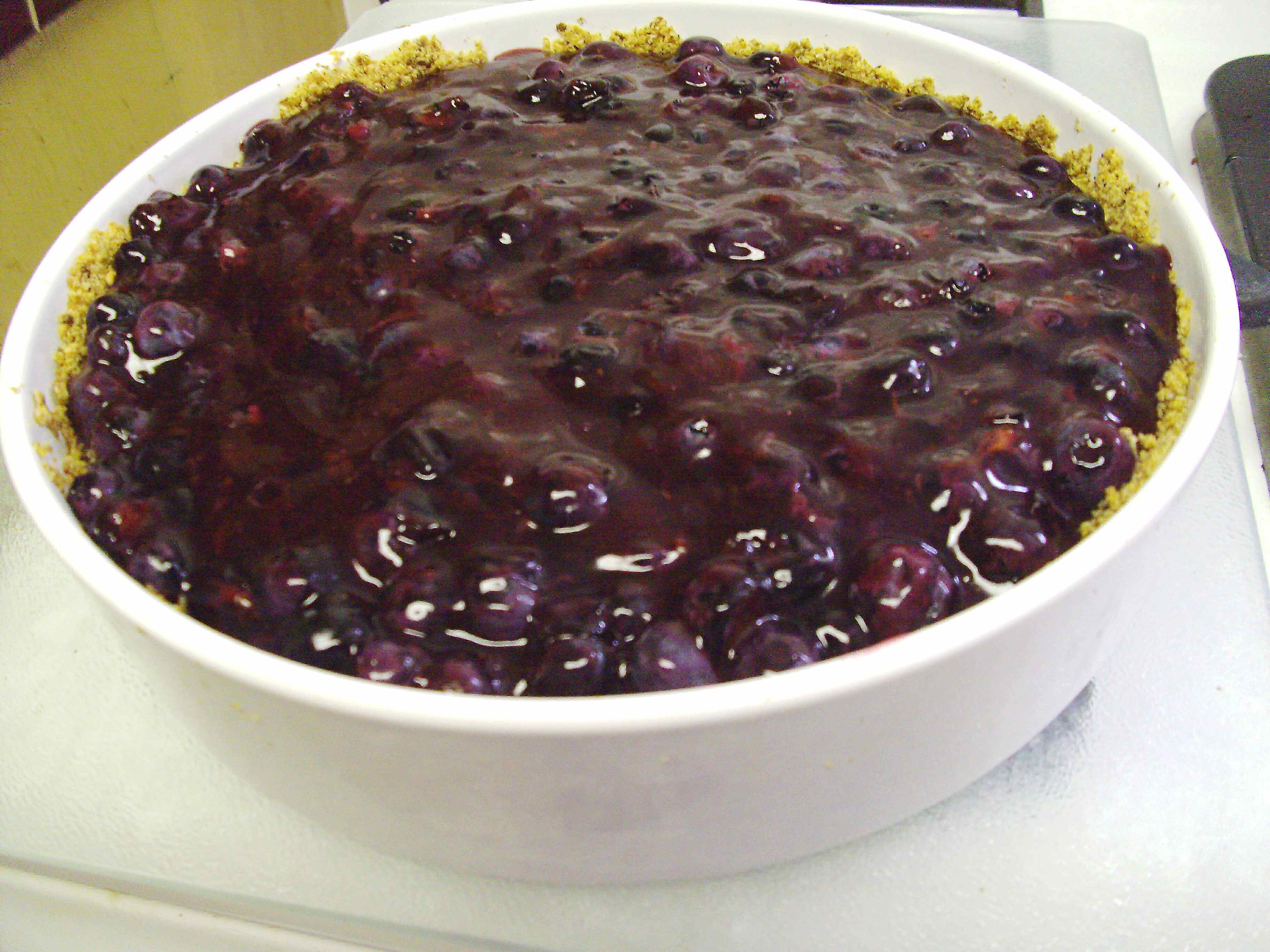
    raw blueberry pie with microwaveable filling and graham cracker crust

    This mostly-raw blueberry pie is a snap to make and very versatile--the filling microwaves in a few minutes, and you don't even have to bake the zippy gingered graham cracker crust--perfect for a hot Fourth of July and all summer long.

  • Recent Posts

  • Contents

  • Archives

  • Now Reading

  • See also my Book Reviews

  • Copyright 2008-2024Slow Food Fast. All writing and images on this blog unless otherwise attributed or set in quotes are the sole property of Slow Food Fast. Please contact DebbieN via the comments form for permissions before reprinting or reproducing any of the material on this blog.

  • ADS AND AFFILIATE LINKS

  • I may post affiliate links to books and movies that I personally review and recommend. Currently I favor Alibris and Vroman's, our terrific and venerable (now past the century mark!) independent bookstore in Pasadena. Or go to your local library--and make sure to support them with actual donations, not just overdue fines (ahem!), because your state probably has cut their budget and hours. Again.

  • In keeping with the disclaimer below, I DO NOT endorse, profit from, or recommend any medications, health treatments, commercial diet plans, supplements or any other such products.

  • DISCLAIMER

  • SlowFoodFast sometimes addresses general public health topics related to nutrition, heart disease, blood pressure, and diabetes. Because this is a blog with a personal point of view, my health and food politics entries often include my opinions on the trends I see, and I try to be as blatant as possible about that. None of these articles should be construed as specific medical advice for an individual case. I do try to keep to findings from well-vetted research sources and large, well-controlled studies, and I try not to sensationalize the science (though if they actually come up with a real cure for Type I diabetes in the next couple of years, I'm gonna be dancing in the streets with a hat that would put Carmen Miranda to shame. Consider yourself warned).

Emergency eclairs

Note: this is not my photo–I have not been to the balcony of Notre Dame lately. I merely share their dismay. [Source: Brittanica Online, with gentle modifications for parody purposes]

You may be wondering what to do if you drop half your éclair over the balcony of the Eiffel Tower, or worse yet, Notre Dame, while pondering your options for the afternoon’s conquest…YSL first, or peut-être Dior?…ooh-la-la-oops!

AAAAAGGGGHHHH!

Screaming will not get your éclair back, though it is a good start. You need to get down to ground level and purchase another tout de suite!

No, this is not really me channeling Miss Piggy at her “Who, Moi?” finest. I don’t have the lavender satin opera-length gloves for it, for one thing. I’ve just been watching too many of the various Muppet movies with my daughter lately.

Plus, and let’s be honest about it, the one time I ever tried on a long blonde wig (for a college skit), I took one look in the mirror and fell down on the costume department floor laughing until my ribs hurt. It was 20 minutes until I could breathe again. Picture Danny deVito (his eyebrows, anyway) peering out from under that wig, hoping to stand in for La Porcette,  and you understand why Frank Oz can never, ever go on vacation.

I have not been to Paris in seven years, and when we were there (for an engineering conference, with our then-kindergartner) we did not actually eat any éclairs. We also did not shop at Pierre Hermé, nor at Hermès, nor anyplace that wasn’t either a museum, an RER or métro stop,  a café or a tchotchke booth along the Seine. Other than for food, if it cost more than 15 bucks (or 11 euros, as for example, the tiny 3-inch-long stuffed unicorn at the Musée du Moyen Age, which we paid for hastily during a shall-we-say-jetlag-inspired meltdown), it was out of the question. I actually spent two full hours–ON VACATION IN PARIS–sitting forlornly in a coin-op laundromat down the alley from our hotel, hoping I had enough change to get all the horrible perfumed detergent back out of our clothes, while my husband and daughter went to the park. Not exactly the Paris experience I’d imagined way back in my high school French class.

So what am I doing imagining that I could climb up OR down the Eiffel Tower in chic heels (instead of the more believable sneakers and backpack with the entire belongings of my family plus bandaids and extra sandwiches…), waving an éclair around with incredible nonchalance and somehow not lose it (which I’ve never actually done; I’m a fervent believer in pastry) or break an ankle (which I have actually done, wearing flats), or both, with loads of people looking on?

Who knows–daydreams like these are the kind of thing mentioning Paris does to one when one blogs about food or fashion. Practically obligatory. It’s fun to imagine a life where such trivial matters can leaven, not to say inflate, my expectations. And, of course, where I’m not the one who has to schlep all the emergency supplies up however many flights of stairs. And back down.

Let’s face it, I’m a natural pessimist and (therefore) fan of both the Muppets and Matt Groening. Tell me true, now, doesn’t the gargoyle on the right look like the original inspiration for that sad shrimpy one-horned character in Life is Hell? He’s even wearing my backpack.

Real life is hard, gritty for more serious reasons than high-heeled éclair mishaps, and it’s filled with nagging of the now-ex-7th-grader. Ahem! These are things we just have to get through because there’s no great alternative (…yet. I’m working on it, believe me.)

Eclairs, on the other hand, are not actually difficult to make. And eating them makes one feel a lot less like life is hell, particularly if one skips the high heels and eats them barefoot.

And on the other other hand, baking anything in Los Angeles, even in winter, may well make one feel that one is actually living in hell, at least while the oven’s on. And right now it’s June.

How to cope? Toaster oven? Microwave?! The eagle squawking in shock above left may not approve of my methods, but he’d find it hard to argue with the results. Especially if you’re in the mood for just a couple of éclairs Right Now, and you have ice cream on hand so you can skip the custard chilling and filling bit and go right to profiterole heaven.

The pastry for éclairs, called pâte à choux, or choux paste (shoe paste! I knew there was a connection to the sudden appearance of high heels in my daydream), takes only a couple of ingredients: flour, water, butter, sugar, eggs. Maybe a pinch of salt too, okay.

Everyone and their uncle (or aunt) who’s ever written a Frenchy kind of cookbook has a recipe for éclairs, but who do you know anymore who’s ever actually made them? Right.

But actually, they’re pretty easy to make. At least as easy as brownies from a mix, and they seem fancier. You boil the butter, sugar and salt with the water, dump in the flour and stir until it looks like stiff mashed potatoes, then take it off the heat and beat in the eggs one at a time and voilà, there you have the dough–shiny yellow stuff to pipe out or dollop out onto a greased and floured baking pan and bake at high temperature for about 30 minutes until they’re really puffed and brown and don’t collapse anymore when you let them cool.

David Lebovitz has the classic recipe on his web site — a cup each of flour and water, 6 T butter, 2 t sugar, 1/2 t salt, and 4 large eggs. Pierre Hermé of exotically-flavored-macaron fame has a richer one with more butter and 6 eggs for the same amount of flour. And I’m sure they’re wonderful. But I can’t help messing around.

First off, I want fewer than 24 éclairs–what do you do with the rest of the dough? (turns out you can pipe it and freeze it, then bake straight from frozen sometime later, or else freeze the baked shells. OK. But still.) So I cut David’s basic proportions in half. Limit the damage to the avoirdupois, I always say. Fewer situps required.

Second, the butter. I know éclairs are the ultimate Unalterable Classic French Recipe but…here starteth the messing around. Like I say, I can’t help it. Continue reading

Little Green Footballs

…and Other Lessons from the Fillo Stratum

cheese and pesto triangles

Two or three weeks ago I got a frantic email from the assistant at my daughter’s Hebrew school: could I lead a cooking session for the 8th graders for an hour that Sunday?

Teens and preteens are not my specialty–I have a friend who’s really terrific with them; she’s an 8th grade and high school teacher and would rather deal with kids than write. I’m the other way around, and my own kid’s turning 13 very soon. Very soon.

Suffice it to say, my answer probably should have been, “Who me? Are you off your nut? Cook with preteens in only an hour?”

And then I thought–but wait. Fillo. It’s inexpensive (a big plus), it’s  easy enough to fold, it’s almost (if you squint) kind of a craft.  Like origami. Make some tasty and quick fillings for it (though no nuts–schools have gotten annoyingly leary of anything with nuts. How are you supposed to teach baklava? Eh? Eh???) and let the kids go to town, a couple of sheets of fillo apiece in the synagogue kitchen. An hour should do it, and it’s a cool, sophisticated food to know how to make–very different from the standard summer camp challah with blue or green food coloring.

So…I bought a couple of packets of fillo (about $2.69 for a roll of 20-24 sheets), a couple of pounds of loose-frozen spinach, an onion, some garlic, a bottle of olive oil and another bottle of canola oil (for the sweet fillings), a packet of dried apricots, a packet of dried figs, some farmer cheese (mistake, doesn’t taste that good; stick with ricotta) and some feta. And some dill and scallions I had at home. Also a lemon or two. I left the fillo in the fridge overnight to thaw slowly the way you’re supposed to, and not the way I usually do (i.e., take the thing out of the wrapper and let it sit an hour on the counter and then wonder why it cracks when I rush to unroll it).

I made the fillings the Sunday morning in a microwaver’s frenzy of immense efficiency:

  1.  Nuke a stick of unsalted butter in a bowl, pour it into a snaplock container.
  2. Thaw the spinach on a plate–4 minutes on HIGH. Take it out.
  3. Dump the dried apricots in a bowl with water to cover and a saucer on top–3 minutes. Meanwhile, start squeezing the spinach dry, and I mean dry, in handfuls over the sink. Nothing worse than soggy spanakopita. Except maybe soggy pizza.
  4. Take the apricots out, put in the bowl of figs with the stems cut off, some water and a lid, 3 minutes for them.
  5. Blend the apricots with a little sugar and water and lemon juice to make a thick paste. Get it out of the food processor and pack it in a disposable container with a lid.
  6. Do the same thing for the figs, only no sugar necessary.
  7. Rinse out the food processor, stick the scallions, wild thyme, fresh dill and basil in and chop them fine, drop in the spinach, a fat clove of minced garlic, and the feta. Pack that too.
  8. Grab all the bags with the goods and don’t forget the oils and the butter and the fillings and the extra feta and farmer’s cheese just in case there’s time to make some cheese-only filling there and somebody wants it. …

I hustled, I got to the synagogue kitchen on time, I set up stations around a stainless steel work table–foil sheets at each place, paper bowls with a dab of melted butter and a pour of oil, plastic baggies to go over everyone’s hands instead of pastry brushes, the carefully unrolled fillo under plastic wrap. The oven–on. The fillings–ready to rock. And then I waited. And waited.

An hour really would have been enough time for that class. But none of the kids showed up for the first 20 minutes because it was also the day the photographers were herding all the classes out into the basketball court area for graduation photos. So when they finally straggled in, all eight–and surprisingly, three of them were boys–I made them wash their hands and then set them to work.

The first thing I did was hand out individual sheets of fillo and pointed out that they were nearly as thin and tearable as tissue paper. They were all surprised when they saw it. None of the kids, who’d been cooking all year and who had attended a lot of bar and bat mitzvah celebrations, had seen fillo “in the raw”.

I got them started on spanakopita triangles–also known sometimes as bulemas (Greek root found here; you’ve heard of bulimia, right? Didn’t mention that connection, of course. You would never want to get into that with a batch of preteens. Don’t get too disturbed, though. The rough translation as used in Hebrew is “appetizers” or “things to gobble”. Of course, in Israel “bulmus” is also what they call anything like the American after-Thanksgiving shoppers’ frenzy or otherwise a run on the stock market…so much for appetites gone hog wild…)

I naturally thought fillo triangles would be a cinch for the boys especially–you do it the same way you fold a paper football and try not to get caught in class. Only with a little more butter and olive oil involved, and hopefully no punting in the kitchen, because I wasn’t gonna clean it up for them when the spanakopita went flying.

Here came the second generational surprise, though: none of the kids, not even the boys, had any idea how to fold a basic paper football! They’d never done it. Paper airplane? I asked desperately.  Continue reading

What she said

I’m shocked, shocked I tell you. I’m about to admire and recommend an article by LV Anderson of Slate.com.

Against foodies: Alison Pearlman’s Smart Casual reviewed

Yes. LV Anderson, the Slate columnist/editor of “You’re Doing It Wrong” infamy, the one who so often makes unnecessary, fussy, time-consuming and sometimes even adverse recommendations for how to “fix” some fairly common and popular foods like chili or muffins. Or guacamole. I’ve disrespected quite a number of her columns over the past year or two, and so have many Slate readers.

But her review of local (LAish) professor Alison Pearlman’s new book on the shallowness of foodieism is really good. It’s thoughtful, sharp and thorough without being annoying.

Anderson has clearly been stuck in an awkward niche for a year or more; her cooking tips are not much to write home about but her book review is, so I’m doing it.

More “breathable foods” weirdness

A couple of days ago, Entertainment Tonight posted a new video tidbit on “breathable” food  from the same Harvard professor, David Edwards, who invented the AeroShot “breathable caffeine” cartridge that has drawn some serious FDA attention of the negative sort.

ET’s anchor breathlessly posed the  question, could this become The Next New Diet Fad in Southern California, when what the LeWhaf vaporizer was invented for was the “aesthetic experience” of breathing food flavors. This according to Edwards, whose Paris-based design lab, Le Laboratoire (names aren’t really his thing?) offers a number of vaporized cocktails at a small sit-down bar.

When I wrote about the first set of inventions, I said I thought it might be an interesting molecular gastronomy-style taste experiment (at least if the flavors were something more sophisticated than “lime,” the flavoring in the AeroShot cartridge), depending on what was being used to create and propel the vapor.

The ET video presents an interview with a young up-and-coming chef who’s offering cocktails of various kinds served in the Le Whaf vaporizers–to be inhaled through a special straw. The accompanying visual looks, frankly, like someone about to use a bong or snort a line of coke, but that could just be the way ET’s camera crew are used to shooting bar scenes…

The chef they interviewed doesn’t serve these vaporized cocktails, not all of which are standard drinks in the daily repertoire (some of them look like beef broth) as a low-cal diet offering but rather as a sideline to enhance some other dish. Very molecular gastronomy. Still he concedes, when pushed, that he can’t see how it would have calories.

(From his doubtful expression, they must have edited out the part where the Barbie Doll reporter shoved a mike in his face repeatedly and insisted with desperation that the vapor must make it calorie-free, it just MUST. She’s the one who tried the AeroShot caffeine spritzer on-camera in the studio to demonstrate the concept, and quickly uttered the dutiful “Mmmm”,  but the video jumped at that point, so I wonder if she really sampled it or not. At least she didn’t start coughing…unless they cut that part too…)

And yet I wonder if ET hasn’t hit on something here–no, not the diet fad. One can’t live on pâté-flavored air alone. One must also vaporize some champagne to go with it, preferably Krug. Could possibly clog the nozzles otherwise.

No. In the frenzy to discover the new French technology that magically removes all calories, ET seems to have let the chef describe the mechanism at the bottom of the vaporizer. Here you are, at a cocktail bar, leaning over the open mouth of a carafe, straw in mouth, ready to inhale cocktail-flavored vapor…produced, about 12 inches from your face, by three ultrasound probes at the bottom of the carafe. Continue reading

Homemade Halvah

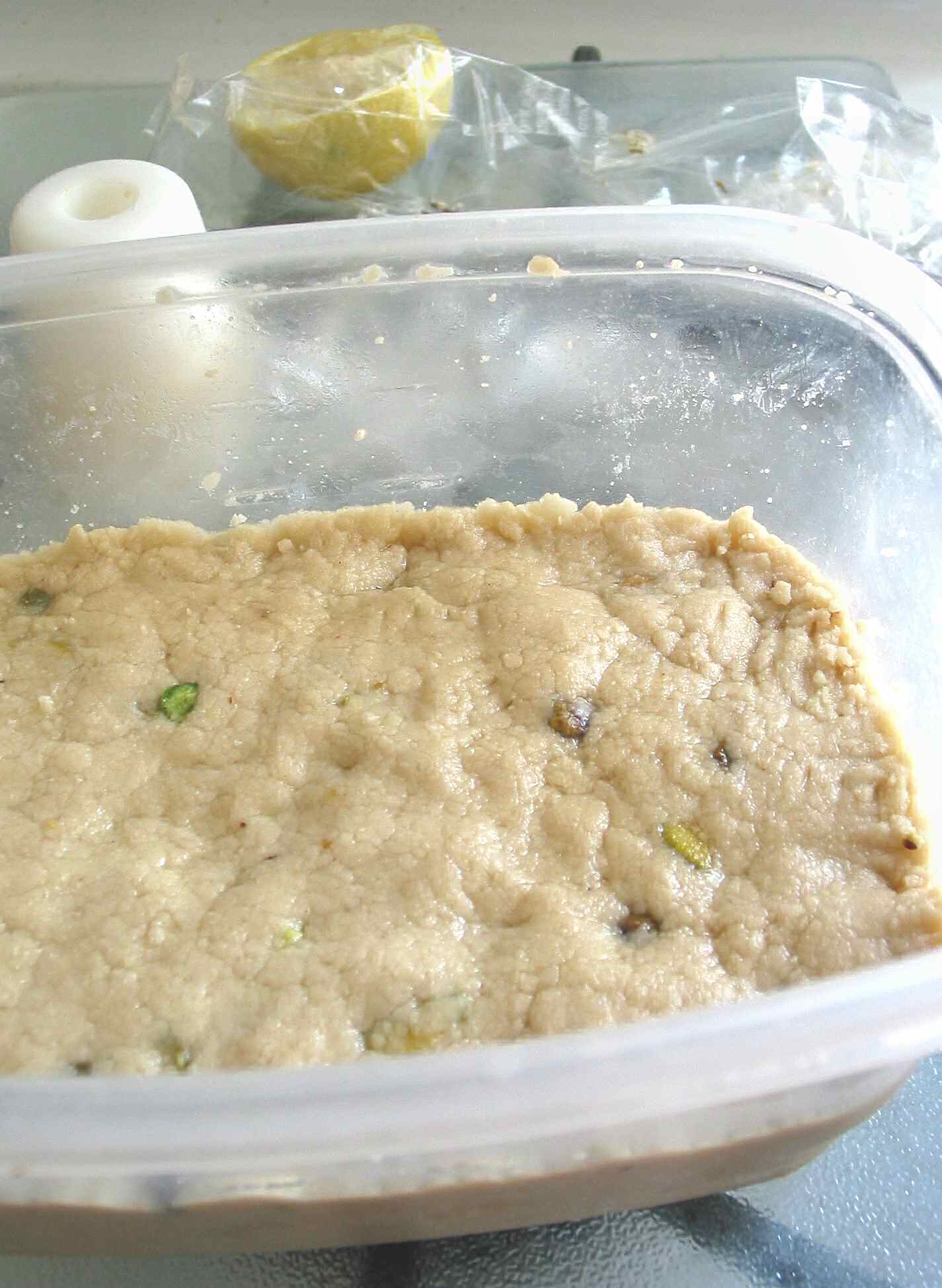
Sesame halvah with pistachios

A little trickier than it looks–this one is nearly right and tastes good, but it was stiffer and more crumbly than professional halvah once it cooled. Next time!

I first tasted halvah at the age of six while visiting my cousins, who lived in my town but had been to Israel the year before. One afternoon my aunt shaved off a very thin sliver from this mysterious loaf of sandy light-brown stuff and handed to me with the caution, “Only a little piece at a time. It’s very rich.” Which it was, but the feathery impossible texture melted on my tongue and I wanted more.  When I got home from the visit, my father laughed when I asked him what my aunt had meant by “rich”–and explained that it meant “heavy”. That made no sense either–the tiny sliver was light and delicate. Then he said that once when he was twelve he’d eaten an entire pound of halvah in a single sitting and been extremely sorry afterward, because it sat in his stomach like a lead brick for hours…

I mention these things not just because they’re true of eating halvah, but they’re a good indication of the balance you need to achieve if you ever try making it.

Last year at Rosh Hashanah I made stuffed eggplants and onions with tamarind sauce from Poopa Dweck’s Aromas of Aleppo. I’ve enjoyed them enough to make the onions repeatedly over the past year, and I’ve also enjoyed the idea of making a new food for the New Year. Dweck’s book happens to have a halvah recipe, and the pictures look right, and the recipe looks really simple.

Well…the ingredients are incredibly simple–tehina, sugar, water, lemon juice, flavorings like a little vanilla, clove and cinnamon, maybe some pistachios or sliced almonds to mix in. The steps–boil sugar with a bit of water until it reaches 240°F on a candy thermometer. I don’t have one but she adds, helpfully, that it’s until the syrup coats the back of a spoon and is at the soft ball stage–shades of childhood reading through the Joy of Cooking‘s mysterious and dangerous section on candy recipes. Ahem! Boil the syrup and pour it hot over the tehina in the food processor, add the flavorings and blend. Take out the mass of halvah and press it into a pan to cool, then cut into cubes or slices and store at room temperature for a week or the refrigerator for up to 6 months…not that it will last that long.

Simple, right? So simple. I can probably microwave the syrup in about 2 minutes instead of simmering it for 20 on the stove, at least if I stir every 20-30 seconds and keep checking it…with the food processor handy, it’s like a 10-minute recipe if that! Simple.

The trouble with making halvah at home, as I discovered last week, three times, is that it’s not so simple. The first time I tried a proportionate miniature test version, with half a cup of tehina and about 3/8 cup of sugar, all measured and calculated down to the gram. The syrup cooked in a minute in the microwave and things were going really well…except the mixture seized up hard and crumbly the instant I mixed the syrup and tehina with a fork. And it was a bit too sweet and bland. Did something go wrong with the proportions? Did it need more of the oily tehina to make it flexible?

The second time I made it, the syrup was a little looser and the mixture turned a flat oily dark putty color and never really solidified past a thick paste. Nearly the same exact proportions, better taste (less bland, less cloying, more sesame). But I had made a soft sesame version of peanut butter fudge. You could slice it in squares, but it would sag like soft caramel.

So clearly it’s not that simple. I went to the web, thinking, of course someone will know what I’m doing wrong. And maybe someone does, but he or she is clearly not on the web expounding on the finer points of making halvah.

Oh, there are dissertations on halvah, but most of them are talking about the wide variety of desserts around the world that go by the same name–kinds that are based on wheat flour, carrots, sunflower seeds, and other main ingredients to mix with the syrup and pat into a pan.

Most of the (relatively few) tehina-based recipes are identical to Dweck’s, a pound of tehina, two cups of sugar, 1/3 cup of water, a teaspoon of lemon juice, a pinch of clove and cinnamon, maybe a spoonful of vanilla.

But the pictures show (and sometimes the rueful comments do too) that it’s not the ingredients at fault when the texture’s off. It’s the technique, which is usually missing from the recipe.

The videos I found on YouTube specifically for making tehina-based halvah didn’t really help. Iraqi halvah workers boiling syrup in an old–well, it kind of looks like a very worn-out steel bowl set over a trash can fire in an abandoned stairwell, and they’re stirring away with a wooden paddle before pouring in the tehina, which turns into curds that they then paddle and knead until they’re happy with it, but you can’t really see what it is that makes the difference.

Then there’s the Syrian halvah factory demonstration posted by Middle Eastern chef and cookbook author Anissa Helou–much cleaner, with an official halvah-kneading machine that Willy Wonka might have been proud of, pummeling the tehina/syrup mixture with what looks like a mechanical boxing glove on a stick, until it looks like hummus that’s Continue reading

Pistachio madness two ways

(plus a handful of other frozen yogurt ideas)

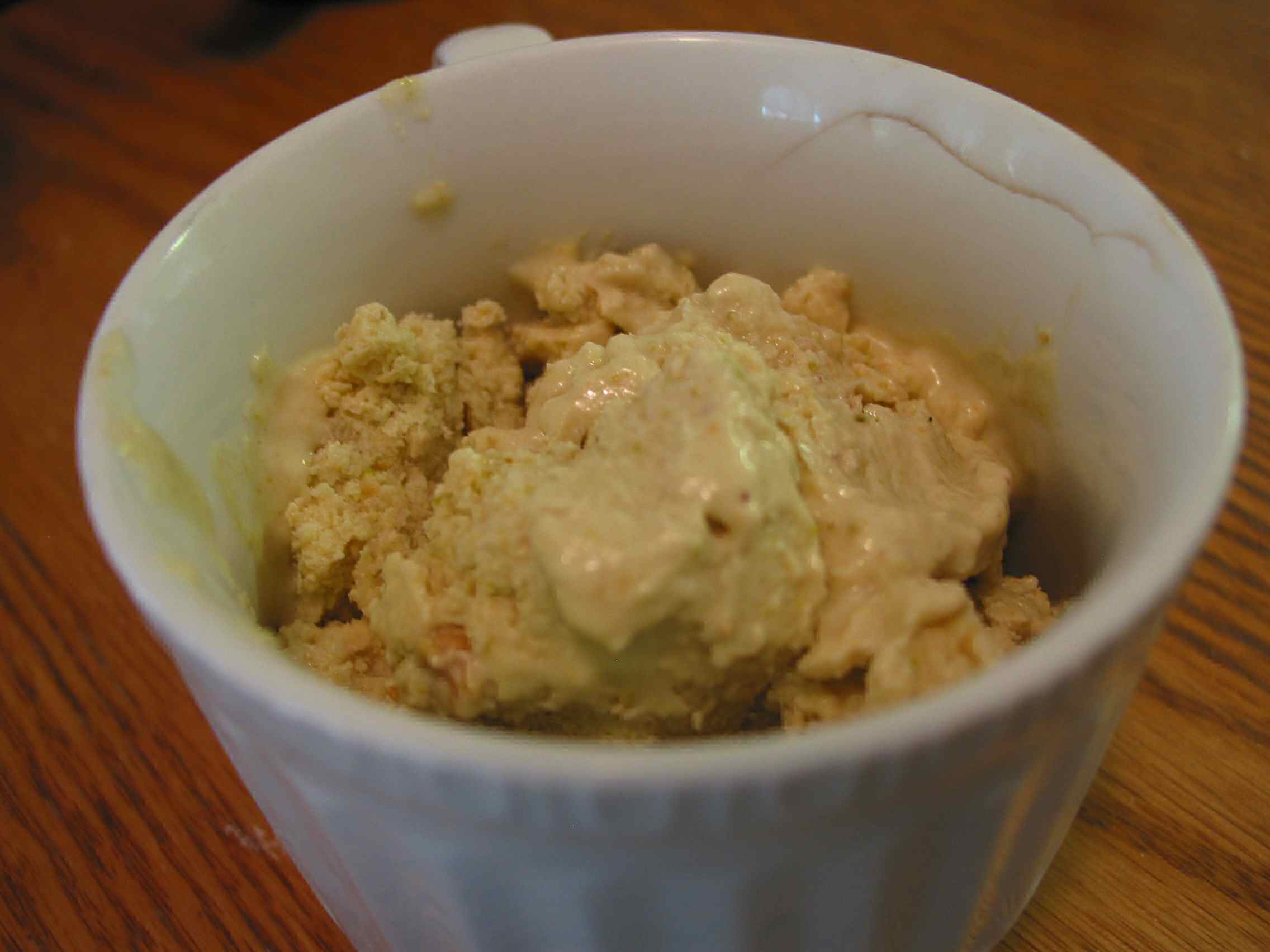
Homemade pistachio frozen yogurt, very low carb

It’s over 90 degrees most of the day in Pasadena, and I’ve gotten tired of looking at the limited selection of Dreyer’s (Edy’s east of the Rockies), Breyers, Haagen Daz, and Private Selection flavors with my daughter. It’s starting to get tedious, and they’ve dropped many of the classics for the cheapest possible quality candy-plus-ersatz-vanilla (note: their real vanillas are better). The forgotten classics were better-tasting, less dependent on goo and sweetened brown wax parading as chocolate or (if salted) peanut butter.

No supermarket ice cream brand in the non-superpremium range today offers rum raisin or pistachio worth considering anymore. It’s easy enough to doctor your own version with storebought vanilla ice cream and the aforementioned rum and raisins, but pistachio?

Pistachio used to be a standard ice cream flavor, didn’t it? Maybe I’m just getting old? Naah. Even in the ’70s when I was a kid, most of the “pistachio” ice cream around was already fake. I want the real thing, not the artificially green, mostly-vanilla-with-a-tinge-of-synthetic-almond kind.

And I want it low-fat for me and my husband and low-carb for my daughter (and us too, why not?) And I want it to taste delicious despite all that. Tall order? Actually, it’s easier than you’d think.

David Lebovitz has a Sicilian pistachio paste-based gelato in The Perfect Scoop, and he blogged about it a couple of years ago as well. He made it sound delicious, but also expensive and hard to find the ingredients for. Not that I’m against a trip to Sicily, except in July when it’s about as searing as LA (been there, done that, got the sunburn and the Fellini moments combined with heat exhaustion).

About the same time, a local gelateria owner in my area took much the same position on the utter superiority of Sicilian pistachios versus California ones for an interview in the LA Times. Which is lovely if you have a good source of Sicilian pistachios or pistachio paste at a decent price, but what if you don’t?

Most of the home-brew pistachio ice cream recipes I’ve seen in magazines, blogs and cookbooks call for adding significant amounts of heavy cream. Or else they involve large amounts of sugar. Or both. Yes, those recipes will give ice cream-like results, but they’re completely offtrack for what I need.

In my universe, good taste on a hot day shouldn’t mean losing your svelte, your cool or your wallet.

The nuts themselves are okay–pistachios, like most nuts and seeds, are very low carb and though high in calories from total fat, most of that is unsaturated. If I can keep the rest of the ingredients low fat and low carb and the stuff still tastes good, I’ll have it. Right?

So okay. I’ve been playing around with California pistachios and–not gelato, that requires making an egg-based custard and blending it with flavorings. Done it once or twice, and it worked, but it’s more work than I want to do most days. Or it used to be. Nowadays I’ve got the microwave moxie to make custard without so much work, but it’s still not what I want today. I want easy.

Frozen yogurt made with real yogurt is too tart to work with anything much but fruit unless you mix in some milk–and then it’s icier and freezes harder.

However, this summer I’ve been playing around with fat-free Greek yogurt as the base for a couple of different ices in small quantities. Greek yogurt varies a bit in nutritional stats from brand to brand, and it’s expensive, which is why I took so long to try it out. But the cheapest all-real (no gelatin) stuff–Trader Joe’s O% fat plain version–while still twice as expensive as the regular plain nonfat yogurt ($5 vs. $2.50 a quart), has considerably less carb, maybe only 7 grams of carb per cup as opposed to 17 for regular. And it has about twice the protein–22 grams per cup. It’s a lot thicker and less acidic, so I’m assuming they drained out a lot of the carb in the whey. And it makes really easy frozen yogurts that taste like something and aren’t overwhelmingly tart.

Just mix in your flavoring of choice (preferably not too watery) with some sugar, and you can still-freeze it within an hour or two. If you think the tang needs to be tamed further, a little milk mixed in works okay and it stays thick enough to freeze fairly gracefully.

The texture is never going to be like ice cream, not entirely. It still mixes up pretty hard and a little icy if you still-freeze it, but once you’ve got it thawed out to the point where you can dig out a serving, it tastes good and changes to a creamy texture as you eat it, something like khulfi. Higher-fat yogurt would break the iciness up a bit but would defeat my purpose of lowering the saturated fat to something I can handle.

And the heavy fats and sugars mask any delicate flavorings. Think Italian gelato (the real kind you get on the street in Florence, not the overpriced stuff you get in pints in the supermarket here) and you know that a lighter base allows you things like rose or ricotta or apricot or kiwi, or hazelnut, or four different highly refined grades of chocolate. If you want to taste anything delicate in your ice cream, you have to get the fats and sugars down enough not to overwhelm it.

Not that I’m entirely subtle. My favorite icier-textured frogurt for when it’s broiling out is mint–Greek yogurt, a couple of drops of mint extract, if that’s strong enough without tasting like postage stamps, and a tablespoon or so of sugar. Divvy it up into 2-4 paper cups or popsicle makers (small is okay for this), freeze. On a searingly hot day it’s pretty good, intensely flavored and refreshing, and its popsicle-style texture is fine with me.

For something like coffee frogurt, I really do want a creamier texture if I can get it. I finally figured I should just brew a little bit of triple-strength coffee so I can mix just a few spoonfuls into a cup of Greek yogurt, maybe with a few spoonfuls of milk, and still get strong enough flavor.

A spoonful or two of alcohol-based flavorings like rum, amaretto, even just vanilla extract can soften the hard-freeze effect, since the alcohol freezing point is lower than that for water.

Or you can add something protein or starch to the mix–egg custards and cornstarch are the usual route for gelati and standard commercial ice cream, but silken tofu and nonfat powdered dry milk also work to break up the ice crystals. Greek yogurt is providing most of the protein here and little water, and the carb is a lot less than for the powdered dry milk.

The last thing on my list, and it sounds either weird or completely obvious, is to add a fat–but I want something unsaturated. Oil? Yuck (though I have seen some olive oil ice creams flavored with basil or the like). But what about nut butters? Those, don’t laugh too hard, work pretty well and give the frozen yogurt a richness that feels like ice cream, only without big saturated fats or modifiers or xanthan gum or corn syrup solids or whatever. Plus they’re interesting flavors.

Halvah: I started with my trusty jar of tehina–sesame paste. It’s got almost all its fat in polyunsaturated form. A tablespoon in a cup of Greek yogurt, plus a tablespoon of sugar, stir, freeze, dig out a chunk–not so hard! And the flavor–kind of like frozen halvah. Very rich, though. Maybe I could get away with less tehina or more yogurt?

Chocolate halvah: I tried a chocolate version–also not bad–by adding two tablespoons of cocoa powder and an additional spoonful of sugar to the tehina/yogurt mix. Pretty good, but the tehina taste was definitely still there alongside the chocolate. Like chocolate marble halvah. You have to be a fan.

Peanut butter? Probably more Americans would like it than the tehina version. Go easy on the peanut butter; a good-tasting mix I once made with half a cup got way, way way too rich very quickly once it was frozen. Stick with a tablespoon or so per cup of yogurt. I’d use natural peanuts-only peanut butter, preferably the crunchy one, for the purest taste, limit the sugar and add a pinch of salt.

But really. I started out wanting pistachio, and that’s where I’m still going with this. Because I ended up with two, count ’em TWO, really good, really different variations on pistachio, and both of them were really easy, really low in saturated fat, and REALLY low-carb. And actively delicious, which is definitely the point.

California pistachios may not be the Sicilian ideal, but they taste pretty good for what they are.  TJ’s sells 8 oz of roasted unsalted ones for about 5 bucks. Not exactly cheap. Still, the shelling’s been done, and for a pint of finished frogurt, you only need an ounce of pistachios. Will that be enough to taste like something? Oh, yes. Continue reading

Montreal

We are back from Montreal, a city which reportedly has more restaurants per capita than anywhere else in the world–does this include Paris? Most of the food we had was very good. Even the dreary-looking and overpriced breakfast bar in the convention center where my husband was attending the IEEE conference had excellent, crisp croissants and thick serious coffee to go with the boring-standard scrambled eggs and dry cereals. I never got a chance to try out the Montreal bagels because we found such good food within walking distance downtown.

The Vieux Port area of downtown has streets full of bistros and is lively to walk through, admiring the art galleries, tchotchke shops, accents (French with a distinctive Western Hemisphere twang) and people (a lot of younger women were sporting platform wedgies in improbable colors like Day-glo orange or pink, and almost all the natives were more fashion-conscious than we were).

On one of the piers we discovered the Centre du Science had a special exhibition of costumes, ship and creature models, and the original concept drawings from the Star Wars movies. We had to see it, even though it meant paying extra and wearing a rubber bracelet with an RFID chip in it so we could pick our species, planet, job description and personality traits as we walked through the stations with film clips illustrative of influences and stages of personal development. I mean, Luke’s upbringing contrasted with Anakin’s? Did I need to see the blame laid on Anakin’s mother’s permissive parenting style for Anakin’s tendency to be drawn to the Dark Side? Mothers get blamed for everything. As for the Dark Side, well, they get all the cool costumes–red leather, black leather, horns, masks, capes, shiny streamlined samurai helmets, wrestler belts with electronic gizmos built in…compare that with the monklike dun-colored burlap and linen outfits for Obi-Wan and Qui-Gon. Of COURSE Anakin would get with the Dark Side. Proof? Darth Vader ends up with the coolest costume of all…apart from that pesky touch of asthma.

On a brighter note, did you know Yoda was originally supposed to look something closer to a European-style elf or garden gnome? Glad they went Japanese.

Another pier–the entire pier–housed the blue and gold striped tents where Cirque du Soleil holds its home court performances nearly every afternoon.

But the weather was unusually hot, in the 90s, and so humid that we didn’t feel like eating much until sundown, when it was finally cool enough to venture out and explore all the sights within walking distance.

I was also under a time sentence–start statins as soon as I got home, test again in six weeks and see if they’re working. So I was doubly uncomfortable eating out all the time, thinking twice about eggs or butter or cheese in anything that was served, wondering if this was the last grapefruit I was going to be able to eat and maybe I’d better have only one small serving of that in the Indian restaurant we went to with our friends, because it was cooked with ghee (there were 25 Indian restaurants in town! crowed our friend’s 9-year-old daughter. She wanted to try them all.)

And why were the only vegetables in the other restaurants buttered (which I’ve never liked; my cholesterol-packin’ genes are more to blame than my actual diet and the doctor’s office pamphlets nearly always say to “cut down” to more saturated fat than I actually eat) or else a tiny salad? Just like the French. Just like the Americans.

And yet…the best place we ate–we went back twice that week–was a small undecorated restaurant in Chinatown around the corner from our hotel, which was across the street from the convention center. When we arrived from the airport at 11 pm, Restaurant Beijing was the only place still open for dinner, and we weren’t expecting much when the concierge recommended it. We trudged around the corner anyway, past the hotel’s dumpsters, around to rue Gauchetière,  and took a peek through the window.

Plain cafeteria-style tables, brightly-lit but plain strip-mall sort of space, chalkboard specials on each wall, no decorations at all other than a few bamboo plants in the window, not even old-style kitsch, and…absolutely packed at that hour of the night. Continue reading

Lightening up homemade scones

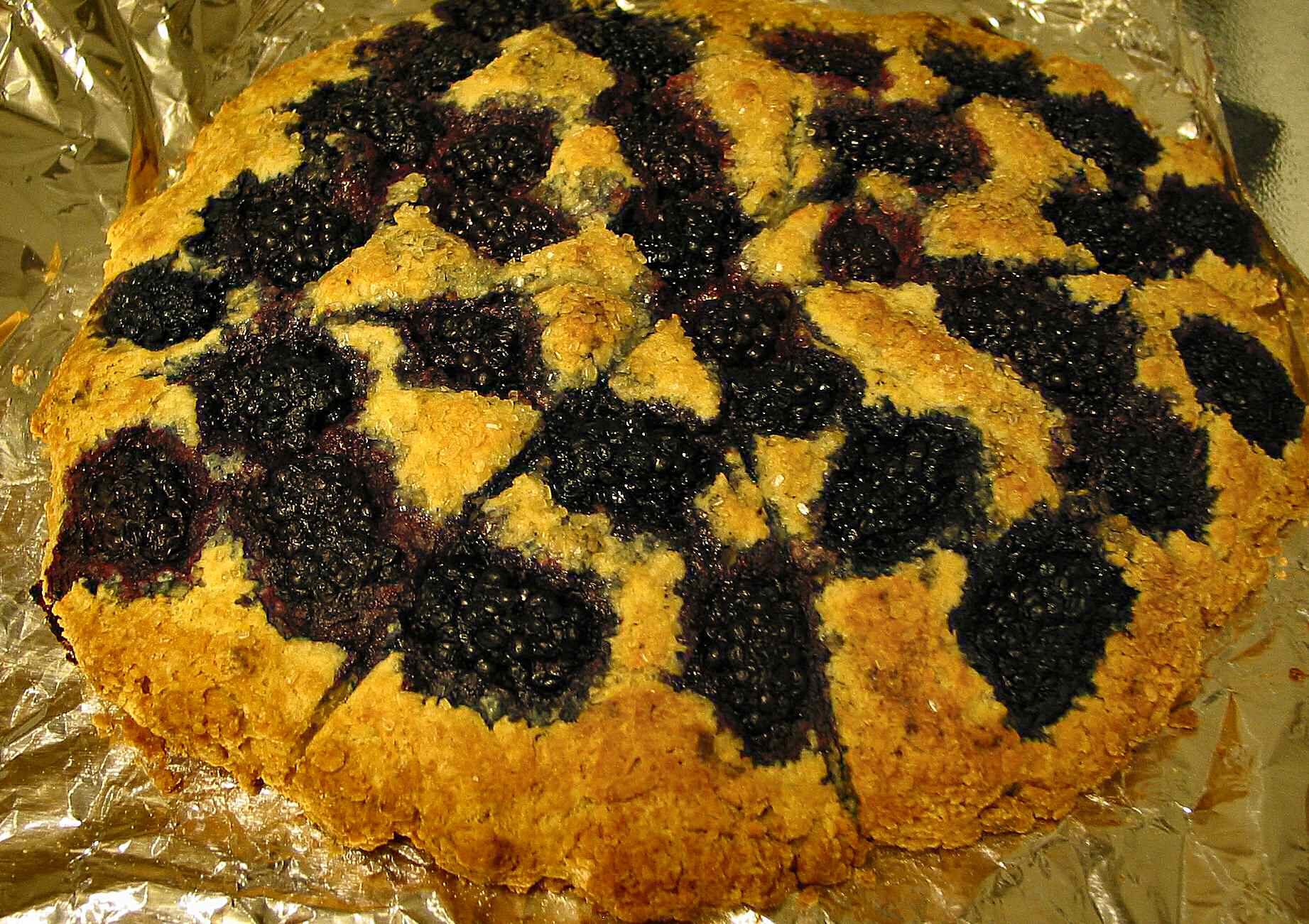
Blackberry scones for brunch

I’ve been wanting to post my favorite scone recipe for some time, but it seems to me that most food blogs start out with good intentions and end up maxing out on the desserts-and-starches end of the food spectrum.

The reason is pretty simple: if you’re a food blogger,  a baking recipe and a pretty picture (or any picture of an aggressively-frosted cupcake) will never put you wrong, even if the real result tastes kind of blah. I mean, cupcakes? Isn’t that what Duncan Hines is for? But if you do feature cupcakes, somebody’s sure to repost it or call it awesome, particularly if you figure out how to add bacon to it. Somehow people just don’t flock to posts about green beans in droves unless you’re redoing the Thanksgiving-straight-from-the-can classic, complete with canned fried onions.

There are way too many variations for every kind of baked good, none with a clear and permanent advantage, and people take them all literally (see under, my New Year’s apple pie insecurities).

So as I say, I’ve been reluctant to put up too many baking posts. Scones, though they’re not exactly the staff of life, are very easy to make and actually taste best when you make them from scratch–much better than buying them in a store and definitely not at your local Starbucks. The question I have is whether it’s a good idea to do it very often–I usually don’t, even on the weekend, but partly that’s because I live in southern California and heating the oven for more than five minutes in my little galley kitchen is often a Very Bad Idea. The other reason is that I keep remembering something Valerie Harper once said (maybe in the role of Rhoda Morgenstern; can’t remember): “I don’t know why I bother to eat this piece of chocolate cake. I should just apply it directly to my hips.”

Most quick breads (i.e., raised with baking soda or powder, or beaten egg whites, not yeast) do fine in a microwave as long as you don’t need them to brown. So lemon-poppyseed cake is okay, as is gingerbread. Scones, which to my mind require a deep and crunchy crust, need a regular oven to do well, but I make the sacrifice (90-degree weather makes it a genuine sacrifice) once in a while on Sunday mornings, because they taste terrific and they’re not exactly rocket science to make.

So if they’re that easy, should I really be posting about them–haven’t you already seen too many wide-eyed, “Look, Ma, I made SCONES!” kinds of posts?

Let’s face it. You can make great scones in a food processor from a very short list of ingredients for cheap, in about half an hour including baking time, and flavor them simply or exotically. Fruit or chocolate chips or chiles and herbs and cheese–all optional. I stick with berries and turbinado sugar, which makes the crust crunchy and glittery. Continue reading

The heady scent of new-crop oranges

Orange peel in syrup with orange blossom flavor

I’ve posted on making impromptu microwaved marmalade before. It works beautifully–5 minutes total!–with sliced kumquats, but I haven’t had as much success with standard navel orange peel–until now. This week my local Trader Joe’s had big bags of organic oranges and when I brought one home I discovered something I’ve never come across before.

It must be the new crop, I think. I don’t have a great sense of smell out here in Los Angeles, but even I can tell something’s really different about these oranges. Southern California is specialty-citrus country, with five or six varieties of tangerines parading through the grocery stores and farmers’ markets all winter long, and beautiful, strange “Buddha’s hand” citrons appearing in December. With all that going on, not to mention the blood oranges and pomelos (which I actually don’t like) and cara caras and key limes and ugli fruit (sumo tangerines, huge and bumpy) and so on and so on, you’d think that ordinary navel oranges would come bottom of the exotica scale. Even if they are organic.

The flesh of these oranges was pretty good but not really remarkable–I actually like them a little tangier and more acidic. But the peel! In addition to the usual bitter-aromatic orange peel scent, the oranges all smelled strongly of orange blossom, even after washing them twice. I didn’t know oranges could smell like orange blossom. The peel even tasted like orange blossom water.

So of course I decided I had to take advantage of this oddity by trying the old microwave marmalade trick and making candied orange peel with them.

Like rose water, orange blossom water or essence often seems to me as though it would be better suited to cosmetics than food flavoring. A little is exotic and mysteriously elegant; a little too much, which could be the difference of a couple of drops, can be distinctly soapy.  The essence is sold in tiny opaque blue French bottles in upscale markets like Whole Foods for several dollars apiece, but it’s also sold in 12-oz bottles for 2-3 bucks at my local Armenian grocery, presumably because most of the customers use it so much more often in all kinds of fillo or almond- or pistachio-based desserts.

But here I was with orange-blossom-scented oranges, the native article, organic no less. If they were awful as candied peel or marmalade, at least the microwave method meant I wasn’t going to be wasting tons of time or effort, and only a little sugar. So I washed two oranges well, took the outside layer of the peel off with a sharp knife and sliced it into thin shreds.

I find that skinning the navel oranges with a sharp knife and taking only a little of the white pith with the peel is better than peeling first with my fingers and then shredding the whole peel with tons of pith attached–somehow they cook through better in the microwave method, absorb the syrup better, and gel a bit better as marmalade.

So anyway–I poured a bit of water on the shreds in a soup bowl, covered the bowl with a saucer and microwaved a minute. The water I poured off was greenish yellow and smelled like orange blossom–tasted like it too.  But the peel still smelled like it as well, so not all was lost. I covered the shreds with about 1/3 c. or so granulated sugar, drizzled on a little water to wet it down and squeezed half a lemon over it all. Covered the bowl with a saucer and microwaved about 4-5 minutes. Very heady scent and beautiful flavor, and somehow not soapy, thank goodness. Might have the lemon juice to thank for that, actually.

The shreds sat in their syrup in a covered container most of the day (for me it was forgetting all about it for a couple of hours while letting it cool, but I’ve discovered that it’s also standard marmalade-making practice that helps the syrup gel; who knew?)

The bonus question, of course, is how does it go with chocolate? (that should almost always be my bonus question)

Answer: knockout with dark chocolate. Also very good on toast as marmalade. Something to savor, and the syrup, if I don’t finish it along with the shreds, might go to flavor some almond-paste fillo fingers later this week. Because with something this good, it just seems right to be decadent in small, appreciative doses.

What good is a recipe for this marmalade, though, if you can’t stumble on orange-blossom-scented oranges of your own? I suspect it’s kind of an accidental find, but the fact that orange blossom tastes so good with actual orange peel means that you could make candied orange peel or marmalade and add a drop or two–no more!–of orange blossom to the peel and syrup once they’re already cooked. Don’t forget the lemon juice or a small shake of citric acid (sour salt) to help the preserves last in the fridge. I think the bit of acidity definitely cuts the possibility of soapiness.

On a fresher, lower-carb/lower-cal note, a light (LIGHT!) sprinkling of orange blossom water goes very well on orange slices you intend to use on green salads. One I sometimes make for parties: sprinkle cross-wise slices of several oranges with a tiny bit of orange blossom water. Let them sit a few minutes, then arrange the orange slices on a bed of oil-and-vinegar-dressed romaine and other greens on a large platter, and distribute thinly sliced red onion, red bell pepper, basil and Greek pitted olives  over it all.

Whif? Whaf? The Wonka of breathable food faces FDA review

It looks like a sleek, avant garde  lipstick or  a purse-sized cologne atomizer–one designed by Halston or Calvin Klein. Atomizer is the right word. Only these AeroShot canisters, which got their start at Harvard’s The Laboratory Art/Science project under David Edwards and became available in the US last fall, are packing “breathable caffeine” (plus a couple of B vitamins).

The previous model, aka “le Whif”, packs “breathable” chocolate powder. It was a moderate success in Paris, where Edwards’ Bauhaus-like other lab center (named Le Laboratoire) produced and promoted the experimental chocolate inhalers as an aesthetic experience at celebrity events, and in London, where its spinoff company Breathable Foods now holds court.

Where did this strange, possibly ludicrous idea come from, that it’s a better aesthetic experience to inhale a shpritz of caffeine (please note: flavorless though with a kick, and definitely a drug-I-have-worked-with-in-the-lab-because-it-blocks-G-protein-coupled-receptors) than drink a long, hot cup of intense coffee while reading this blog and contemplate the degree to which your barista still favors you by regarding the temperature and the decoration in the steamed milk foam served on top? Why is it better to puff a little chocolate-flavored powder on your tongue than eat actual chocolate? Somehow, I don’t think the “calorie-free” argument really plays into the decision very strongly, so what’s driving this?

Do we not still have taste buds? Do we not long to extend our coffee break as far from our cubicles as it will stretch? Do we really want our hearts to suddenly kick into overdrive after we have to get back to the office, just when we’re stuck behind the counter, attempting to explain that glitch in the irate customer’s bill? For that matter, do we really want to ingest B vitamins with our caffeine? Or figure out which recycling bin the little plastic aerosolizer goes in when it runs out? Will the aerosolized flavors or food components even still be interesting if we have a stuffy nose?

Do we want to miss out on the gustatory satisfaction of real food?

In the public demos for Le Whif, (according to Edwards’ book, anyway) the French surprisingly enough didn’t mind the fact that many of the chocolate inhalers didn’t work well, or that they started coughing whenever the chocolate powder went the wrong way. They didn’t mind being used as impromptu guinea pigs–or perhaps realize that they were–despite the fact that these products were being tested informally and some of them demonstrated the adverse health risks right away, and that just possibly breathing chocolate-flavored particulates into your lungs might not be all that smart, particularly if you have asthma.

These things obviously didn’t bother the French too much. The packaging was chic, the concept ultramodern, and the activation gestures analogous enough to lighting up a (now-forbidden) cigarette with one’s coffee at a sidewalk café table. And, so the company promised, it was a calorie-free chocolate experience.

Even more surprisingly, it didn’t really matter what kind or quality of chocolate was in the little gadgets, or how it actually tasted in comparison with ordinary solid chocolate. This was closer to participating in Modern Art, or at least in fashion’s idea of modern art. Like a visit to the now-closed El Bulli, which paired some dishes with a side beaker of aromatic vapor, only much less expensive, disposable, and with a simple popular flavor everyone understands. Molecular gastronomy for the common man. Or woman.

Americans of my generation–which also happens to be Edwards’–are a little less sure than the French about the chic value of shpritzing odd substances onto one’s tongue, much less as a high-class cultural or intellectual activity. Our references include tacky mouth spray breath fresheners (made fun of in numerous movies and tv shows over the decades), Bic lighters, Pez dispensers, and asthma inhalers. Kind of low on chic.

So Breathable Foods found the right marketing paradigm–“buzz”–for its target audience:  college students cramming at exam time, athletes who want that Continue reading