
• Enter your email address to subscribe to this blog and receive notifications of new posts by email.

    Join 241 other subscribers
  • Noshing on

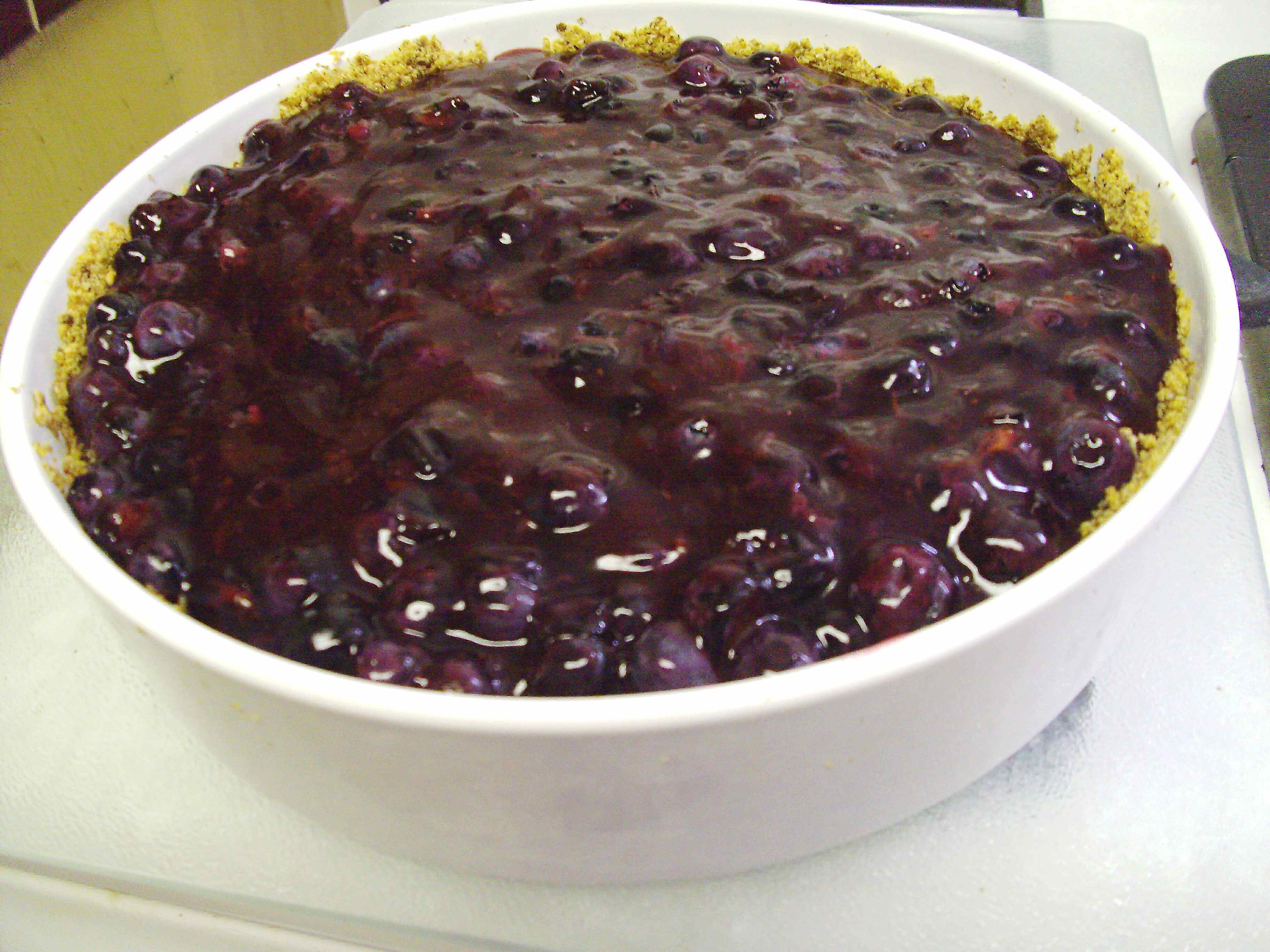
    raw blueberry pie with microwaveable filling and graham cracker crust

    This mostly-raw blueberry pie is a snap to make and very versatile--the filling microwaves in a few minutes, and you don't even have to bake the zippy gingered graham cracker crust--perfect for a hot Fourth of July and all summer long.

  • Recent Posts

  • Contents

  • Archives

  • Now Reading

  • See also my Book Reviews

  • Copyright 2008-2024Slow Food Fast. All writing and images on this blog unless otherwise attributed or set in quotes are the sole property of Slow Food Fast. Please contact DebbieN via the comments form for permissions before reprinting or reproducing any of the material on this blog.

  • ADS AND AFFILIATE LINKS

  • I may post affiliate links to books and movies that I personally review and recommend. Currently I favor Alibris and Vroman's, our terrific and venerable (now past the century mark!) independent bookstore in Pasadena. Or go to your local library--and make sure to support them with actual donations, not just overdue fines (ahem!), because your state probably has cut their budget and hours. Again.

  • In keeping with the disclaimer below, I DO NOT endorse, profit from, or recommend any medications, health treatments, commercial diet plans, supplements or any other such products.

  • DISCLAIMER

  • SlowFoodFast sometimes addresses general public health topics related to nutrition, heart disease, blood pressure, and diabetes. Because this is a blog with a personal point of view, my health and food politics entries often include my opinions on the trends I see, and I try to be as blatant as possible about that. None of these articles should be construed as specific medical advice for an individual case. I do try to keep to findings from well-vetted research sources and large, well-controlled studies, and I try not to sensationalize the science (though if they actually come up with a real cure for Type I diabetes in the next couple of years, I'm gonna be dancing in the streets with a hat that would put Carmen Miranda to shame. Consider yourself warned).

Starting with Breakfast

“The Well” blog at the New York Times has posted a new interview with pediatric endocrinologist Dr. Robert Lustig about his new book, the Fat Chance Cookbook, and about the possibilities for treating obesity in children with a better, less processed diet.

Two or three takeaways from the interview surprised me by echoing things I’ve either thought or written about here since my daughter became a Type I diabetic four years ago.

Almost always, we see an obese kid come in with an obese parent. And when the kid loses weight, the parent loses weight, because the parent actually changed what’s going on in the home.

We do something called “the teaching breakfast.” Every kid comes in fasting because we’re drawing blood. So they’re all hungry. They go to the teaching breakfast with their parents – it’s six families all at a communal table – and our dietitian spends an hour with them. The dietitian narrates exactly what’s on the table and teaches the parent and the kid at the same time….We make sure four things happen. No. 1, we show the parent the kid will eat the food. No. 2, we show the parent that they will eat the food. No. 3, we show the parent that other kids will eat the food, because they have other kids at home and they have to be able to buy stuff that they know other kids will eat. And No. 4, we show them the grocery bill, so they see that they can afford the food. If you don’t do all four of those, they won’t change.

Also, and I think this is my favorite:

…my wife is Norwegian… When she’s mad at me, she bakes…My wife has learned by experimenting that she can take any cookie recipe, any cake recipe, and reduce the amount of sugar by one third, and it actually tastes better…. And you can taste the chocolate, the nuts, the oatmeal, the macadamia – whatever is in it.

Right on!

Back to the top, though, I’ve got to say I love the idea of the teaching breakfast. My one concern is the reality of time cost for families with school-aged children, because eggs and vegetables, two of the (sometimes) inexpensive staples of the UCSF clinic’s teaching breakfast, take more time to prepare than a bowl of cereal, and require more cleanup. On weekdays, that might be a real challenge, especially for families with two working parents and/or long drives to school. A lot of the families I know in this situation (long drives and no school buses being a common problem in Southern California) are used to tossing their kids in the car with some kind of makeshift breakfast to eat on the way–often resorting to bagels, pop tarts, or bananas, none of which are great choices.

Perhaps if the dietician showed some simple microwaveable 5-minute meals like oatmeal or an easy vegetable-filled frittata (with some of the yolks left out) that can be made the night before and refrigerated? The plain yogurt with fresh fruit idea is also quick and simple but not especially cheap–these days a quart of plain non-Greek yogurt goes for $2.50 at Trader Joe’s, almost the same as a gallon of milk, and costs even more at the local Ralph’s (west coast Kroger affiliate), but it serves only 4 if each serving is a whole cup. Cereal with milk is a lot cheaper–but it could certainly be better cereal, high in fiber and low in sugar and salt, and measured by the cup or on a scale before pouring it into the bowl to make sure you don’t get more than you think you’re getting.

Cutting up fruit and vegetables takes time that parents usually feel they don’t have. And berries, which don’t need cutting up, are relatively expensive fruits, even when frozen. So showing parents a couple of “instantly grabbable” ways to serve the less expensive fresh (or fresh-frozen) fruits and vegetables instead of Froot Loops might be key.

A simple “just wash and nosh” approach would probably be a good start. I know I generally rail against buying precut, expensive little baggies of manicured (and dried out) vegetables in the supermarket, but the big bags of “baby carrots” that don’t require peeling and are finger-food size would be an okay starting point to get kids and parents to think about vegetables as a good snack or even breakfast choice. My daughter lived on them for lunches (along with a PBJ on whole wheat and an apple) for most of her grade school years, and even though she has (and will probably always have) a mean sweet tooth, she still seeks out raw green beans, wedges of red cabbage, roma tomatoes and broccoli or cauliflower branches to break off, rinse under the tap and nosh on after school.

Ganache

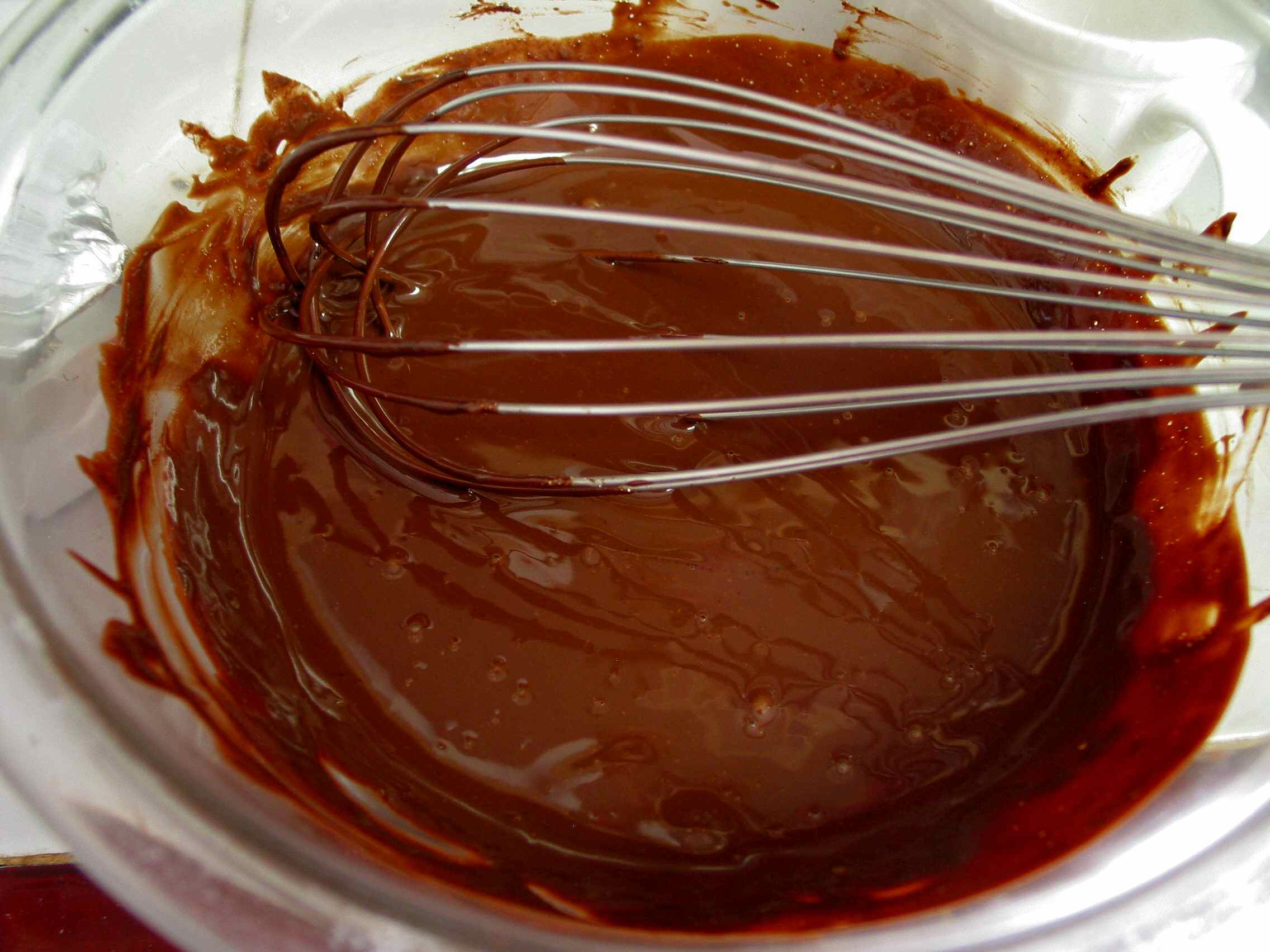
chocolate ganache

Ganache–the most versatile Valentine’s Day dessert in the world–takes about 5 minutes to make. If that.

This post started out being about Valentine’s Day 2013, if you can believe it,  and all the lame, anemic, inferior, chocolate-free pastries being touted in last year’s February food mags–Thomas Keller’s very, very plain beige custard tart without any decoration on it comes to mind as one of the worst offenders. He named it–get this–“Pomme d’Amour”. If you served me that as a Valentine’s date dessert, without so much as a raspberry or a mint leaf on the side, much less a caramelized-sugar top as for crème brulée, I’d be very unimpressed with it and probably with you. Especially at French Laundry prices. I’m not giving the link for it. If you’re genuinely hung up on Keller’s recipes, go away and don’t come back until you’ve convinced yourself that I’m right–a lot of fuss for so much bland. Because…..

Valentine’s was meant to be about chocolate. Or, if you’re very lucky, chocolate sauce. I don’t hear any dissent out there–except perhaps among the lovers of beige food. Takes all kinds…

So anyway, it should surprise no one that I’m late for this by an entire year. And dinner is tonight. In any case, you should know this post has morphed, thanks to time, tide, procrastination that knows no bounds, and my deep, deep love of chocolate ganache (because it is bitter and because it is my heart? Hell no: because it is unbelievably simple and quick and fun to play with and tastes damn good and impresses people who don’t know any better. Why else?)–Ahem! This post has morphed into a couple of ways to impress people who no longer cook. Including yourself if you’re one of those most of the time, and even if you’re not, because tonight you don’t want to spend a lot of time fussing over the food, you want to be taken out to dinner or else, if you’re snowed in, you want something delicious and very quick that takes only very simple, not too expensive ingredients you probably (hopefully) already have on hand somewhere at the back of the cupboard.

As I think I discussed in my post over the summer about the dangers of baking for one’s kid’s bat mitzvah (or other big celebration), many of these lost souls who never cook at all, to my great chagrin, can be counted among my close friends. To the point where making a cake of any kind, even from a box mix, is impressive.

Anyway, irritated by the selections I’d seen in all of last year’s February foodie magazines, I realized that most of my ideal recommendations, that is, the ones that I wasn’t seeing but wanted to, all relied on some form of chocolate ganache or fudge sauce–variants on a shockingly simple recipe. Even the French expert versions are just about this simple–mine’s better because I use a microwave and save washing a saucepan (always key), but the rest is history either way.

If you’re ready to mess around with the proportions until they feel and taste right, you’re my kinda cook. If you’re not, well, just consider that it’s “holiday season” (well, President’s Day, anyway, on Monday) and this is almost a free gift. Seriously, a five-minute (plus a little cooling time) recipe with two or at most five (fanciest variation) ingredients can win you a lot of unearned praise and maybe even a hot date.

All this is merely to point out that, if, like me, you have been tasked with dessert on short notice, you can skip the supermarket frosting horrors if you feel like it (and if your intended audience deserves it) and be amazed (and disturbed) as you flaunt instant and completely fictitious pastry “skills” that–and you don’t have to tell your heart’s desire or any of your friends this–rely almost entirely on some half-and-half and some dark chocolate chips or bars and a microwave. In short, I give you: Ganache.

. . .There is never a completely wrong time for chocolate ganache, except perhaps in the middle of a corned beef on rye with half-sour dills. OK, sorry I mentioned that. . .back to that romantic “cooking” thing. . .  Continue reading

Instant Pickles, Hold the Salt

Fast-marinated cucumbers, half-sour kosher dill style

One of the things that kept me motivated for blogging SlowFoodFast after the first fine careless rapture was my indignation at how popular over-the-top salting was becoming in popular food magazines, cookbooks, blogs and TV shows as chefs became celebrities, and how dangerous I knew it was for most people to eat that way regularly. A large part of my career a couple of decades ago was exploring the history of dietary sodium in cardiovascular research and writing about the DASH Diet.

What I’ve missed the past few years is just how many people, particularly younger ones, are starting to take up the challenge of cooking low-sodium and blog about their trials and successes. There’s a whole community out there, and they’re cooking pretty well. It is definitely possible, and generally easy once you get past the “how do I read a label and cook from scratch” aspect.

I just ran into Sodium Girl (aka Jessica Goldman Foung)’s blog-based cookbook, “Sodium Girl’s Limitless Low-Sodium Cookbook”. Diagnosed with lupus and kidney failure in her early 20s, she turned around her diet by dropping her sodium intake drastically to give her kidneys a rest in the hope they’d regenerate, and it worked. She’s been innovating with low- and near-to-no-sodium versions of favorite foods ever since, working with the National Kidney Foundation and other organizations. Her book, like her blog, is attractively photographed, full of cheerful writing and surprise takes on favorite foods.

One of the substitutions she makes that I have to approve of is a molasses-and-vinegar-based “faux soy sauce”. So I wasn’t the only one!

Another of her successful experiments is pickles. She goes for sugar-and-vinegar-style pickles, which makes sense, since they have no added salt in them, but I can’t help it–I have always cringed at sweet pickled anything. If it’s supposed to be a pickle, for my money, it’s gotta be a half-sour kosher dill and nothing but (or else an Indian lime or mango achaar pickle, or Moroccan preserved lemons, but that’s another story and still pretty high-salt at this writing. I’m working on it, but not yet holding out a lot of hope…)

Anyway, looking through Foung’s book reminded me of a simple, hearty and low-to-very low sodium version of my favorite pickles in the world. Continue reading

Leftover Logic

Two weeks ago The Guardian‘s business section published the following salvo against glam-food waste: “Food’s latest hot trend: leftovers”. Some of the interviewed chefs, who grew up eating leftovers in the ’70s, have apparently joined forces with the Women’s Institute in York (shades of “Calendar Girls” and Helen Mirren’s shaky attempt at a Yorkshire accent) for a project to reduce food waste as supermarket prices continue to rise and rise.

Some interesting quotes in the article, and interesting questions on frugality–the columnist claims household food waste is down about 13 percent in the UK since last year, which is pretty telling about the economy. She and the people she quotes attribute the current lack of knowledge on how to use leftovers to a sharp decline in cooking skills that coincides with the surging popularity of perfect, coffee-table-worthy food fantasy cookbooks.

Is it really the fault of photo-heavy cookbooks, food magazines, blogs and tv cooking shows that only perfect produce makes the cut, and everything with a blemish on it must automatically be thrown out? Possibly…but the article also cites another trend–the heavy push of boxed microwave-meals-for-one that leads so many people to fear cooking and believe they could never be talented enough to cook from scratch.

Of course, if you never touch an uncooked bulk vegetable or a piece of raw meat, you never risk making a mistake in the kitchen. But the other side of the coin is that the produce in the magazines will never show up on your table. Because the frozen tv dinners really don’t come out looking or tasting as good as the pictures in the magazines.

If you do cook, the idea of using up what you have in the fridge can be nearly as daunting as having to pay for fabulous (and expensive) first-rate pre-sorted extra-polished pre-cut vegetables. In a branded bag. Can you eat less-than-perfect-condition food mag-quality decorator vegetables and still be safe?

Yes, you can. Obviously, when you go to buy vegetables, you want the best and freshest ones you can get for a reasonable price. Nothing you buy should be leaking or moldy or worm-ridden or otherwise clearly spoiled. But short of that, quite a lot of produce can be eaten just fine without having to be picture-perfect.

No one in the professional or amateur food enthusiast world ever talks about how to handle imperfect, wrinkled or slightly old vegetables, but they should. Because no matter how they look when you buy them, if you actually buy enough vegetables and enough variety for a week, some of your produce is going to start drying out or going a little less crisp or whatever in the later days. And you don’t necessarily need to throw it out because of that. Most of it you can probably still use and it will still be fine.

Local corner greengrocers often sell the oversized, undersized, riper or otherwise less-perfect-looking vegetables for a fraction of what they go for in big chain supermarkets. Customers at my local Armenian grocery routinely stagger out with huge bags of red peppers, onions, green beans, cabbages, eggplants, zucchini…all at a dollar a pound or less. Probably most of those vegetables are less than shiny-perfect. It doesn’t matter. The customers who lug them home are going to cook them up in large batches and short of actual spoilage, they’ll use them up.

And I myself did it today–foraged around in the fridge for the eggplants I bought last week. They were just starting to show brown dimples at the flower end. Not lovely but not a disaster. Then I found the less-than-great winter Roma tomatoes, a few of which were already starting to show little smudges of black at the stem ends because I’d had to store them in the fridge–no room on the counter, and I had them in a plastic bag that kept the moisture in more than was really good for them. Damn! I weeded out two that were clearly beyond saving–cracked and leaking slightly, not good–and took the others out to inspect. How bad were they?

Now the eggplants were only a little bruised or dimpled in a few places. Peeling off a little of the skin at those points revealed that the flesh inside was still okay. No worse than a bruised apple. Cut them up, microwave them, drain off the juices and fry them for eggplant-and-chickpea stew, and they’re just fine.

The tomatoes are a little scarier, no question. No one wants mold on their vegetables. But except for showing the tiny beginnings of mold at the stem ends, the six tomatoes I had left seemed fine and firm, dry and uncracked. Throw out six tomatoes at this time of year? I decided not to. I washed them carefully on the theory that the peel, if it’s unbroken, is working hard to seal out dirt and contamination and any mold spores on the surface can therefore be washed off. I sliced off the tops about half an inch below the stem ends–giving them a margin of safety at least in my mind.  Then I dared to taste a bit of the tomato below that. Also fine–or as fine as winter tomatoes get, anyhow. No sight, smell or taste of bitterness anywhere, and not mushy or discolored, and they tasted reasonably fresh. So I cut up the tomatoes and put them in the stew.

And everything was fine, and no one got sick or started convulsing (or screeching at the top of their larynxes) like Robert Plant at the height of his Led Zep days. This was fortunate, because we don’t yet have the larynxes back in shape after Losangelitis week, not to mention the stomach muscles, the tight jeans (well, the jeans are a little tight but not on purpose–we’re workin’ on it! hate those sit-ups) or the massive and tossable hairdo. Then again, neither does Robert Plant these days. So I don’t feel that bad about it. And neither should you.

Losangelitis: ‘Tis the season for tisanes

I didn’t want to be writing this post. I really didn’t. It’s 85 degrees outside, for crying out loud! And I have Losangelitis again anyway–the local sinus and cough misery that sometimes leads to laryngitis if you strain your voice yelling at your kid to practice piano while you have it. It’s got no agreed-on cause or cure, and absolutely no respect for sunshine and palm trees and tomato plants that are starting to bloom in my backyard (because Pasadena is weird, and for no better reason–I’m a purple thumb gardener at best, but if we get tomatoes out of this I’m good with it…)

I know the rest of the country is suffering worse than I am (and my husband; a coughing fit out of me at 3 a.m. is no joy for him either). I know it’s cold and snowy and icy and I don’t exactly miss it this time around.

But if you’re stuck at home with a cold and you want to lessen the misery a little without resorting to cold medicines and menthol-eucalyptus lozenges and other disorienting and/or sugary stuff, I actually have a few suggestions.

The first (if it’s definitely a cold virus and not a bacterial thing) is ibuprofen–helps shrink the sinus and upper airways inflammation so there’s less “production” to congest you. Also reduces pain–you might cough less and feel less sore and worn out. Always a plus.

The second is un- or very lightly sweetened (your option) tisanes, which you can make the regular boil-water-and-pour-over-herbs-etc-in-mug way or just microwave a mugful of water with the desired additions until hot (1-2 minutes depending on your microwave and mug of choice, make sure the handle doesn’t get too hot). You don’t have to pay for a box of exotic tea-like mixtures unless you happen to like them, in which case, go ahead.

Not everyone thinks tisanes should taste medicinal, and I’m with them generally. Why be weird for weirdness’ sake? But they give you the option of mixing reasonable flavors you might not otherwise consider.

Sweet-ish tisanes

I generally go for something aromatic and herbal and vaguely sweet  plus maybe something “hot”–either ginger or clove–and something mildly citrus–a little lemon or orange or lime juice. I don’t want too much sweet or acid when I’m sick; I want a combination of soothing plus heat.

Mint leaves–fresh is much better than dried–are an obvious choice for tea and tisanes, especially for when you have a cold. A good couple of stalks in a mug of boiling water and let steep a minute or so. A squeeze of lemon works fine. A quarter-to-half teaspoon of sugar will keep the leaves greener if you’re microwaving, but it’s optional. Moroccans and plenty of others require black tea and a lot more sugar (I’ve heard “three handfuls per pot” as a boast, and I’ve tasted it, and my teeth still haven’t forgiven me). If you’re skipping the caffeine or theophylline (the tea version of caffeine), leave it out. Continue reading

The “other” moussaka–eggplant and chickpea stew

It’s been a fuller month than I expected, with a lot of travel and the unlooked-for complications of Thanksgiving and Chanukah falling on the same week. Supposedly we don’t get to do that again for another 77,000 years or so.

Most of the food features about the “Thanksgivukkah” mashup this year have been bemused, amused, and imaginative only in the sense of suggesting (always) latkes and sufganiyot (doughnuts) for the Thanksgiving menu. Not in replacement of any other starches or desserts, you understand. They mean in addition to. Forgive me if I can’t dig it, but I don’t think either holiday really benefits from the “double your starches, double your fun” idea.

We had a great long weekend up with my in-laws and family in San Jose; and what was on the table? A pretty decent meal by any standards, traditional or California modern.

Thanksgiving 2013-Northern California style

At my in-laws’, 5 minutes before showtime. A lot more green on this table than I remember as a kid. It could only be an improvement, and believe it or not, most of the broccoli got snapped up with the fabulous mustard garlic dressing (not yet on the table)

Turkey (kosher, and cooked by accident upside down because my in-laws stuck it in three entire shopping bags and couldn’t tell which end was up–but it came out better than most of their other attempts, so they’re doing it again next year on purpose–I highly recommend it). A little stuffing and mashed potatoes and gravy for those who insisted, which wasn’t us; cranberry orange sauce, a stellar Georgia pecan pie among the desserts. But the rest of it was California-conscious; farro salad with chestnuts and mushrooms, a roasted red-squash-and-onion platter with whole cloves of roasted garlic strewn around, a big green spinach and fennel salad with endive and pomegranate seeds, and my contribution, an impressively large platter of very green, just-steamed broccoli with a spicy mustard garlic dressing that, and I may say so, rocked the Casbah and provided the necessary Jewish influence.

Not just because of the olive oil-at-Chanukah factor–which would have been enough for me and was plenty symbolic–but for the balance of a big blob of sharp spicy brown mustard with a big fat clove of garlic. Plus red wine vinegar, olive oil, and a little white wine. . . whisk and taste, whisk and taste. When it’s just sharp enough, still thick but can be drizzled, tastes good and has just the right degree of excessive garlic without going to Gilroy (which, btw, is only about half an hour outside of San Jose and holds a surprisingly popular garlic festival every summer), you know it’s done.

The broccoli itself was a little undercooked for me but others insisted it had to be still crunchy to avoid killing the little green vitamins–a new trend in Califoodian philosophy, at least northern Califoodia. It was in the San Jose Mercury News that week or something. But the garlic mustard dressing made up for all that nutritional selfrighteousness and helped the turkey no end as well. Cranberries are well and good and I love them, but they’re no substitute. I maintain [talmudically, in question form]: if there’s no garlic, is it really food?

But with a week of too much food and travel and lectures on nutritional trendiness aside, I find myself thinking, do I really need to be thinking so much about food? Southern California makes it easy to eat well with very little effort–even with very little money, as long as you shop at the local Armenian or Latino markets for vegetables and stick to the unbranded or store-brand and whole foods only.

However…although it was about 85 degrees out when we came home to Pasadena, the temps quickly dropped and have been in the 50s all week, with and without drizzle (yes, you can pity us sarcastically if you want to. They don’t sell coats of any worth better than a sweatshirt here, so to us it’s cold). I realized it was time for a stew. With, obviously, garlic.

Most people think of moussaka as the Greek eggplant-lamb casserole with béchamel topping. But a much simpler vegetarian eggplant stew with chickpeas, onion and tomatoes is also called moussaka (also found on the web as “musakk’ah”). It stems from Lebanon and is popular throughout the Middle East. Continue reading

The Carmen Maura special

(The gazpacho edition)

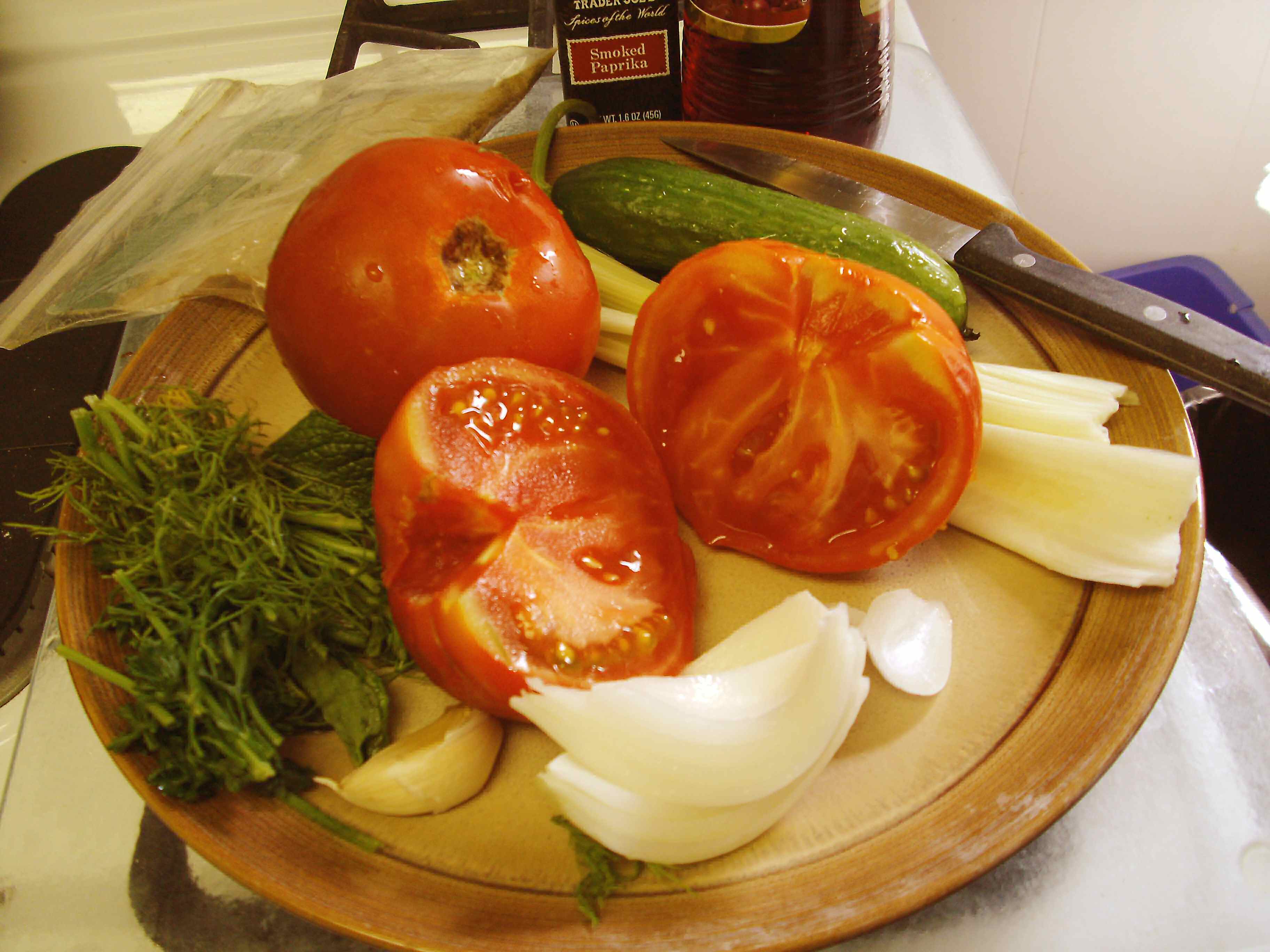
gazpachoingredients

My gazpacho has some extra ingredients like herbs and chile flakes–but nothing from the medicine cabinet!

So okay, five or six posts in a row–all summer long, in fact–with no recipes. Oy. I’m sure that says something about my summer between my daughter’s bat mitzvah in late June and the day she started back to school.

Contrary to the impression of no cooking, no cooking, especially in 100 degree heat (a sane approach to life if ever there were one) I have actually done some cooking, just not a lot of new dishes. So this post is just to catch up in summary form…

The bat mitzvah Saturday night dance party for instance–I made the cake for it, a huge monster of a Sacher torte. And yes, it was Duncan Hines devil’s food cake made with applesauce instead of oil for the layers, because it’s still better than from scratch, and a lot faster. None of my friends cook at all, I’m sorry to discover, and they were all bizarrely impressed that I didn’t get my cake from Costco, so despite how dismayed and embarrassed I was that they were fawning over a box mix cake, I took it as graciously as I could and didn’t tell them. It was actually a good cake, but huge. Four, count ’em four, boxes worth of DH for a very large 4-layer cake. Way too much. Apricot fruit spread between layers, killer chocolate ganache–from scratch, but easy–on top (another post will be dedicated to the shocking true story of ganache and its many creative uses, but it’ll have to wait until it cools down out here), plus a little creative decorating with strawberries and grapes by two friends when the upper layer split on the way to the forum, right before I could frost it, and I didn’t have the brains to just flip the whole thing over.

You know how that goes: you’ve rushed over to get there before the guests arrive, you’re wearing your grubbiest can-get-chocolate-frosting-on-and-no-one-notices black teeshirt and brown pants, you’ve forgotten your party clothes and your camera. Your friends see you looking harried and sweaty in the back kitchen, wielding a tub of ganache at a cracked cake and the chocolate fumes just get to them. They rush around sticking fruit on top like it’s kindergarten craft time again. They’re hard to stop once they get going, to tell you the truth. People really liked the cake anyway, and we had leftovers for the next 10 DAYS…still working it off.

TIP: don’t stick green grapes on top of chocolate ganache, they really don’t go all that well tastewise even if they looked fun at the time.

What else in the way of summer cooking? A bowl of dough in the fridge, turned into pitas and calzones (once the sun went down far enough that I could stand to turn the oven on for 20 minutes at a hop). Did that several times.

Frittatas–omelets for the three of us with mushrooms, onions, marinated artichoke hearts and feta, or spinach and feta, or just feta and feta…a lot of those, this summer, with about half the yolks removed and not missed at all. Makes a 10-minute supper, and you get your Julia Child mojo on when you go to flip it. You get to tell everybody to give you some room and keep the cat out of egg flippin’ range. Very impressive.

What else? Hummus–yet again, I know. Although I’ve made two batches this summer using chickpea flour instead of actual cooked chickpeas. Chickpea flour is raw, so you have to mix it up with water to a thick batter and then microwave it a couple of minutes, until it’s cooked through–it’ll be pretty thick, maybe even solid, but it’ll have lost the raw-bean taste when it’s done. Then I blended it in a food processor with water, garlic, lemon juice, cumin and tehina–which was fine, actually, and very smooth…until I packed it into the fridge and took it out the next day. It had set up like tofu, sliceable and slightly gelatinous! A little weird, no doubt about it. But still edible! and quick, dammit, very quick.

Other things–eggplant parmigiana, twice or three times, and really good. No apologies necessary.

Extra eggplant slices with a surprisingly good low-sodium chipotle salsa from Trader Joe’s and some low-fat mozzarella, microwaved and slid onto toasted ciabatta or fingerbread. Worth doing again, maybe even in casserole form–half salsa, half marinara, kind of a smoky parmigiana? Could be all right.

But it’s summer, you say. Where is all the fruit? You’re not wrong. Nectarines, plums of all shapes and colors, a few apricots, a few cherries, strawberries, and figs…all of them, eaten raw. But in the way of cooking (minimally, anyhow) I made a fantastic “raw blueberry pie” a week ago, cutting back a little on the sugar in the recipe I had from the San Jose Mercury News from years back, and using the microwave to cook the “jam” part (water, potato or cornstarch, sugar, 1 cup of blueberries, stirring madly every 30 seconds to avoid the starch turning into a rubber lump, and lime juice after the fact, once it thickened) before mixing in the other 3-4 cups of blueberries raw and sticking the whole thing in a graham cracker crust and chilling it.

But summer is mostly about tomatoes. Even in California, it is really, really HARD to get good tomatoes at the supermarkets, even in summertime (don’t even ask about corn, the prices are a disgrace to the nation). Unless you go to the Armenian corner grocery (where I’m headed yet again in about 5 minutes) to pick up bags and bags of huge, ripe Fresno tomatoes for salads. For about six or seven dollars, I can get ten or even more large beefsteak-style tomatoes…and these actually taste like something. They’re not the ones that go to the supermarket, because they just don’t last. They go to the small ethnic markets because they’re too ripe, and everyone knows that the regulars don’t shop small when it comes to tomatoes, peppers, eggplant and so on. They’ll get snatched up, no problem.

So what do you do when you get a couple of tomatoes that were pretty seriously ripe to begin with and are starting to split or get poked by the stems of the other tomatoes only a couple of days later?

I make gazpacho, because it’s a 5-second soup, it’s cold, it only takes what I have in the fridge, and I know I can eat half a cup at lunch every day this coming week and feel full for hours, especially in this heat. It’s the perfect diet food.

Well that, plus the fact that it makes me feel (momentarily, anyhow) like Carmen Maura in Women on the Verge of a Nervous Breakdown. It’s probably the most famous (mis-)use of gazpacho at the movies, and very funny. Continue reading

Sour grapes, aging grapes

Well, we never said they were Paul Masson, but really:

According to the LA Times last week,  a large Australian winemaker is ditching $35 million worth of their Napa-produced Beringer wines that have passed their “sell-by” date but haven’t been sold and distributed yet. Apparently they’re the exception on the US market, but it’s still pretty disconcerting to think of all that table wine going to smash.

Beringer is drinkable enough but supposedly doesn’t age like better-made wines, according to the parent company. I don’t see why not, unless it isn’t really wine–is that what they’re claiming? Can’t be. So in reality, it probably has enough tannins to age at least a little if you leave it alone in a decently cool dark corner unopened for 3 or 4 years. At least the cabernets and merlots, I would think. Might show a little improvement, if given a chance.

But the company is probably looking at the bottom line–they ain’t movin’, so why should we pay storage for another 3 years, because the supermarket chains won’t buy it that they’ve become better wines deserving of a higher price? And at the million-bottle level, I can see that argument. I can. Storage is expensive. And they can claim a business loss.

For home consumers, though, I’d say it’s worth taking a chance. One of the most interesting wine-tasting experiences I’ve ever had was the opening of 20-year-old bottles of California wines a friend had inherited from her late father. He’d been one of those early nuts–an enthusiast in Northern California in the 1960s and 1970s, when local winemaking was still in its infancy and not all that well thought of. Whenever he tasted something better than screwtop, he bought a case or so, opened up one or two bottles and put the others up to age in a part of the basement that had been dug into the side of a hill. The wines were okay to start with, maybe a bit better than that, and the makers became better known and better at their craft over time. But what started out as vin ordinaire did, after 5, 10, 15 years, transmogrify into something much more graceful, sophisticated, and  interesting in a number of cases.

Those wines have no match in the supermarket selection of 2- and 3-year-old bottles. So as an ordinary down-at-the-heels consumer without a fat trust fund, you probably can’t get anything like them without aging your own. Just because the wineries insist their wines are sold ready-to-drink-now doesn’t mean they have no further potential or that aging is a thing of the past. It just means the bigger companies don’t see much profit in it. But of course the small wineries up and down California always keep a few “library wines” for their customers to try–that’s how they end up selling a $15 or $20 bottle’s older cousin for $50, $150 or even more.

What for those of us living in apartments or lacking cooled hillside cave basements of worth? I’ve always been more ready than the average cook to play with my food and eat my mistakes as long as they don’t risk rampant botulism or salmonella. So this might seem tacky or harebrained: I’m not advocating those Continue reading

Little Green Footballs

…and Other Lessons from the Fillo Stratum

cheese and pesto triangles

Two or three weeks ago I got a frantic email from the assistant at my daughter’s Hebrew school: could I lead a cooking session for the 8th graders for an hour that Sunday?

Teens and preteens are not my specialty–I have a friend who’s really terrific with them; she’s an 8th grade and high school teacher and would rather deal with kids than write. I’m the other way around, and my own kid’s turning 13 very soon. Very soon.

Suffice it to say, my answer probably should have been, “Who me? Are you off your nut? Cook with preteens in only an hour?”

And then I thought–but wait. Fillo. It’s inexpensive (a big plus), it’s  easy enough to fold, it’s almost (if you squint) kind of a craft.  Like origami. Make some tasty and quick fillings for it (though no nuts–schools have gotten annoyingly leary of anything with nuts. How are you supposed to teach baklava? Eh? Eh???) and let the kids go to town, a couple of sheets of fillo apiece in the synagogue kitchen. An hour should do it, and it’s a cool, sophisticated food to know how to make–very different from the standard summer camp challah with blue or green food coloring.

So…I bought a couple of packets of fillo (about $2.69 for a roll of 20-24 sheets), a couple of pounds of loose-frozen spinach, an onion, some garlic, a bottle of olive oil and another bottle of canola oil (for the sweet fillings), a packet of dried apricots, a packet of dried figs, some farmer cheese (mistake, doesn’t taste that good; stick with ricotta) and some feta. And some dill and scallions I had at home. Also a lemon or two. I left the fillo in the fridge overnight to thaw slowly the way you’re supposed to, and not the way I usually do (i.e., take the thing out of the wrapper and let it sit an hour on the counter and then wonder why it cracks when I rush to unroll it).

I made the fillings the Sunday morning in a microwaver’s frenzy of immense efficiency:

  1.  Nuke a stick of unsalted butter in a bowl, pour it into a snaplock container.
  2. Thaw the spinach on a plate–4 minutes on HIGH. Take it out.
  3. Dump the dried apricots in a bowl with water to cover and a saucer on top–3 minutes. Meanwhile, start squeezing the spinach dry, and I mean dry, in handfuls over the sink. Nothing worse than soggy spanakopita. Except maybe soggy pizza.
  4. Take the apricots out, put in the bowl of figs with the stems cut off, some water and a lid, 3 minutes for them.
  5. Blend the apricots with a little sugar and water and lemon juice to make a thick paste. Get it out of the food processor and pack it in a disposable container with a lid.
  6. Do the same thing for the figs, only no sugar necessary.
  7. Rinse out the food processor, stick the scallions, wild thyme, fresh dill and basil in and chop them fine, drop in the spinach, a fat clove of minced garlic, and the feta. Pack that too.
  8. Grab all the bags with the goods and don’t forget the oils and the butter and the fillings and the extra feta and farmer’s cheese just in case there’s time to make some cheese-only filling there and somebody wants it. …

I hustled, I got to the synagogue kitchen on time, I set up stations around a stainless steel work table–foil sheets at each place, paper bowls with a dab of melted butter and a pour of oil, plastic baggies to go over everyone’s hands instead of pastry brushes, the carefully unrolled fillo under plastic wrap. The oven–on. The fillings–ready to rock. And then I waited. And waited.

An hour really would have been enough time for that class. But none of the kids showed up for the first 20 minutes because it was also the day the photographers were herding all the classes out into the basketball court area for graduation photos. So when they finally straggled in, all eight–and surprisingly, three of them were boys–I made them wash their hands and then set them to work.

The first thing I did was hand out individual sheets of fillo and pointed out that they were nearly as thin and tearable as tissue paper. They were all surprised when they saw it. None of the kids, who’d been cooking all year and who had attended a lot of bar and bat mitzvah celebrations, had seen fillo “in the raw”.

I got them started on spanakopita triangles–also known sometimes as bulemas (Greek root found here; you’ve heard of bulimia, right? Didn’t mention that connection, of course. You would never want to get into that with a batch of preteens. Don’t get too disturbed, though. The rough translation as used in Hebrew is “appetizers” or “things to gobble”. Of course, in Israel “bulmus” is also what they call anything like the American after-Thanksgiving shoppers’ frenzy or otherwise a run on the stock market…so much for appetites gone hog wild…)

I naturally thought fillo triangles would be a cinch for the boys especially–you do it the same way you fold a paper football and try not to get caught in class. Only with a little more butter and olive oil involved, and hopefully no punting in the kitchen, because I wasn’t gonna clean it up for them when the spanakopita went flying.

Here came the second generational surprise, though: none of the kids, not even the boys, had any idea how to fold a basic paper football! They’d never done it. Paper airplane? I asked desperately.  Continue reading

Frankenbeanies: Gigantes, take II

Giant favas or gigantes are really as big as they look

Giant favas or gigantes really are as big as they look.

No kidding. That’s a soup spoon on the right, up there in the photo. These giant fava beans are huge–which is part of the fun of cooking them.

Because I had so much trouble getting the nice-looking pre-peeled dried giant favas to cook last week (and the time before), I went and got the bulk giant favas with the brownish-greenish-pinkish peels left on this time. And I was right. Buying the ones with the peels still on means that the dried beans stay relatively fresh and cook up a lot better–and faster–than the pre-peeled ones.

To peel them, dump the washed and sorted beans into a big bowl of very hot-to-boiling water and let them sit about an hour. The peels will start to wrinkle around the edges and turn leathery-soft. A sharp little paring knife makes it easy to crack into them and pop them off. Then soak them overnight in cold water. (Or soak the beans first and then take the peels off. Whatever’s easier.)

These beans were clearly fresher than the pre-peeled ones–in the morning, the bean water smelled almost like fresh apple juice. Bizarre. Anyway.

Rinse and cover with fresh cold water. And then you can actually microwave them 10 minutes (for a pound of peeled gigantes in a bowl with water to cover by about an inch and a lid on top) and let sit half an hour and they’ll be about halfway there, then nuke again for 5-7 minutes once or maybe twice, with 20 minutes in between. Or you could simmer them on the stove about an hour.

Or of course you could buy them in cans, but where’s the fun in that?