• Enter your email address to subscribe to this blog and receive notifications of new posts by email.

    Join 241 other subscribers
  • Noshing on

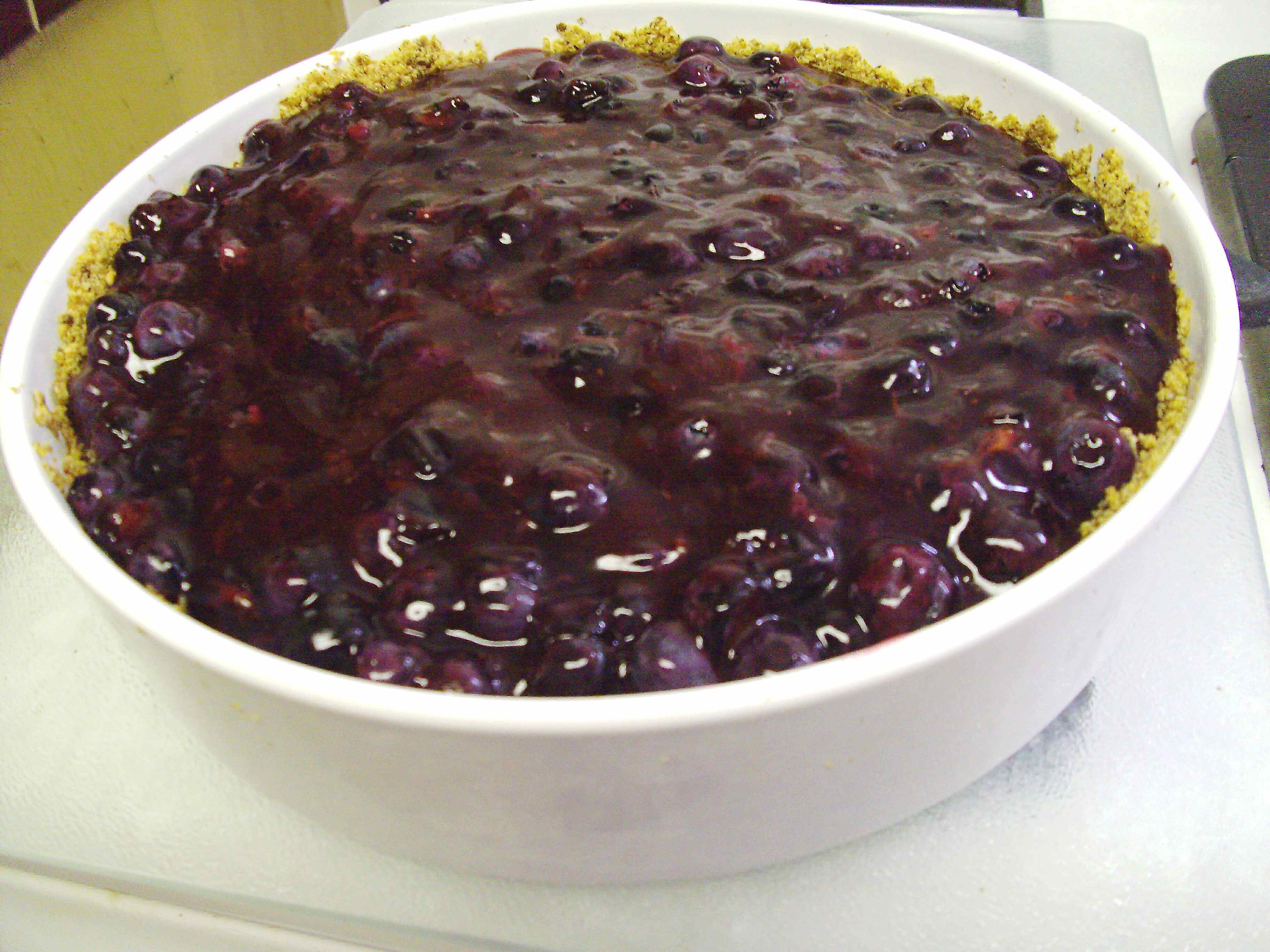
    raw blueberry pie with microwaveable filling and graham cracker crust

    This mostly-raw blueberry pie is a snap to make and very versatile--the filling microwaves in a few minutes, and you don't even have to bake the zippy gingered graham cracker crust--perfect for a hot Fourth of July and all summer long.

  • Recent Posts

  • Contents

  • Archives

  • Now Reading

  • See also my Book Reviews

  • Copyright 2008-2024Slow Food Fast. All writing and images on this blog unless otherwise attributed or set in quotes are the sole property of Slow Food Fast. Please contact DebbieN via the comments form for permissions before reprinting or reproducing any of the material on this blog.

  • ADS AND AFFILIATE LINKS

  • I may post affiliate links to books and movies that I personally review and recommend. Currently I favor Alibris and Vroman's, our terrific and venerable (now past the century mark!) independent bookstore in Pasadena. Or go to your local library--and make sure to support them with actual donations, not just overdue fines (ahem!), because your state probably has cut their budget and hours. Again.

  • In keeping with the disclaimer below, I DO NOT endorse, profit from, or recommend any medications, health treatments, commercial diet plans, supplements or any other such products.

  • DISCLAIMER

  • SlowFoodFast sometimes addresses general public health topics related to nutrition, heart disease, blood pressure, and diabetes. Because this is a blog with a personal point of view, my health and food politics entries often include my opinions on the trends I see, and I try to be as blatant as possible about that. None of these articles should be construed as specific medical advice for an individual case. I do try to keep to findings from well-vetted research sources and large, well-controlled studies, and I try not to sensationalize the science (though if they actually come up with a real cure for Type I diabetes in the next couple of years, I'm gonna be dancing in the streets with a hat that would put Carmen Miranda to shame. Consider yourself warned).

“The Trip”: supposedly about the food?

Steve Coogan and Rob Brydon have paired up again in a new movie called The Trip  and I actually got to see it in an actual movie theater Thursday! First time I’ve been in a theater since Ratatouille came out. (Hadn’t realized that was going to be a foodie movie; at the time I just wondered why they didn’t make good movies like that for grownups anymore.)

I was going to see The Trip anyway because I’d seen Tristram Shandy several years ago on disk and got bitten by Coogan and Brydon’s backstage banter. I was looking forward to seeing how the pair,  who had played exaggerated versions of themselves in the first movie, were planning to stretch their dueling Robert deNiro and Al Pacino impressions from the end credits of Tristram Shandy–by far the best shtick in the whole thing–to a two-hour buddy road trip format.

And The Trip was also supposed to be about food–specifically, the current state of northern England’s upscale eateries (now apparently as haute as anywhere on the continent) and the shockingly savage and comical food reviewing traditions of British news media.

So I dragged my husband with me to the matinee and promptly started disregarding the “please, no talking during the film” signs. What fun is it to sit there not giggling horribly as Coogan and Brydon get on the road north to Yorkshire, or saying nothing to my mate as they try to correct each other’s Michael Caine impressions and improve on them in increasingly loud voices while being served all manner of square food on long rectangular plates lapped with flavored foams à la Adrià? With the inevitable scallops for starters, and a number of historical interludes–a sleep in one of Coleridge’s beds, visiting the church ruins in a town where Ian McKellan did not actually grow up, but it’s got the same name, so it counts?

The truth is, of course, that The Trip is much less about food (despite several spliced-in foodie snippets of what’s going on in the kitchens and pans where tasting menus are being prepared) than about love, loss, what’s left to look forward to in one’s encroaching middle-40s, and how to impress girls with your Michael Caine (or Al Pacino) impressions at a 3-star restaurant in the Yorkshire dales or the Lake District.

Of course, the sixth or seventh rendition of Michael Caine (interspersed with Pacino and friends) starts to wear even on our intrepid actors-almost-playing-themselves as they grapple with the hearts they refuse to admit are pinned to their sleeves. It turns out there’s a solid reason for this: Continue reading

The Minimalist Makes His Exit – NYTimes.com

You’ve probably already seen this–Mark Bittman is stepping out of his role as The Minimalist at the New York Times.

The Minimalist Makes His Exit

I don’t agree with some of his recipes. Desserts with more butter than they really require to be good, expensive Italian hazerai (Yiddish for “that greasy pig stuff”) in a lot of the food, and too much reliance on salt as a flavoring, though he’s nowhere near restaurant-standard. To my mind, these could use a remake. I also don’t think Bittman always walks the walk when it comes to touting nonmeat meals and affordable, commonsense ingredients.

But you can’t fault his enthusiasm and you definitely can’t fault his sense of fun on video. I don’t really think he’ll be able to parlay his next NY Times gig, on food politics and the like, into personal parodies of Blue Man Group, The Thin Man’s Return (He Couldn’t Resist the Spaghetti), or Legend of the [you-name-it Kung Fu] Master.

But I could always be wrong. In the meantime, he’s given us more loose-jointed “101 variations” kinds of roundups for summer salads, Thanksgiving side dishes, etc. than almost anyone else and has written two gigantic tomes on How to Cook Everything –even though I’m not sure I’d really want to cook everything. I mean, everything? Too many dishes to wash. Makes me tired just thinking about it.

Going retro for real croissants

I’m not really a follow-the-recipe-in-the-cookbook kind of person. But I love looking through cookbooks that have interesting techniques. Learning to cook means, for me, being willing to eat your mistakes or half-good attempts and try again with tweaks. It also means playing with your food until it works for you.

So croissants are one of those things I try out again every once in a while, because the dough is really not as much trouble to put together as it sounds. Most of the time is just letting the dough rest in the fridge.

Mostly I keep trying because I’d really like it to work well eventually, as opposed to half-right. It’s something about the baking that’s always giving me trouble–the outside will be hard and the inside will be steamed and still doughy. Or else the things will puff up  enormously but will be more like a popover with absolutely no layering inside because the butter layers melted away into the dough during the long rise. Or if I roll them and bake them right away straight out of the fridge they won’t rise at all in the oven and they’ll be tough. Or they’ll be gummy. Or flat tasting. Or even a little bitter.

None of this would be so bad if it were just my own fault for noodling around with a classic. But the last few times I’ve tried to follow Dorie Greenspan’s instructions from Baking with Julia more dutifully than usual, and it just hasn’t worked out right at all. Worse, in fact, than some of my offhand attempts a couple of years ago when I changed nearly everything there was to change, starting with cutting the fat in half and ending with an almond-flour attempt that actually didn’t come out so far off. Except, of course, for the gummy insides.

Julia Child, "The French Chef" DVD from PBSBut last week I stumbled across the elusive two-part The French Chef series of DVDs from…not PBS, which is probably still out of stock, but…my local library. The disks (2 and 3 disks, respectively) are a bit scratched up and tend to halt at awkward moments unless you fast-forward or skip or rewind or whatever tricks I could come up with.

But there was a croissant episode from the late 1960s in black-and-white, just as I remembered the show from when I was 4 or 5 years old. So I watched it, wondering how dated it was, whether the old recipe was anything like the one she lent her cachet to in the mid-1990s with all her guest expert bakers, and what the results would be like. At the time of this early show, she’d been home in the States less than 10 years, had just delivered Mastering the Art of French Cooking a few years before, and was still extremely rigorous about everything. Or was she?

For the croissant show, she discusses different flours, the toughening effect they might have on the dough and how to counteract it with a bit of salad oil or by mixing 2 parts pastry flour to 1 part all-purpose. But then she includes a frozen commercial bread and pizza dough as a possible alternative to making your own yeast dough. Not the tenderest choice, she says, but for someone who doesn’t yet feel at ease making their own, it’s an encouragement to try making croissants at all, and it works all right. She’s astoundingly practical in these early shows even though some aspects of her cooking aren’t (exaggeratedly rich sauces for sole, for example). And I remember that back in those days, you couldn’t get real croissants in American bakeries. If you wanted them, you had to make them at home.

Dorie Greenspan’s modern, supposedly streamlined, layering process calls for cutting the butter into cubes and mixing them into the dough before rolling out, doing six “turns” with three rests in the fridge, cutting, stretching and rolling the croissant triangles in an elaborate way with some extra scrap dough in the middle for shaping, rising them for 2 1/2 – 3 hours, gilding with egg wash and baking at 350 F for about 20 minutes.

Julia’s 1960s version is somewhat different–more aggressive, and probably much closer to classic boulangerie technique. It’s also simpler. She makes a very simple milk-based yeast dough in a bowl with her hand and kneads it a couple of minutes, picking it up and slapping hard on the work surface, all while talking flour grades (you could talk Yankees versus Red Sox if you want–she probably could have too, come to think of it).

She takes a stick of butter and bashes it into a softened flat mess with a big solid rolling pin, then scrapes it up and flattens it into a square and rechills it. She lets the dough rise until double on a heating pad, then chills the dough. Then she takes the butter and the dough out of the fridge, wraps the square of butter in the larger piece of dough and then rolls and folds and turns and chills for a full 2 hours each time, but only for a total of 4 turns–2 sets of 2–before rolling and cutting out the croissants.

She doesn’t put an extra lump of dough in the middle when she rolls the croissants. She doesn’t stretch them a lot. And she does let them rise in a relatively cool room, but only for an hour or hour and a half until just Continue reading

Lightening Up Apple and Almond Cake

Since Nigella Lawson’s Feast came out a few years ago, her “Damp Apple and Almond Cake” has been praised by food bloggers, morning tv show hosts, and just about everyone else who’s tried making it.

Most of her dessert recipes are not for the health-conscious. In the past 10 years, most of her food has become if anything a lot heavier and gooeyer and richer, migrating from Thai and Vietnamese summer salads with sharp clean flavors to avocado AND bleu cheese AND sour cream WITH taco chips, or chocolate bar AND non-natural peanut butter AND whipping cream AND caramel as an ice cream sauce. Or chicken pot pie WITH a lot of bacon in it and no vegetables AND a store-bought puff pastry top (a whole sheet goes for a mere two servings). I can’t think how far she’ll take things next.

But the  “Damp Apple and Almond Cake”–despite the less appetizing connotation of “damp” in American speech (I think “moist” would probably be the equivalent word over here, or at least I hope so. It would at least conjure up fewer images of seeping rot under the stairwell)……….. okay, where was I with all the parentheses? Oh yeah.

What people have to say about this recipe is that it works as written, and it’s really good. No mean thing these days.

So okay. I have almond meal, I have apples, I have a fresh lemon, and I have some decent vanilla for a change (the Kroger stuff I bought for my daughter’s birthday cake back in mid-summer was shamefully weak). And I have eggs. That’s basically what you need to make this cake.

But it’s blazingly, disgustingly hot, 100+ Fahrenheit, yet again in Pasadena. And–AND–I look at the original recipe (serves 10-12) and realize that while the almond meal is a good move–much, much lower carb than flour–the recipe requires 8 eggs. Eight. E-I-G-H-T. Which puts it in the European spongecake class of baking. My grandmother made a similar thing, only with flour and chocolate chips, and probably 12 eggs, for a huge wheel of a cake.

And the directions call for simmering the apples down to a thick applesauce, then cooling and blending in the food processor with a huge, heavy amount of almond meal and a fairly high amount of sugar and all the eggs, and it’s a “dense” cake. No wonder.

Three and a quarter cups of almond meal. Dense. And almond meal tends to require a little less sugar than flour-based cakes to register sweetness–maybe that could be cut down too?

Those eggs–do you need all the yolks? Do you need all eight eggs for that matter? And while you’re at it, why not take advantage of what eggs do best, since it’s a European-style cake with no other leavening. Separate them and whip the whites to fold into the batter.

So here was what I came up with on a hot September pre-Rosh Hashanah afternoon.

Lightened-Up Apple Almond Cake

  • 3 fairly big Granny Smith apples, peeled and sliced or chopped (~23-25g carb each or ~75)
  • 2 c. almond meal (see Trader Joe’s for a decent-priced 1-lb bag at about $4) (20 g carb/cup or 40)
  • 2 T. flour or matzah cake meal (~10 g carb)
  • 1 c. sugar (200 g carb)
  • 3 yolks
  • 4 egg whites
  • 1 t. vanilla
  • juice of a lemon
  • 1-2 oz. orange juice (optional) (~3-5 g carb)
  • grated rind of half a lemon
  • grating of nutmeg
  1. Put the apple slices or chunks on a microwaveable dinner plate and microwave on HIGH 3 minutes.
  2. Blend the almond meal and sugar in a food processor until very fine (whiz several seconds, good enough)
  3. Add the yolks, apples, flour or matzah meal, lemon juice and rind, vanilla, orange juice and nutmeg and blend well.
  4. Whip the egg whites separately in another bowl large enough to pour in the batter from the food processor. When the whites are stiff (can be done easily enough by hand in only a minute or so with a big balloon whisk, just tip up the bowl and hold it at a slight angle in your other hand, or else use your method of choice), start pouring the batter into them a little at a time and folding with the whisk. I know this is backward from the usual method but it works out ok and saves a third bowl…
  5. Pour into a deep-sided microwaveable casserole or a deep dish pyrex pie plate (chancy, may spill over a bit).
  6. Set a microwaveable soupbowl upside down in the middle of the microwave turntable. Center the casserole or pie plate on top, and microwave uncovered 7 minutes on 70% (for an 1150ishW oven). Stop if it seems to be overflowing and wait a minute before continuing. When it stops rising and settles back in the plate, you might cover with a dinner plate and microwave another minute or so on HIGH until you’re convinced it’s cooked all the way down to the bottom.

Cool and slice–the total carb count is about 325 for the recipe, so 1/16th should be about 20 grams, 1/10th, if you can eat that much, is 33 grams, etc. It’s light, soft, substantial and rich-tasting, and 1/16th slice was pretty good tonight for all the testers at my table. And it only took 4 eggs and a cup and a quarter less almond meal. And about half the sugar of Nigella’s recipe but all the apples.
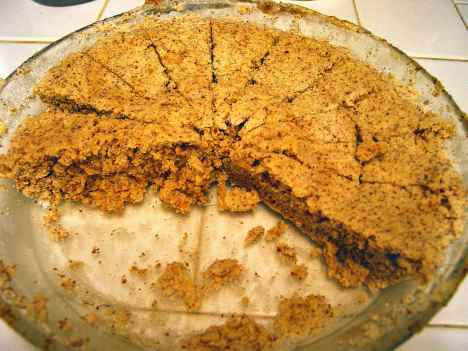
Lightened-up microwave version of Nigella Lawson's "Damp Apple and Almond Cake"

Not a looker in the microwaved version here, which doesn't brown the top, and I didn't decorate with slivered almonds or lemon slices, but the flavor's so intense and tangy that the 1/16th wedges here were perfect for a quick light dessert.

Verdict—Really, really good, and when I do it again maybe I’ll have cool enough weather to try out the oven so it’ll brown as well (about 25 minutes). I would probably go for a deep-sided casserole or even a soufflé dish. Then I could top it with slivered almonds as in Lawson’s version, and perhaps capture a little more of the rise from the egg whites without it collapsing down afterward.

In a regular oven it’s best to oil the pan and dust it with a little almond meal, but I didn’t have to for the microwave–probably for the same reasons it doesn’t brown on top, it also doesn’t cause a lot of sticking on the bottom.

Another change I might make next time would be to add just a couple of drops of almond extract–not enough to overpower the lemon and apples, just enough to play up the almond meal. This time around when I reached for the little bottle I discovered it was bone dry–hence the nutmeg, which actually worked out quite well.

But all in all, and despite the fact that it LOOKS like a typical Passover choke cake, it really isn’t. It’s very moist and even this way the flavor was wonderful and satisfying. So b’te’avon (bon appétit in Hebrew) and kudos to Nigella Lawson, and maybe this will encourage you (and her) to lighten up a little.

Unappetizing: Nutrition “Awareness” on Top Chef

Perhaps it’s a futile attempt to understand how restaurant chefs think about food and nutrition, but lately I’ve been watching the very warped “Top Chef” episodes for the last couple of seasons–easy to do online. I can’t help wondering not only at the contestants, all of whom seem to display basic ignorance of what used to be called the “Four Food Groups,” but at some of the judges who fault them on nutritional challenges.

In this season there have been two, the School Lunch Challenge and–not that the judges even thought about it as a nutritional challenge, which they should have–the Baby Food Challenge. In both, the judges seemed at least as lacking in nutritional knowledge as the contestants, and in some aspects even worse.

The School Lunch Challenge brought out scathing comments on the show and on a number of blogs, particularly when the bottom-ranked chef, who went home for her gaffe, attempted to make a banana pudding palatable by adding sugar. Tom Colicchio made a big deal of her adding two pounds of sugar to the pudding–which was to feed 50 students.

And admittedly it’s not great for nutrition, but it was hardly the disaster he and the other judges made out. If anyone had bothered to whip out a calculator and known how to use it for pounds-to-kilos conversions, they’d have discovered that the two pounds of sugar amounts to 0.91 kilos. Or 909 grams, to be a little more precise (which we shouldn’t, the chef was eyeballing what she added). Divide by 50 and you get 18 grams per serving or about 4 teaspoons–not all that surprising an amount of sweetener in any prepared dessert. Add that to the starch already present as thickener and the sugars from the milk and bananas and you probably have 30-40 grams of carb or thereabouts per half cup of pudding.

It would be a lot for someone diabetic, like my daughter, but not disastrous as long as she knew how much carb was in it, and it certainly wouldn’t be disastrous for most school kids if the rest of the meal was balanced with low-fat protein and vegetables and not too much other starch.

But actually, most of the lunch entries were pretty starchy. The fact that they didn’t all have as much noticeable added sugar is almost immaterial–starches break down into sugars. You have to count them all.

What really stood out was the pathetic nature of the criterion “to include a vegetable.” One that was most-praised–a slab of caramelized (talking of sugar) sweet potato under a chocolate sorbet as a dessert–was mostly a starch, though in its favor it had vitamin A and fiber. Another team served celery (no vitamins and very low fiber, despite the stringiness) with a peanut-butter mousse (why, oh lord, not just peanut butter? chef-think at work?) piped out directly onto the celery, supposedly so kids would eat it. No one liked the mousse because it looked Continue reading