



I know bourekas aren’t health food, they’re party food, but it doesn’t stop me from wanting to make and eat good ones in (small, sane, occasional) quantities.
Key to the desire for bourekas of worth is my never-ending hunt for a pastry dough with all the right qualities–lighter, tenderer, massively flaky, and oh, while we’re at it, much less heart-stopping than puff pastry or most pie dough, but still capable of flaking and puffing up nicely. I almost had it a couple of years ago with an Armenian dough that calls for a little vegetable oil in with the butter, a bit of cider vinegar for tenderness and an egg to help out the puff. But with butter, there’s automatically a lot of saturated fat, plus it takes more work than I like.
Enter the nondairy, oil-based borekita dough. Israeli (Turkish, Bulgarian, Sephardic…) bourekas, nowadays usually made with commercial puff pastry and sold in characterless boxes or plastic-wrapped trays from the supermarket, are nonetheless wildly popular with almost everyone in The Land whether they voted for Bibi or Benny. The boureka is not in doubt.
Puff pastry is nice enough in most circumstances–after all, it is what I’m aiming toward, or would ideally like to be aiming toward, if I can get away with something lighter. But after a while the packaged versions of puff-pastry bourekas all start to taste the same–salted potatoey stuff, indistinguishable through the mouthful of flakes, and not exactly fresh.
Homestyle boureka dough is much less puffy, more like the dough for sausage rolls. But still–less rich, usually made with oil rather than butter, so it’s both nondairy, to go with meat meals if you keep kosher, and lower in saturated fat (unless you go big on cheese fillings, anyhow) and lower on fat percentage generally. It’s also more economical, more delicate and less oversalted, and it doesn’t overwhelm the fillings.
But the real tests of how low on fat you can go–how well does it flake? How does it taste?–require a head-to-head comparison of different doughs with different fat content. Since it’s down in the 80s I decided to do small batches of each type and see how they worked.
There are two common versions of this home-style boureka dough, a more-oil version and a more-water version.
More oil than water
Al HaShulchan (“On the Table,” the Israeli food magazine) editor Janna Gur‘s recipe on her English-language site is very simple especially if you weigh everything out on a digital food scale (easier and more accurate than trying to juggle dry vs. wet measuring cups and scooping and sweeping and sifting). By weight, it’s about 50% fat to flour–four parts flour, two parts salad oil, one part water, a little but not too much salt. Her recipe makes about 50 borekitas; I decided to quarter that for this test because I’m not stupid and I know myself, and what was I going to do with 50?

The dough for this version has the texture of shortbread or playdoh, very short, and oil will definitely coat your hands when you pinch off walnut-sized balls to roll out for the borekitas, but at least it’s polyunsaturated, not solid fats. Because it’s so oily and you handle it so lightly, there’s no gluten built up. The dough is a bit fragile and rolls out a little ragged as you can see above, but you can roll, fill and bake right away.
Less oil, more water
Bureka Boy, whose Is-that-my-bureka blog, with its wealth of Sephardic and other Jewish recipes, paused for posterity in 2009 (though recently it looks like he may have shifted to Facebook or Instagram or both), has a smoother dough with the proportions of oil and water reversed, so about 25% oil to flour by weight. The water is added very hot when you stir it in (much like jao tze dough), so the dough develops gluten and needs an hour’s rest after mixing and kneading. It’s still quite oily when you go to pinch off individual balls for the borekitas, but it’s more elastic, with a smooth surface and better strength to roll it thin without breaking. You can handle it more and get neater pinched edges on the seal.


So…on to the Flake-Off!
Janna Gur’s Borekita dough, cut down to 10 or 12
Because it’s got so much more oil than water, the dough is very tender and flaky when baked, but it’s a bit rough and fragile and prone to cracking after rolling out, so handle it gently. It needs no resting because of the high oil content and light handling, so it’s a bit quicker to mix up and bake for a party.
- 1 c (120 g) flour
- 2 oz (60 g, 1/4 c. or 4 T) salad oil (canola, soy, corn, safflower, grapeseed, light olive)
- 1 oz (30 g, 1/8 c. or 2 T) water
- large pinch of salt (1 g or a bit less–for the original, I think it was a teaspoon or 6 g for about 4-5 times the amount of dough, but here the salt taste comes through plenty strong as-is and more would be gagging, especially with a savory filling)
- beaten egg for gilding
- optional sesame or nigella seed or grated cheese for sprinkling on top
Preheat the oven to 400 F (180-200 C? I think).
Mix the oil, water and salt together in a bowl (it will turn cloudy and emulsify thanks to the salt). Stir in the flour gently until just combined, knead once or twice with a fork or your hands, it will be very oily. Break off 10 or 12 1″ (walnut-sized) pieces, roll into balls and flatten between sheets of plastic wrap or parchment paper with a rolling pin to about 4-5 inches (10-12 cm) in diameter.
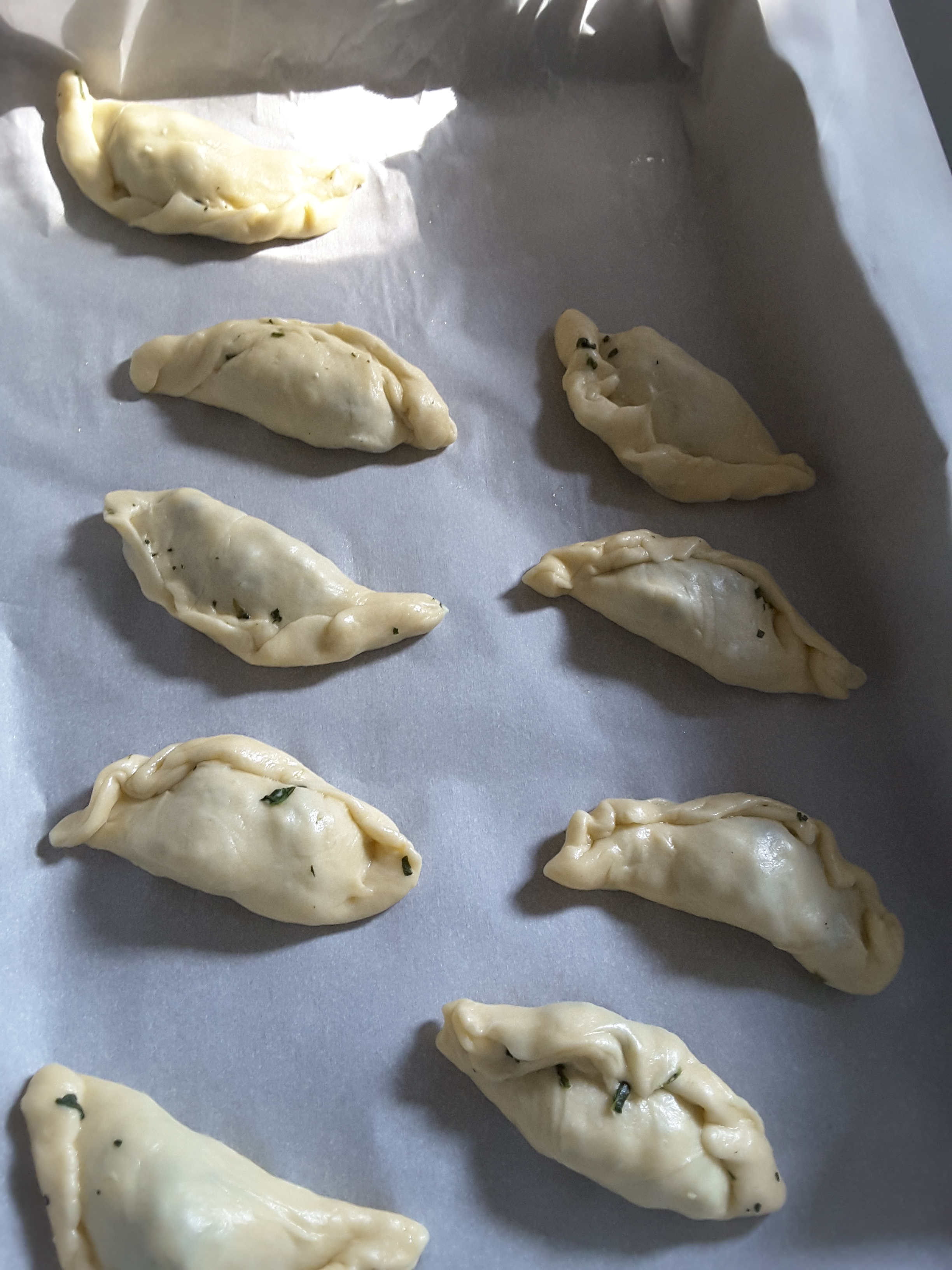
Lift one edge of the dough circle off the plastic or parchment paper as gently as you can with the help of a butter knife or spatula and fold it over the filling so the borekita is half-moon shaped (same as for empanadas, sambusak, turnovers, hand pies, jao tse, etc.; it’s all the same general idea). Press the edges together to seal in the filling. To be decorative, you can either crimp the edges with the tines of a fork or pinch-and-roll the edges over gently with your fingers for a scrolled edge (this is a little easier with the other less-oily dough below). If the dough cracks, smooth it over gently with your finger as best possible. Lift each borekita gently and place on ungreased parchment paper or foil on a sheet pan. Brush the tops of the borekitas with a beaten egg and sprinkle on sesame seeds if desired.
Bake at 400 F for 20-25 minutes until golden brown, crisp and smelling delicious. >>>Let the borekitas cool before digging in–hot oil is really hot, and these are usually served just-warm or at room temperature anyway. Because of the oil content, you may want to cool them on paper towels.
— — — — —
Bureka Boy’s Version
(also adapted for 10-12 borekitas and less salt than on his blog)
- 1 c flour (120 g)
- 1 oz oil (30 g)
- 2 oz very hot water (60 g)–can be microwaved 15 s or so in a mug
- 1 g salt–maybe again, just a pinch
- 1 t lemon juice (which I forgot to put in, but it would have tenderized this better)–use cider vinegar if you don’t have lemon juice
Stir the flour and salt together, lightly stir in the oil and lemon juice to get the shaggy beginnings of dough, pour on the hot water and stir thoroughly, then knead lightly. The dough should be firm but elastic and smooth. Cover and let rest at room temperature for an hour to relax the dough before breaking off pieces and rolling it out.
Preheat the oven to 400F/180-200C. Roll out, fill, gild and bake the same as for Janna Gur’s recipe above.
Fillings
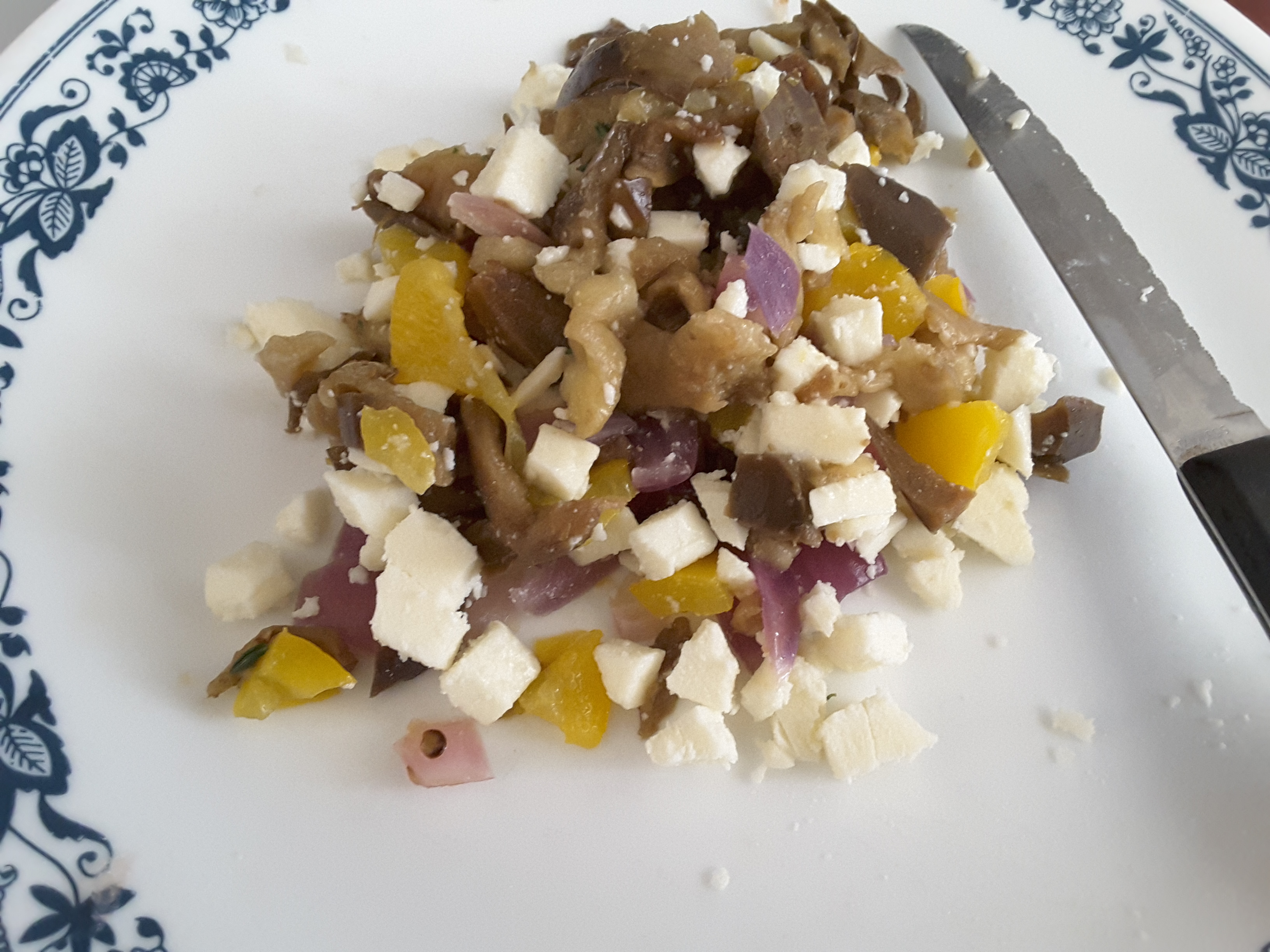
For either mini-batch of dough, fill with a spoonful of any relatively quick savory vegetarian filling that’s not too drippy. You can take advantage of your microwave oven to precook these and drain any liquid off quickly before stuffing bourekas. About 1 cup will be enough for 10-12 borekitas:
- microwaved eggplant (or some leftover eggplant, pepper and onion salad), drained and chopped with a little crumbled or diced feta, paneer or queso fresco-type white fresh cheese and a little thyme or marjoram
- spanakopita-style filling: microwaved and squeezed-out spinach, crumbled cheese, and mixed chopped herbs–dill, thyme, a bit of garlic and/or scallion, a tiny grating of nutmeg
- microwaved chopped mushroom and onion, nuked on an open plate for 1-2 minutes until wilted, drained, then mixed with a bit of thyme and optional garlic
- microwaved and mashed/chopped potato, or else finely-chopped cauliflower, wilted with optional chopped onion on an open plate in the microwave to parcook as for the mushroom filling, then drained well and mixed with cheese and some thyme or or marjoram
- or just queso fresco-type cheese, crumbled and mixed with a small sprinkle of thyme or nigella seed.
I don’t include beaten eggs or flour in the fillings even though they’re listed as a binder in many traditional recipes–this is impromptu and doesn’t really seem to need it. I do gild the tops of the sealed borekitas with eggwash before baking, though.
The results
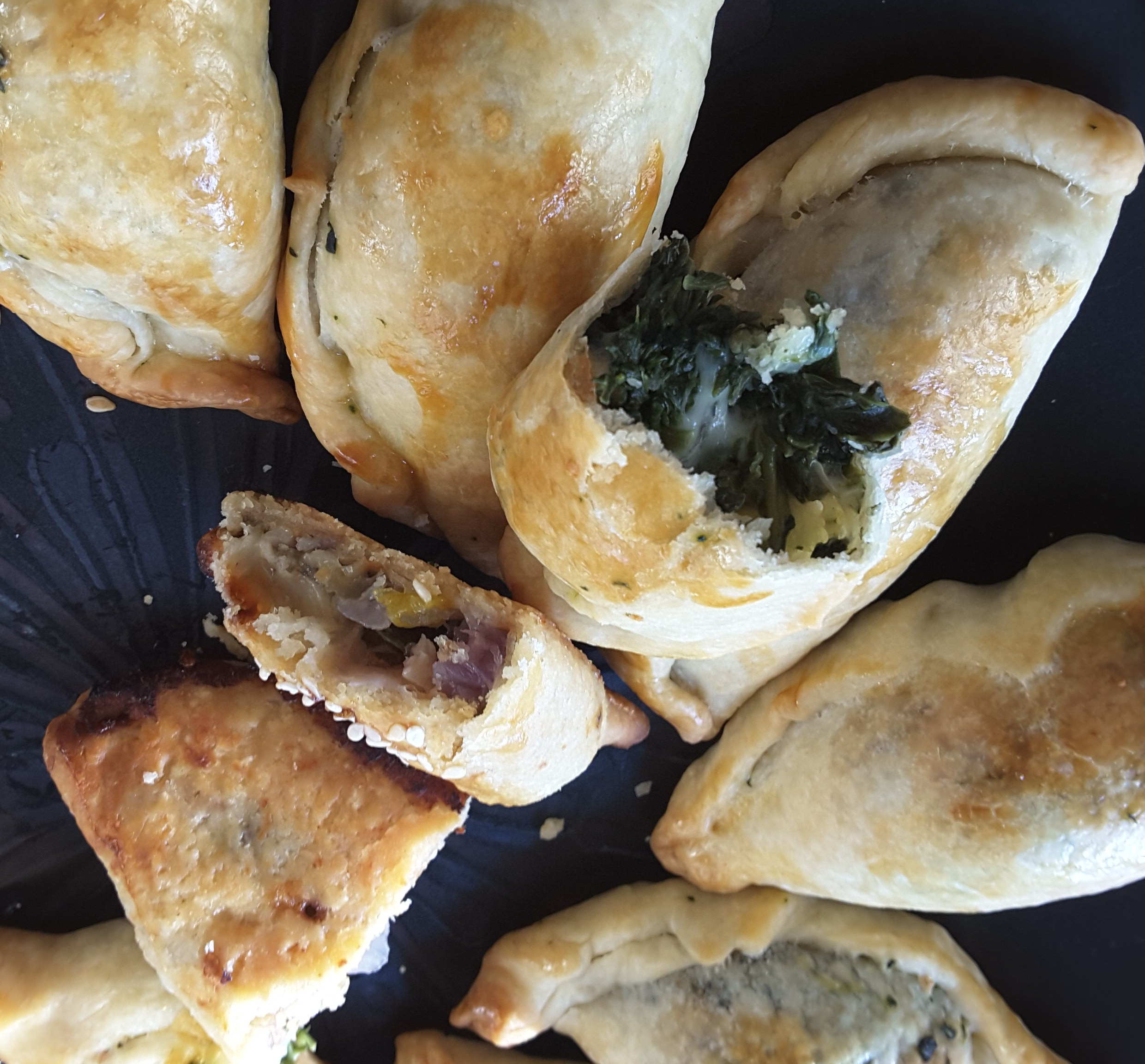
Janna Gur’s more-oil version is definitely quicker; there’s no gluten worked up so you don’t have to wait to shape and fill the borekitas. They don’t puff up much but once they’re done they’re very tender, somewhat flaky and a little crisp on the outside while still hot, especially if you’ve brushed on some beaten egg before baking. It would have been nice if the dough had puffed into layers, like fillo or puff pastry, but it didn’t. With a chopped eggplant/pepper/onion salad mixed with diced queso fresco and a little thyme, it was surprisingly delicious.
Bureka Boy’s more-water version definitely builds up gluten within a few seconds of stirring in the hot water, and it’s still got a lot of stretch after letting it rest an hour, so I had hopes of puffing. It shaped better, as noted above, but didn’t puff up very much in the oven either. For this one I used nuked and squeezed-out spinach mixed with diced queso fresco, a bit of grated garlic and a tiny sprinkle of nutmeg, a classic Italian-style flavoring that was also good here. The baked shell was crisp on the outside, very thin, a little less tender than Gur’s and more crusty, like a tiny version of calzone to the bite. It did show a bit of flaking and tenderized slightly as it cooled. As I note in the recipe for it, the lemon juice I forgot would probably have helped make it tender.
Overall, which is better? Both versions are pretty good, and neither contains saturated fat in the dough, but the calorie content is obviously quite different since one contains twice as much oil for the same amount of flour. So it depends on your personal preferences–do you like it tenderer and not mind the evident oiliness of Gur’s dough, even after baking? Or do you prefer something just a little breadier, like a mini-calzone, only crisper and thinner?
My version, for pies
Of course, as in The Land, you could always go half oil, half water and split the difference. I decided to do this for both a dairy and a nondairy version for a plum galette. The results were pretty encouraging–tenderer and flakier than BurekaBoy’s, but less oily than Janna Gur’s, and a pretty respectable taste for something without butter. That post is next up; this one’s long enough as is…meanwhile,
B’te’avon! (bon appétit, mangia bene, eat nice, nosh!)
Filed under: appetizers, Food Blogs, Food Magazines, frugality, holiday cooking, Revised recipes | Tagged: baking, food, recipes, vegetarian cooking |
 Slow Food Fast