• Enter your email address to subscribe to this blog and receive notifications of new posts by email.

    Join 241 other subscribers
  • Noshing on

    raw blueberry pie with microwaveable filling and graham cracker crust

    This mostly-raw blueberry pie is a snap to make and very versatile--the filling microwaves in a few minutes, and you don't even have to bake the zippy gingered graham cracker crust--perfect for a hot Fourth of July and all summer long.

  • Recent Posts

  • Contents

  • Archives

  • Now Reading

  • See also my Book Reviews

  • Copyright 2008-2024Slow Food Fast. All writing and images on this blog unless otherwise attributed or set in quotes are the sole property of Slow Food Fast. Please contact DebbieN via the comments form for permissions before reprinting or reproducing any of the material on this blog.

  • ADS AND AFFILIATE LINKS

  • I may post affiliate links to books and movies that I personally review and recommend. Currently I favor Alibris and Vroman's, our terrific and venerable (now past the century mark!) independent bookstore in Pasadena. Or go to your local library--and make sure to support them with actual donations, not just overdue fines (ahem!), because your state probably has cut their budget and hours. Again.

  • In keeping with the disclaimer below, I DO NOT endorse, profit from, or recommend any medications, health treatments, commercial diet plans, supplements or any other such products.

  • DISCLAIMER

  • SlowFoodFast sometimes addresses general public health topics related to nutrition, heart disease, blood pressure, and diabetes. Because this is a blog with a personal point of view, my health and food politics entries often include my opinions on the trends I see, and I try to be as blatant as possible about that. None of these articles should be construed as specific medical advice for an individual case. I do try to keep to findings from well-vetted research sources and large, well-controlled studies, and I try not to sensationalize the science (though if they actually come up with a real cure for Type I diabetes in the next couple of years, I'm gonna be dancing in the streets with a hat that would put Carmen Miranda to shame. Consider yourself warned).

Tipping the scales at Whole Foods

From The Los Angeles Times today:

Whole Foods paying $800,000 for overcharging in California

Pricing violations included not zeroing out the container weight when weighing prepared items from the food bar, shorting weights on packaged goods, and other problems.

This of course is bad practice toward consumers, but it doesn’t really address the critical issues with Whole Foods.

Yes, Whole Foods has been fined for pricing violations in California. The court injunction will mean five years of oversight and audits. But the real problem is beyond court remedies: everything’s overpriced and the customers seem to like it that way.

Produce prices that can rise to $10/lb for things like cherries when other nearby supermarkets are charging maybe $4-5. Fish prices in the $30/lb range. Whole Foods trades on a reputation for sourcing more variety than the average chain supermarket, and it does achieve that, but not everything it carries is really so exclusive that it justifies a higher price tag.

And in any case, the real money (other than the food bar, which is up to about $8/lb. across the board, whether for roasted eggplant and peppers or for things like canned kidney beans and flaked tuna and cucumber slices) is in cosmetics and pharmaceuticals parading as dietary supplements (and vice versa). Whenever I go into Whole Foods for a small coffee and a roll, the person ahead of me in line is inevitably ringing up more than 100 bucks worth of things like holistic soap bars at $5-10 apiece (compare “Ivory” bath bar 10-pack at about $6 at the local Ralph’s/Kroger’s) and cases of “vitamin waters” at about $4 per bottle, and dietary supplements with a $40-50 fantasy surcharge per bottle. And maybe a scrawny bunch of kale that they’re not sure how to deal with.

An Appreciation of Lox

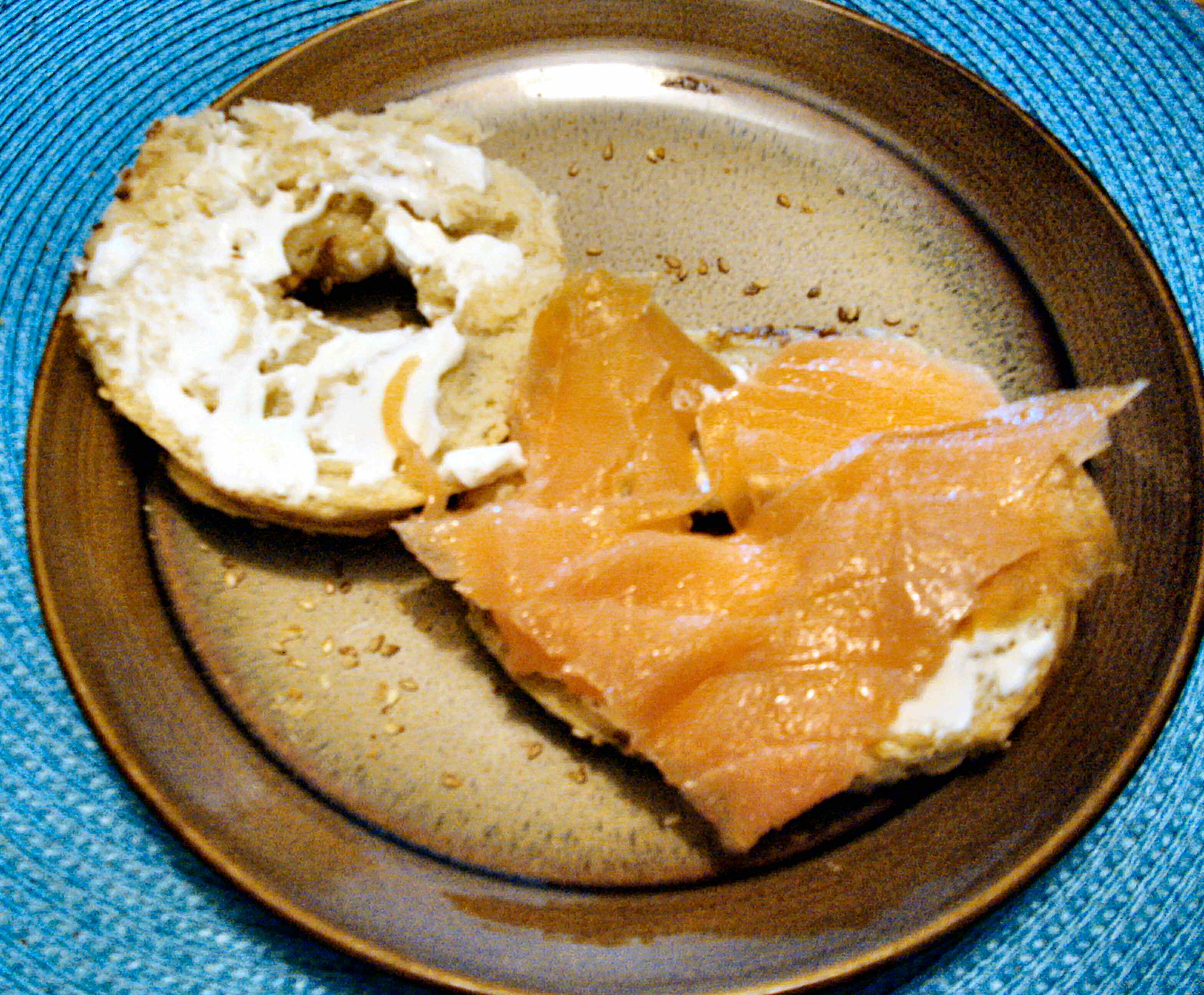
bagel with nova lox

Homemade bagel with nova from a local Los Angeles smoked fish company


For its annual Mother’s Day brunch, the Men’s Club at our synagogue always serves a surprisingly lavish spread with the woiks–lox, bagels, fruit salad, eggs and mimosas. Although I’m not a huge fan of big and slightly-kitschy gatherings featuring big and slightly-kitschy piano acts, I really deserved someone else making me a lox-and-eggs Sunday brunch right about then. But at the last minute I had to miss it in order to hock my kid about her last oversized ridiculous semester projects for 8th grade (due the next day, naturally). Better mothers complained to the principal, who just smiled nicely but did nothing useful. I just figured we’d get through it all so my daughter never had to be an 8th grader again. It worked–salutatorian, even–so, moving on but not required to give a speech: win/win.

But the lost lox! and the not having to cook or do dishes for Mother’s Day! Then I agreed to chaperone a school science camping trip the last week before graduation and  ended up with sand, grime, KP duty, outdoor showers, iffy Boy Scout Camp-style food, and not just one but 32 whole teenagers preoccupied with their hair and late to class.

So now that it’s all over I’m in serious need of payback.

My local Armenian greengrocer has locally-smoked nova lox (they have sable, too–I was tempted) and I had a bowl of dough in the fridge just sitting there waiting to be used up–so I made a few impromptu bagels the last Sunday morning of the school year, as soon as I’d gotten all the sand back out of everything and my kid was done with classes for the year. The bagels weren’t quite as dense as they ought to be because I used my standard pizza/pita/calzone dough instead of the genuine classic, but they did well enough because the dough was several days old, cold-proofed and straight from the fridge, and I boiled them before baking. And there was lox. Throw in a few once-over-medium eggs and some shmear and some fruit and hot coffee and you’ve got the ideal late-spring/early-summer breakfast, even if you have to make it yourself.

Now I know lox is a high-salt item–even the Nova. I anticipate it not for the salt, which I always think we could do with a little less of, but because it’s lox. A delicacy. Something to enjoy on the rare occasion when you get to celebrate. Something to treat with respect.

I’m not going to apologize for enjoying it, either. In the modern world of food publishing, people are forgetting how to do that. Even Jews. Maybe especially Jews, some of whom act as though our traditional deli and “appetizing” (bagels, cream cheese and smoked fish of all kinds) is suddenly something to shove under a rug or apologize for liking on the grounds that it’s not organic or locally sourced or Whole Foods or food-mag-trendy enough, and because it doesn’t include bacon or pancetta. Or kale.

The idea that enjoying lox simply because it’s lox isn’t cool enough anymore has gained a lot of traction in the past few years of foodieism. A couple of years ago, Martha Rose Shulman committed a serious travesty in the New York Times with “Lavash Pizza with Smoked Salmon” (she didn’t even call it lox). Toasted lavash is perfectly good for other things, but not for lox. Too fragile, and frankly too flavorless. I mean, why not rice cakes, as long as you’re being tasteless? But it wasn’t just the bread choice.

Somehow Shulman had abandoned the Joy of Lox. Shulman actually called her lox on lavash “a great way to work more salmon, rich in omega-3 fats, into your diet.” I have to ask, are most of us really having that much trouble “working in” more salmon? More to the point, does any lox fanatic really want to be thinking about fatty acids of any kind while eating it?

But at least she wasn’t agonizing over it as too Jewish. Mark Bittman pulled this inexplicable self-flagellation-in-print a few weeks ago in the New York Times, apologizing publicly for eating lox and bagels on a Sunday morning. In New York, yet. (Maybe it’s because he moved to Connecticut?) He’s kvetching about skipping his morning run, his usually-so-virtuous-but-betrayed-just-this-once-by-shameful-genetic-temptation stance on (gasp) farm-raised salmon, his devouring of shmear, which he says is too bland for the calories to like officially. He even had the nerve to blame his decision to eat it all on a sudden mental breakdown. And then he went further and called bagels and lox “comfort food.” As though it were in the same low-grade category as mac and cheese or mashed potatoes from a box.

Vey ist mir! I mean, come on. I’m pretty sure Woody Allen still eats lox without apologizing for it.

Bittman should be apologizing for being ashamed of enjoying lox (all the while glupping it). Along with apologizing for promoting pancetta and guanciale while professing a greener and more affordable diet. And for forgetting to add garlic to his recipes. That’s almost worse than deprecating lox.

More recently, Melissa Clark met with one of the scions of Russ & Daughters, which by now you’d think was the only serious lox and whitefish emporium left–it’s the subject of a documentary I just missed at the last LA Jewish film festival. The two laid out a spread for at least thirty or forty very lucky people, by my standards, but I think they were doing it mostly for a few family and friends–maybe 10-15 people–and posing it all on the table for the camera. It was beautiful but way too much. At least, though, she was both thrilled and nostalgic, the right way to be when faced with a complete beauty pageant of smoked fish.

Altogether, I could only think Shulman, Bittman and Clark all grew up in big cities with too much lox around. Because when I was a kid in the small-town South, we could only get lox twice a year when one or another set of grandparents came down from New York.

Other people’s grandparents bring toys. Ours brought pastrami, corned beef, half-sour kosher dills, pickled green tomatoes, real bagels, serious breads you just couldn’t get down South, and lox. All of them were special, not just to us but to our grandparents–real deli was part nostalgia, part roots, part pride, part simply great eats.

Pastrami and corned beef to go with the pickles and the tough, chewy pumpernickel and rye with the union label pasted on the end (you were supposed to fight for it)–these were the working people’s foods of their youth on the Lower East Side and the Bronx,  and they still loved them. And so did we.

My mother’s parents, born in the shtetls of Poland and Ukraine, came to America as children and, thank G-d [only instance of poverty being worthwhile], couldn’t afford to go back when their parents got homesick.

Fast forward to the ’70s: My Grandma Thel, short, plump but ladylike, coiffed, and wearing those pale oxford pumps I used to think of as librarian shoes, would step off the little regional plane in Charlottesville loaded down with huge grocery bags full of chewy, crackle-crusted bagels, Jewish kornbroyt or “corn bread” (a heavy European wholegrain sourdough; no actual cornmeal except what’s dusted on the baking sheets to keep the loaves from sticking), rye bread laced with bitter caraway seeds, sometimes a babka, and always, a huge half-wheel of her own light chocolate-flecked sponge cake (for which I’ve inherited the recipe but haven’t tried it yet–will post when I get it right). I hope the other passengers were smart enough to be jealous. The aromas alone should have clued them in. Grandpa Abe, of vishniak fame, was a lucky man.

On the drive home from the airport, Grandma Thel would tell me and my sister how she just managed to argue another customer at Andell’s or Goodman’s out of the last loaf of kornbroyt with seeds because she was bringing it down to her very special grandchildren so we would grow up knowing the real thing, and that the other lady Continue reading

The CDC tries defining “powerhouse” veggies

carrotsareveryhealthytom-ABS“Carrots are very healthy!” “Mmmhm, very healthy, Tom. Good for your eyes. Vitamin A I think.” A six-year-old’s view of carrots and nutrition, courtesy of my daughter from several years ago, and (obviously) influenced by the best of the cartoon world…

The Centers for Disease Control seems to have taken up the nutrition density scoring gauntlet to rate high-value fruits and vegetables for their “powerhouse” value. A research paper in this month’s Preventing Chronic Disease journal derives a nutrient density formula that’s not a million miles away from the ANDI scoring scheme Whole Foods was touting a couple of summers ago. The author presents a table of 41 plain, raw and unadorned fruits and vegetables that made the cut by delivering more than 10 percent of your recommended daily value of a combo of 17 major nutrients for 100 grams of raw weight and/or (this part wasn’t quite as clear) 100 kcal worth of food.

The fact that the CDC is now publishing this kind of study lends nutrient density scoring more legitimacy than perhaps it really deserves.

On the plus side:

  • The author, Jennifer Noia of William Paterson University in New Jersey, is an actual trained nutrition researcher with a Ph.D. in the field.
  • She’s not making a pitch or selling special dietary supplements. Her stated goal is to help the CDC develop practical guidelines for public health reduction of cancers and cardiovascular disease by rating vegetables and fruits for their general nutrition-worthiness.
  • She doesn’t bias her formula in favor or disfavor of her favorite name-dropping superfoods or taboos, as Joel Fuhrman and the admirers who started the ANDI scoring empire did.
  • Avocado doesn’t score big; it’s not even included (too caloric for what it delivers).
  • Noia does not include trendy components with questionable or untested nutritional value, things like  selenium, antioxidants (unspecified groups of) and phytochemicals (unspecified groups of) among the 17 well-tested nutrients she counts in for the composite formula.

So far, so good.

But the specific method she derives is still kind of muddled, and the logic behind the nutrient density comparisons is too.

First, are we going for 100 grams or 100 kcal (also known outside the lab as “100 calories”) as the standard amount of each food for comparison? The article switches back and forth without clarifying and the formula does not normalize to one or the other as a uniform standard.

Second, how does that amount, whichever one is in use, compare with a likely normal serving of the specific fruit or vegetable? Arugula’s way up near the top for nutrient density–but if you ate 100 grams of it, or worse yet 100 calories’ worth, at a sitting, you’d be trying to eat an entire plateful or maybe several platefuls of it. Very bitter. Most people include a small handful, maybe a quarter cup per serving, in a mixed salad for interest, or (as I do) on a sandwich. With mustard or vinaigrette and some other veggies.

Same for watercress. And both are expensive per serving compared with romaine, bok choy, Chinese cabbage, turnip greens…parsley??? Who’s going to eat 100 grams OR 100 calories’ worth of parsley? Scallions? Maybe if you grill them, but then again, 100 grams? 100 calories?

The list is also a little arbitrary and incomplete in terms of what’s included. Green beans make no appearance on the list, for good or ill. Maybe it’s because they don’t deliver a ton of vitamins per se, even though they have some fiber and potassium and are low in calories. Mostly, though, they don’t happen to fit into one of the four broad categories (cruciferous, leafy greens, citrus, and yellow/orange) included in the selected list. That’s not a nutrition criterion, it’s a plant classification criterion, even though it is based on some generalizations that those four categories are the most nutrient-dense of the common vegetables and fruits. But at least the author acknowledges that limitation in her study and isn’t saying green beans have no worth in one’s diet.

Of what is included in the list, the rankings by nutrient density score are a bit counterintuitive. Broccoli and cauliflower are, perhaps disappointingly, rated a lot lower on the scale than watercress–in the 20-25  range, not the 100 (maximum score). So are carrots and tomatoes.

One of the reasons for this is, as Dr. Noia writes, “As some foods are excellent sources of a particular nutrient but contain few other nutrients, percent DVs were capped at 100 so that any one nutrient would not contribute unduly to the total score.”

So the scoring formula is purposely handicapped toward well-rounded performers. Is that realistic or meaningful? Some of the foods that scored lower within each of the four broad categories  may provide large amounts of one critical nutrient–vitamin C or A, or fiber, or potassium, or iron–but perhaps not loads of B vitamins or calcium.

Well–that’s the way it is. Very few single vegetables–and almost no fruits–deliver so many different nutrients at high density in an edible portion. It’s why we eat a variety of vegetables and fruits and don’t just gravitate toward one impossible or hard-to-eat-exclusively jack-of-all-trades food.

And that’s the major flaw in this approach to defining nutrient-worthiness through a catch-all formula. The author of this study, the ANDI Score folks, Dr. Fuhrman and countless others really are looking for a magic bean. They want “AND”, not “OR”, a vegetable or fruit that delivers everything by itself. Even if they think they’re making it simpler for the average consumer to get better nutrition advice, they’re working from a false premise.

Still, at least Dr. Noia isn’t overreaching as much as the commercial popularizers of “superfoods” schemes. She admits the list is limited, and that the formula she’s derived from previously validated major studies is still preliminary. The correlation between her nutrient density score and established nutrients with some cardiovascular disease and/or cancer-prevention effect is predictably high–well, there’s a lot of overlap to begin with, so what it really tells you isn’t a great deal.

But there is some value in looking at the list of what scored at least a 10 out of 100. What can you really learn from this list?

First, “Bitter is Better.” Sort of, anyway. You wouldn’t want to make a whole dish of arugula or watercress, but you might want to throw a good handful or so into your salad or sandwich or pasta.

Notably, though, “More Expensive and Trendy isn’t Necessarily More Nutritious.” Kale isn’t as high up on the list as ordinary unglamorous spinach or turnip greens, or even darker leafy lettuces–isn’t that interesting?

Third, “Green is Good.” Darker greens are closer to the top of the list, and even between broccoli and cauliflower there’s a slight pan-nutrient decrease, though it’s not meaningful enough to start shunning cauliflower. Which I happen to like nearly as much as broccoli, and sometimes in combination with it. And although brussels sprouts are marginally more nutritious than cauliflower, they’re also more of a pain to peel and trim, and there’s a lot more waste.

The real Green Effect here has to do with calories. You notice that none of the citrus or berry fruits are up in the top 10 in the list. Apples and bananas don’t make the list at all, and melon is right out. So are summer stone fruits. Even apricots, which have a fair amount of vitamin A. That’s because the greens on the list are very low-calorie, with almost no carbohydrate or sugar. And because the nutrient density scoring formula accounts for nutrients per 100 calories (at least sometimes, when there are countable calories involved), fruits are naturally going to score lower.

From the perspective of diabetes prevention and weight control, this is a reasonable way of looking at how we get critical vitamins and minerals. The common phrase “fruits and vegetables” leads people to assume that fruits should be thought of first when you shop, and vegetables are kind of an afterthought. But it’s obvious from this kind of scoring that fruits should be considered dessert rather than the major source of vitamins and minerals.

However–given that citrus fruits, berries and stone fruits deliver large doses of vitamins C and A respectively, plus potassium and vitamin E and fiber on occasion, they shouldn’t be shunned for not “doing it all” and doing it carb-free. We need some carbohydrates, and if you eat an orange, a half a grapefruit, or even a nectarine at breakfast instead of a piece of coffeecake, so much the better. Just notice that you’re also eating some carbohydrate in the form of fruit and don’t eat three at a time. Or dump sugar and butter on it and still think it’s righteous because it’s nominally fruit.

I think we can all handle that. Even without calling anything a superfood.