

• Enter your email address to subscribe to this blog and receive notifications of new posts by email.

    Join 241 other subscribers
  • Noshing on

    raw blueberry pie with microwaveable filling and graham cracker crust

    This mostly-raw blueberry pie is a snap to make and very versatile--the filling microwaves in a few minutes, and you don't even have to bake the zippy gingered graham cracker crust--perfect for a hot Fourth of July and all summer long.

  • Recent Posts

  • Contents

  • Archives

  • Now Reading

  • See also my Book Reviews

  • Copyright 2008-2024Slow Food Fast. All writing and images on this blog unless otherwise attributed or set in quotes are the sole property of Slow Food Fast. Please contact DebbieN via the comments form for permissions before reprinting or reproducing any of the material on this blog.

  • ADS AND AFFILIATE LINKS

  • I may post affiliate links to books and movies that I personally review and recommend. Currently I favor Alibris and Vroman's, our terrific and venerable (now past the century mark!) independent bookstore in Pasadena. Or go to your local library--and make sure to support them with actual donations, not just overdue fines (ahem!), because your state probably has cut their budget and hours. Again.

  • In keeping with the disclaimer below, I DO NOT endorse, profit from, or recommend any medications, health treatments, commercial diet plans, supplements or any other such products.

  • DISCLAIMER

  • SlowFoodFast sometimes addresses general public health topics related to nutrition, heart disease, blood pressure, and diabetes. Because this is a blog with a personal point of view, my health and food politics entries often include my opinions on the trends I see, and I try to be as blatant as possible about that. None of these articles should be construed as specific medical advice for an individual case. I do try to keep to findings from well-vetted research sources and large, well-controlled studies, and I try not to sensationalize the science (though if they actually come up with a real cure for Type I diabetes in the next couple of years, I'm gonna be dancing in the streets with a hat that would put Carmen Miranda to shame. Consider yourself warned).

Government nutritional estimates for “mixed dishes”–where do they come from?
The federal “MyPlate” program has expanded its consumer information on dietary guidelines but some of it looks suspiciously old-hat and soft on nutritional crime, very much in keeping with the USDA’s traditional approach of pandering to the processed food industry. I stumbled across it while helping my daughter find school lunch nutrition information for her latest science project, which was to analyze her new public school’s lunch program.

Of course, my 7th grade daughter’s reaction to her first day in a real live public school cafeteria last month was shock. Because she’s diabetic and vegetarian, we agreed the best strategy for her would be to bring her standard lunch from home–PBJ on whole wheat with an apple. She had trouble the first day with the routine–shove through the cafeteria line, squeeze in at a table, shovel down food, run for the bell.

What did the other kids eat? I asked. “They ate crap,” she answered without so much as a pause. “Pizza and french fries, stuff they can eat in about five minutes while gossiping with their friends. They hardly even notice.”

Now–as I’ve said before–peanut butter and jam on whole wheat is not gourmet, but it’s fairly nutritious (beats Oscar Meyer bologna for protein, believe it or not) and with a small apple, it’s reasonably worthwhile and you can eat it fairly quickly–certainly within 15 minutes, if you can shove through the cafeteria line and find a seat. If you make friends, as my daughter quickly did, you can even find some time for gossiping and having fun. And it costs less than a dollar and takes less than 5 minutes to pack at home. The school lunch is $2.35, and yes they do offer apples and some sort of packaged salad stuff and skim milk, but as my daughter noticed, few of the kids actually eat those items. Maybe the milk–well, at least offering the fresher food is a start.

Still–“crap” is not that far off. Pizza AND fries? A tough act to follow with anything but gallbladder surgery at 40.

And as she looks at the school menus online for September–they declare that they follow the USDA school nutrition guidelines–we notice a lot of things that aren’t really sound thinking from a diabetic’s point of view. A lot of menus that don’t come close to matching the ChooseMyPlate.gov guidelines, which call for half the plate to be vegetables and fruits (in that descending order of quantity), a quarter of the plate protein, a quarter complex carbohydrate.

“There’s a lot more meat,” she says. “Actually, my friend had the chicken patty today and spat it out. She said it wasn’t chicken. My other friend said it was, it was just cafeteria chicken.” Sounds like some of her new friends have a better take on the school food than the government does. My bet–the chicken patty is like standard bologna, only about half is anything that actually came from a chicken–including fat and skin–and the rest is probably starchy and high-salt fillers.

So, speaking of food that really isn’t as good as it seems…

The ChooseMyPlate.gov brochure on “mixed foods”, which is what I promised up at the top, might be part of the same sad thing. Here’s the sample chart they offer for things like pizza, lasagne, double cheeseburgers, burritos…that are supposedly hard to judge on nutrition.

MixedDishes.pdf 

Any takers on this one? My first impression is that the calorie counts are probably low–maybe as little as half–for a standard chain restaurant or frozen-entree serving of any of these items. Probably because a USDA recommended standardized “portion” for nutrition labeling purposes is very small compared with what people are actually eating and what companies are serving.

My second impression is–fruit servings? for pizza? who are they kidding, and why is this column even in here? Fruit is optional–it’s a carb. Nonstarchy vegetables with some actual vitamins and fiber are required eating. It’s pretty obvious from the table that the vegetables are pretty scant in this list of “mixed foods” too–mixed in this case seems to mean starches and fats plus some form of meat.

And what isn’t listed–the salt and fat and total carb. The fiber, vitamins and minerals. Most of this food is high in stuff that should be low, and low in stuff that should be high.

On second thought, maybe we should just read down this table for suggestions on what not to serve.

Homemade Halvah

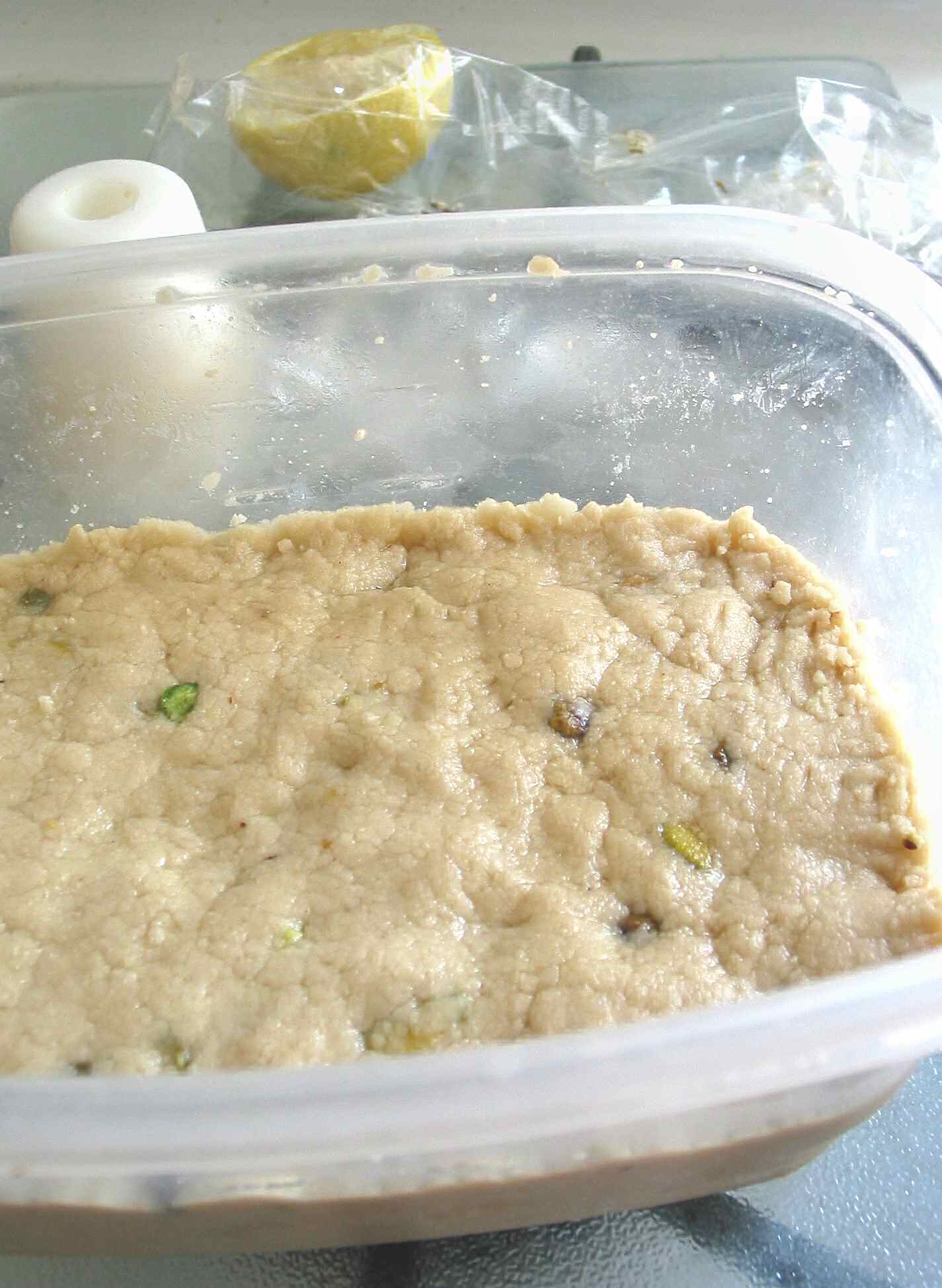
Sesame halvah with pistachios

A little trickier than it looks–this one is nearly right and tastes good, but it was stiffer and more crumbly than professional halvah once it cooled. Next time!

I first tasted halvah at the age of six while visiting my cousins, who lived in my town but had been to Israel the year before. One afternoon my aunt shaved off a very thin sliver from this mysterious loaf of sandy light-brown stuff and handed to me with the caution, “Only a little piece at a time. It’s very rich.” Which it was, but the feathery impossible texture melted on my tongue and I wanted more.  When I got home from the visit, my father laughed when I asked him what my aunt had meant by “rich”–and explained that it meant “heavy”. That made no sense either–the tiny sliver was light and delicate. Then he said that once when he was twelve he’d eaten an entire pound of halvah in a single sitting and been extremely sorry afterward, because it sat in his stomach like a lead brick for hours…

I mention these things not just because they’re true of eating halvah, but they’re a good indication of the balance you need to achieve if you ever try making it.

Last year at Rosh Hashanah I made stuffed eggplants and onions with tamarind sauce from Poopa Dweck’s Aromas of Aleppo. I’ve enjoyed them enough to make the onions repeatedly over the past year, and I’ve also enjoyed the idea of making a new food for the New Year. Dweck’s book happens to have a halvah recipe, and the pictures look right, and the recipe looks really simple.

Well…the ingredients are incredibly simple–tehina, sugar, water, lemon juice, flavorings like a little vanilla, clove and cinnamon, maybe some pistachios or sliced almonds to mix in. The steps–boil sugar with a bit of water until it reaches 240°F on a candy thermometer. I don’t have one but she adds, helpfully, that it’s until the syrup coats the back of a spoon and is at the soft ball stage–shades of childhood reading through the Joy of Cooking‘s mysterious and dangerous section on candy recipes. Ahem! Boil the syrup and pour it hot over the tehina in the food processor, add the flavorings and blend. Take out the mass of halvah and press it into a pan to cool, then cut into cubes or slices and store at room temperature for a week or the refrigerator for up to 6 months…not that it will last that long.

Simple, right? So simple. I can probably microwave the syrup in about 2 minutes instead of simmering it for 20 on the stove, at least if I stir every 20-30 seconds and keep checking it…with the food processor handy, it’s like a 10-minute recipe if that! Simple.

The trouble with making halvah at home, as I discovered last week, three times, is that it’s not so simple. The first time I tried a proportionate miniature test version, with half a cup of tehina and about 3/8 cup of sugar, all measured and calculated down to the gram. The syrup cooked in a minute in the microwave and things were going really well…except the mixture seized up hard and crumbly the instant I mixed the syrup and tehina with a fork. And it was a bit too sweet and bland. Did something go wrong with the proportions? Did it need more of the oily tehina to make it flexible?

The second time I made it, the syrup was a little looser and the mixture turned a flat oily dark putty color and never really solidified past a thick paste. Nearly the same exact proportions, better taste (less bland, less cloying, more sesame). But I had made a soft sesame version of peanut butter fudge. You could slice it in squares, but it would sag like soft caramel.

So clearly it’s not that simple. I went to the web, thinking, of course someone will know what I’m doing wrong. And maybe someone does, but he or she is clearly not on the web expounding on the finer points of making halvah.

Oh, there are dissertations on halvah, but most of them are talking about the wide variety of desserts around the world that go by the same name–kinds that are based on wheat flour, carrots, sunflower seeds, and other main ingredients to mix with the syrup and pat into a pan.

Most of the (relatively few) tehina-based recipes are identical to Dweck’s, a pound of tehina, two cups of sugar, 1/3 cup of water, a teaspoon of lemon juice, a pinch of clove and cinnamon, maybe a spoonful of vanilla.

But the pictures show (and sometimes the rueful comments do too) that it’s not the ingredients at fault when the texture’s off. It’s the technique, which is usually missing from the recipe.

The videos I found on YouTube specifically for making tehina-based halvah didn’t really help. Iraqi halvah workers boiling syrup in an old–well, it kind of looks like a very worn-out steel bowl set over a trash can fire in an abandoned stairwell, and they’re stirring away with a wooden paddle before pouring in the tehina, which turns into curds that they then paddle and knead until they’re happy with it, but you can’t really see what it is that makes the difference.

Then there’s the Syrian halvah factory demonstration posted by Middle Eastern chef and cookbook author Anissa Helou–much cleaner, with an official halvah-kneading machine that Willy Wonka might have been proud of, pummeling the tehina/syrup mixture with what looks like a mechanical boxing glove on a stick, until it looks like hummus that’s Continue reading